Hotel ERP vs PMS: What's the Difference and Which Does Your Hotel Actually Need?
Confused between a Hotel PMS and Hotel ERP? Learn the key differences, when to upgrade, and how to choose the right solution for your hotel's growth.
 By Ankit Rawat·July 31, 2026
Running a hotel in India today means juggling front-desk check-ins, GST billing, housekeeping rosters, online bookings, and F&B, often across disconnected spreadsheets and legacy tools. When hoteliers start searching for a technology solution, two terms keep coming up: Hotel PMS and Hotel ERP. Most buyers in India treat them as interchangeable, they are not, and choosing the wrong one can cost you significant time and money.
WHAT IS A HOTEL PMS?
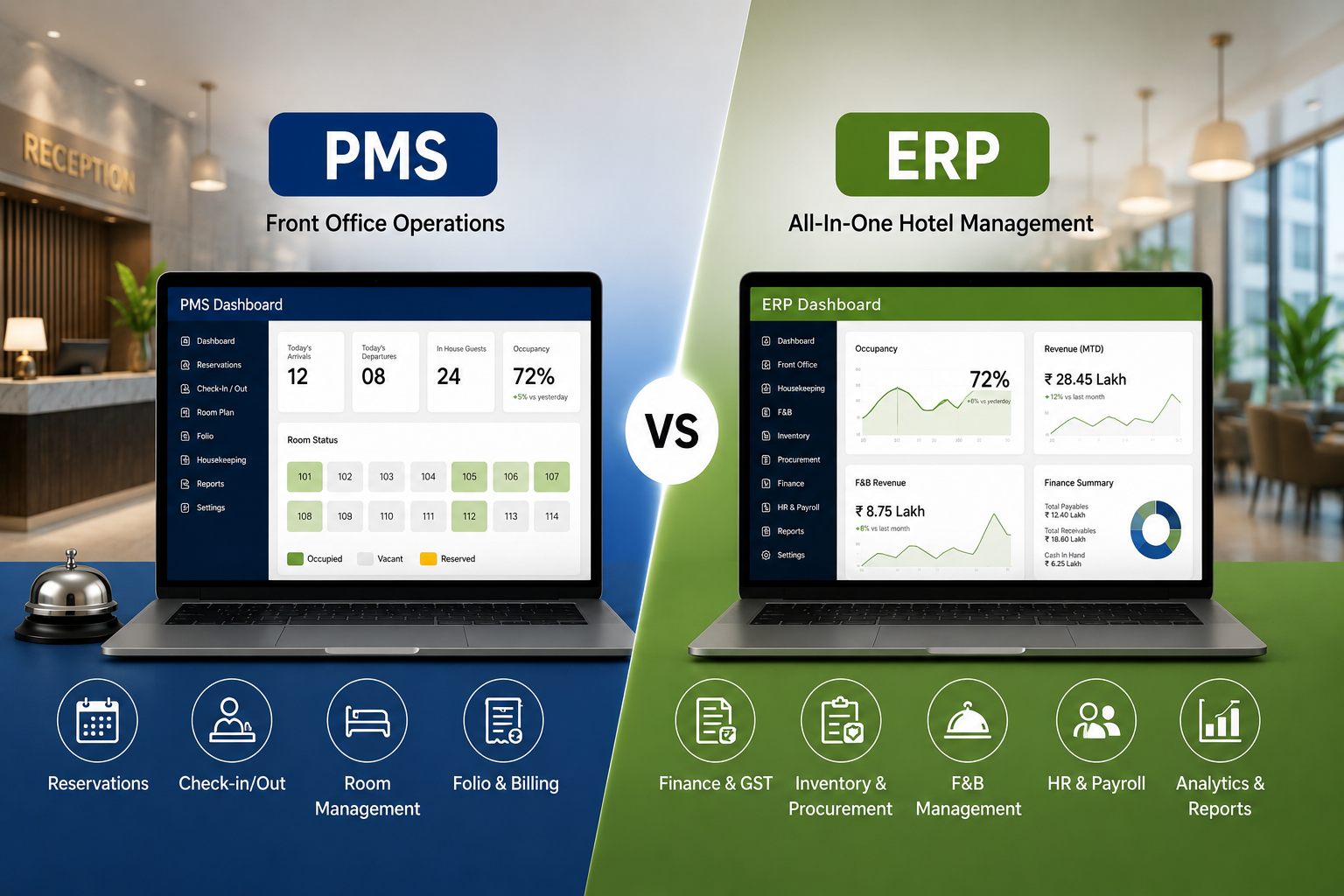
A Property Management System (PMS) is purpose-built to manage front-office operations, reservations, check-in/check-out, room allocation, and folios. Think of it as the digital receptionist for your hotel. Popular PMS tools used across Indian hotels handle day-to-day guest interactions efficiently, but they stop there. Inventory procurement, accounts payable, payroll, and analytics are largely out of scope.
WHAT IS A HOTEL ERP?
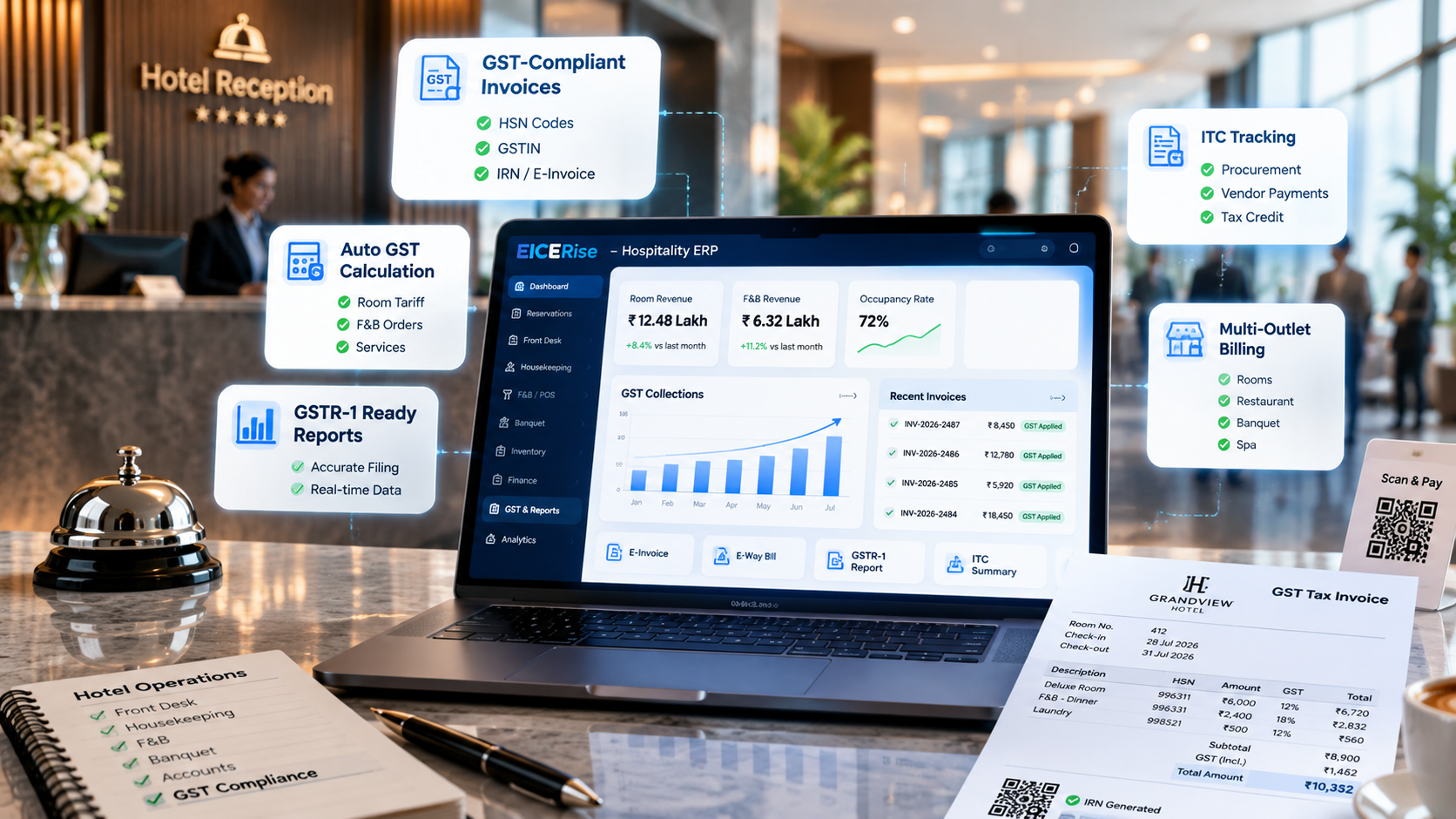
A Hotel ERP (Enterprise Resource Planning) system goes several layers deeper. It integrates every department, front office, housekeeping, F&B, procurement, finance, and HR, into a single platform. In the Indian context, a modern hospitality ERP software India also covers GST compliance, e-invoicing, TDS management, and multi-property consolidation.
If a PMS is your receptionist, a Hotel ERP is the entire management team working from one shared dashboard.
KEY DIFFERENCES AT A GLANCE
• Scope: PMS covers front office; ERP covers all departments
• GST & Finance: PMS typically requires a separate accounting tool; ERP has it built in
• Reporting: PMS gives operational reports; ERP gives business intelligence across functions
• Scalability: PMS suits single properties; ERP suits chains and growing hotel groups
• Integration: ERP includes channel manager, OTA sync, and booking engine natively
WHICH ONE DO INDIAN HOTELS ACTUALLY NEED?
For independent hotels and boutique properties with fewer than 30 rooms, a standalone PMS may suffice initially. But for 3-star, 4-star, and growing hotel chains in India, a full cloud hotel ERP system is the smarter long-term investment. The ability to unify GST billing, housekeeping, F&B, and online booking under one roof eliminates costly data duplication and cuts manual reconciliation time by up to 60%. Platforms like EiceRise are built specifically for the Indian hospitality market, handling GST-compliant invoicing, integrated channel management, and multi-department operations in one cloud-based hospitality ERP. Instead of patching together three tools, Indian hoteliers can manage everything from one screen.
FINAL THOUGHT
If you are still asking 'PMS or ERP?' the honest answer is: it depends on where your hotel is today and where it needs to be in three years. Most fast-growing hotels in India eventually outgrow their PMS. Starting with an ERP-first approach saves a costly migration later.
Frequently Asked Questions
Q: What is the difference between a Hotel ERP and a Hotel PMS?
A: A Hotel PMS focuses on front-office operations such as reservations, check-ins, and room allocation, whereas a Hotel ERP integrates departments including housekeeping, finance, procurement, F&B, HR, and reporting into one platform
Q. Is a Hotel ERP suitable for small hotels?
A: Independent hotels with fewer than 30 rooms may initially manage with a standalone PMS. However, growing hotels and chains benefit from a Hotel ERP that centralizes operations and simplifies compliance.
Q: Why are Indian hotels moving from PMS to ERP?
A: Hotels are adopting ERP systems to unify operations, automate GST-compliant billing, reduce manual reconciliation, and manage multiple departments from a single cloud platform.
See Hotel ERP in Action
Discover how EiceRise helps hotels manage reservations, billing, housekeeping, inventory, and finance from one integrated platform.
Related in Hospitality Technology
Hospitality Technology Trends in India 2025–2026: What Hotels Must Know
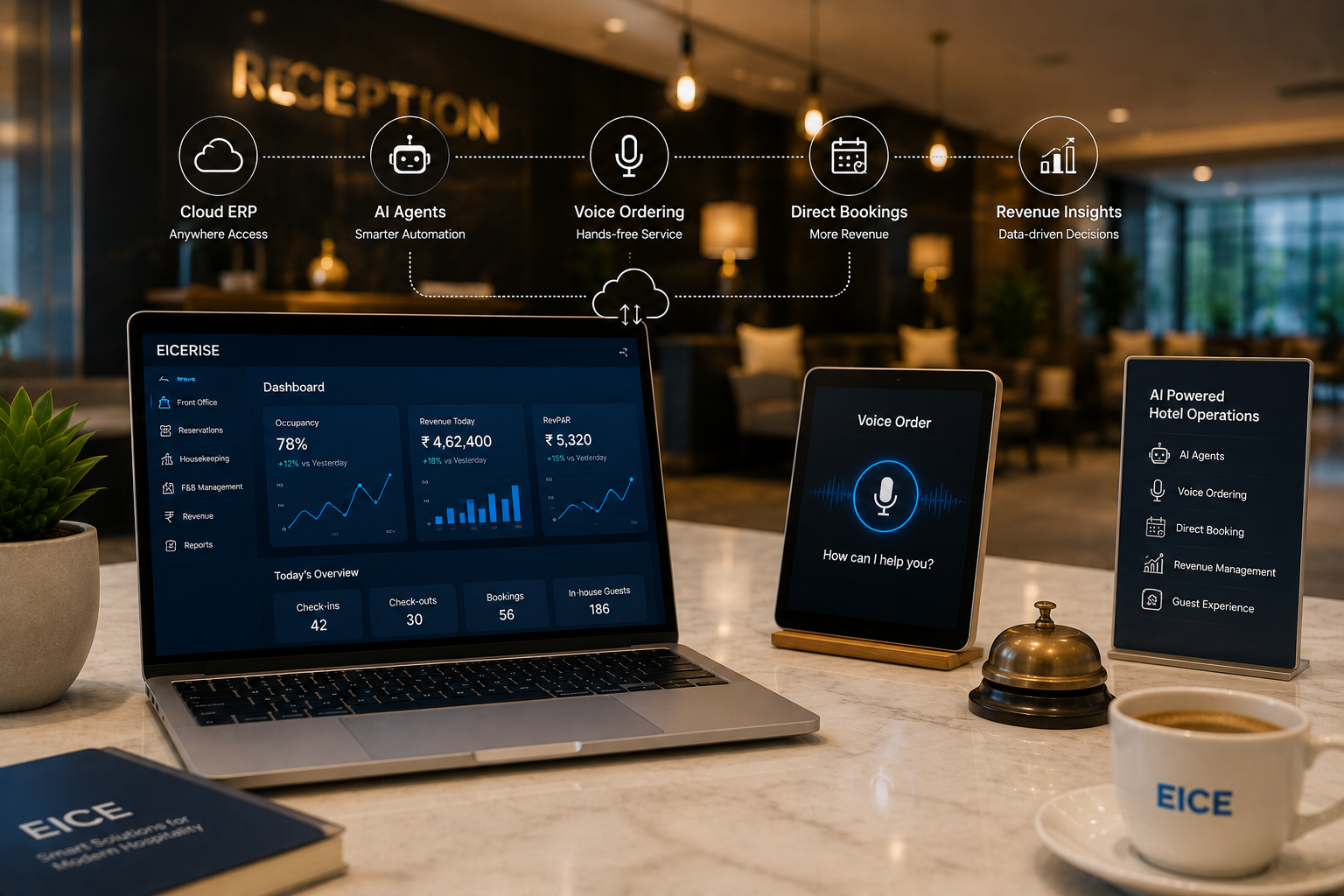
Explore the hospitality technology trends shaping Indian hotels in 2025-2026, from cloud ERP and AI-powered guest communication to voice ordering, direct bookings and revenue management.