Complete Guide to E-Way Bill Integration with Logistics Software in India
Learn how E-Way Bill integration with logistics software simplifies GST compliance, reduces paperwork, and helps businesses move freight more efficiently.
 By Ankit Rawat·July 31, 2026
Since the introduction of the E-Way Bill system under GST in India, logistics and transport companies have been scrambling to stay compliant. Generating E-Way Bills manually for every consignment, especially at scale, is error-prone, time-consuming, and often leads to detentions at state checkpoints. The solution? Integrating E-Way Bill generation directly into your logistics management software India.
WHAT IS AN E-WAY BILL AND WHY DOES IT MATTER?
An E-Way Bill is a mandatory electronic document required for the movement of goods worth more than ₹50,000 across or within states in India. It is generated on the NIC portal and must accompany the consignment throughout transit. Non-compliance can result in penalties up to 200% of the tax amount, a significant risk for any transport company in India.
THE PROBLEM WITH MANUAL E-WAY BILL GENERATION
• Consignment details must be re-entered manually, a duplication of work already done in your TMS
• Human errors in GSTIN or HSN codes lead to mismatches and checkpoint delays
• Part-B (vehicle details) updating after transshipment is often missed
• Extension and cancellation workflows are handled outside the system, causing reconciliation gaps
HOW E-WAY BILL INTEGRATION WORKS IN LOGISTICS SOFTWARE
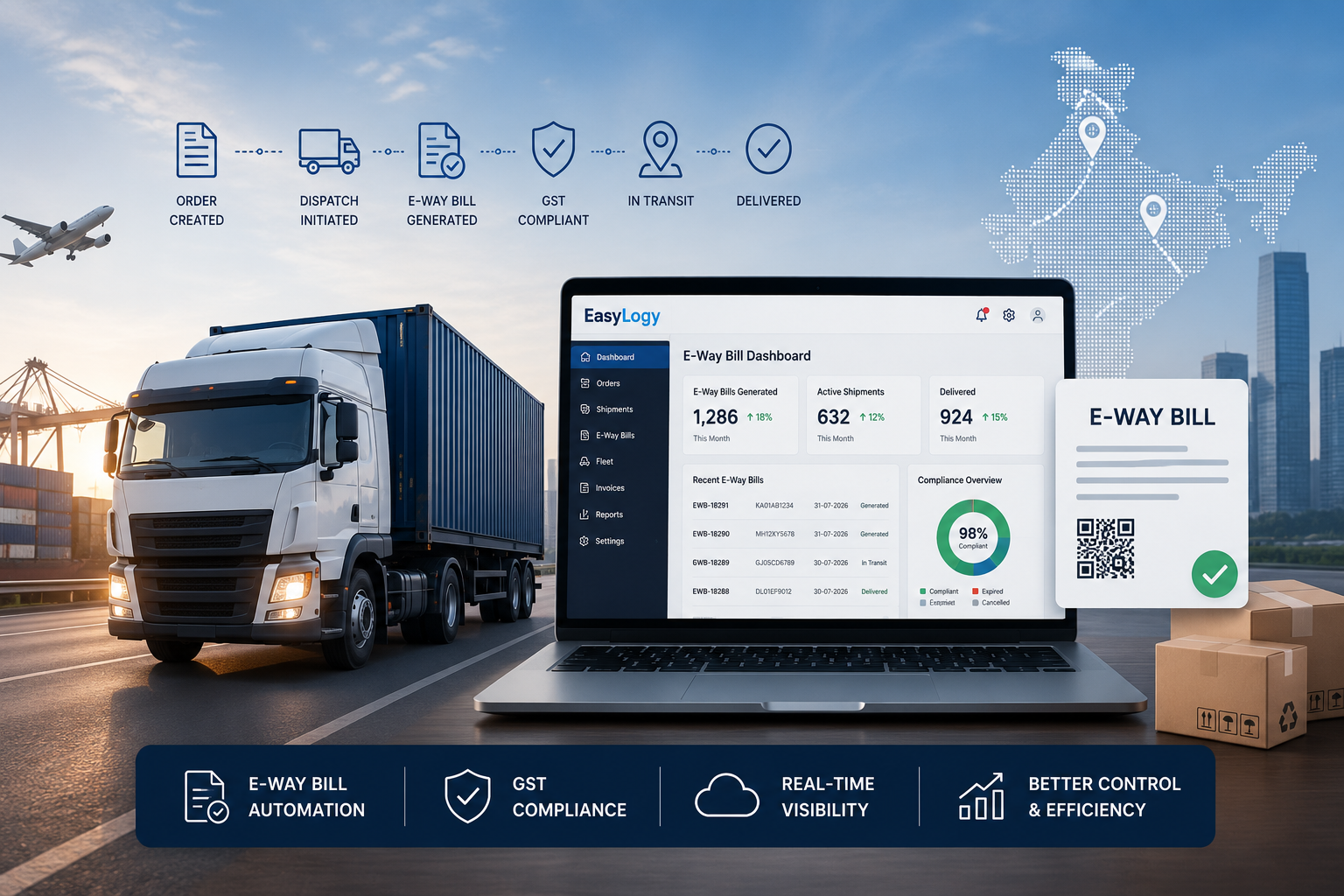
Modern logistics ERP software with E-Way Bill integration connects directly to the NIC API. When your operations team creates a new consignment entry in the system, the E-Way Bill is auto-generated using data already captured, GSTIN, consignee details, HSN codes, and vehicle number. No re-entry, no portal switching. The integration also handles Part-B updates when vehicles change, auto-extension when transit time exceeds validity, and cancellations, all from within the logistics dashboard.
BENEFITS FOR INDIAN LOGISTICS COMPANIES
• Save 2–4 hours daily on manual E-Way Bill generation per operations executive
• Eliminate checkpoint penalties caused by data mismatches
• Maintain a full audit trail of every E-Way Bill against each consignment
• Enable real-time compliance reporting for GST returns
• Reduce transporter liability with automated Part-B tracking
EASYLOGY: BUILT FOR INDIAN COMPLIANCE
EasyLogy is a cloud-based logistics management software for Indian businesses that comes with native E-Way Bill integration, FASTag API support, and GST-compliant billing, all in one platform. Whether you run a small trucking fleet or a large 3PL operation, EasyLogy keeps you compliant without any manual overhead. Indian transport companies using EasyLogy have reported a 70% reduction in E-Way Bill processing time and near-zero compliance rejections at checkpoints.
CONCLUSION
E-Way Bill integration is no longer optional for serious logistics operators in India — it is a baseline compliance requirement. The smarter approach is to stop managing it as a separate task and embed it directly into your logistics workflow. That is exactly what integrated TMS software with GST compliance India enables.
Frequently Asked Questions
Q. What is E-Way Bill integration in logistics software?
A. E-Way Bill integration connects logistics software directly with the NIC portal, allowing businesses to generate, update, extend, and cancel E-Way Bills without manually entering shipment data.
Q. Why should logistics companies automate E-Way Bill generation?
A. Automation reduces manual effort, minimizes GST and HSN code errors, prevents checkpoint delays, and maintains a complete audit trail for every shipment.
Q. Can E-Way Bill integration improve GST compliance?
A. Yes. Integrated logistics software keeps E-Way Bills linked to consignments, simplifies compliance reporting, and helps businesses meet GST requirements more efficiently.
Simplify Logistics Compliance
See how SmartFit automates E-Way Bills, GST billing, shipment tracking, and logistics operations from a single dashboard.
Related in Logistics Technology
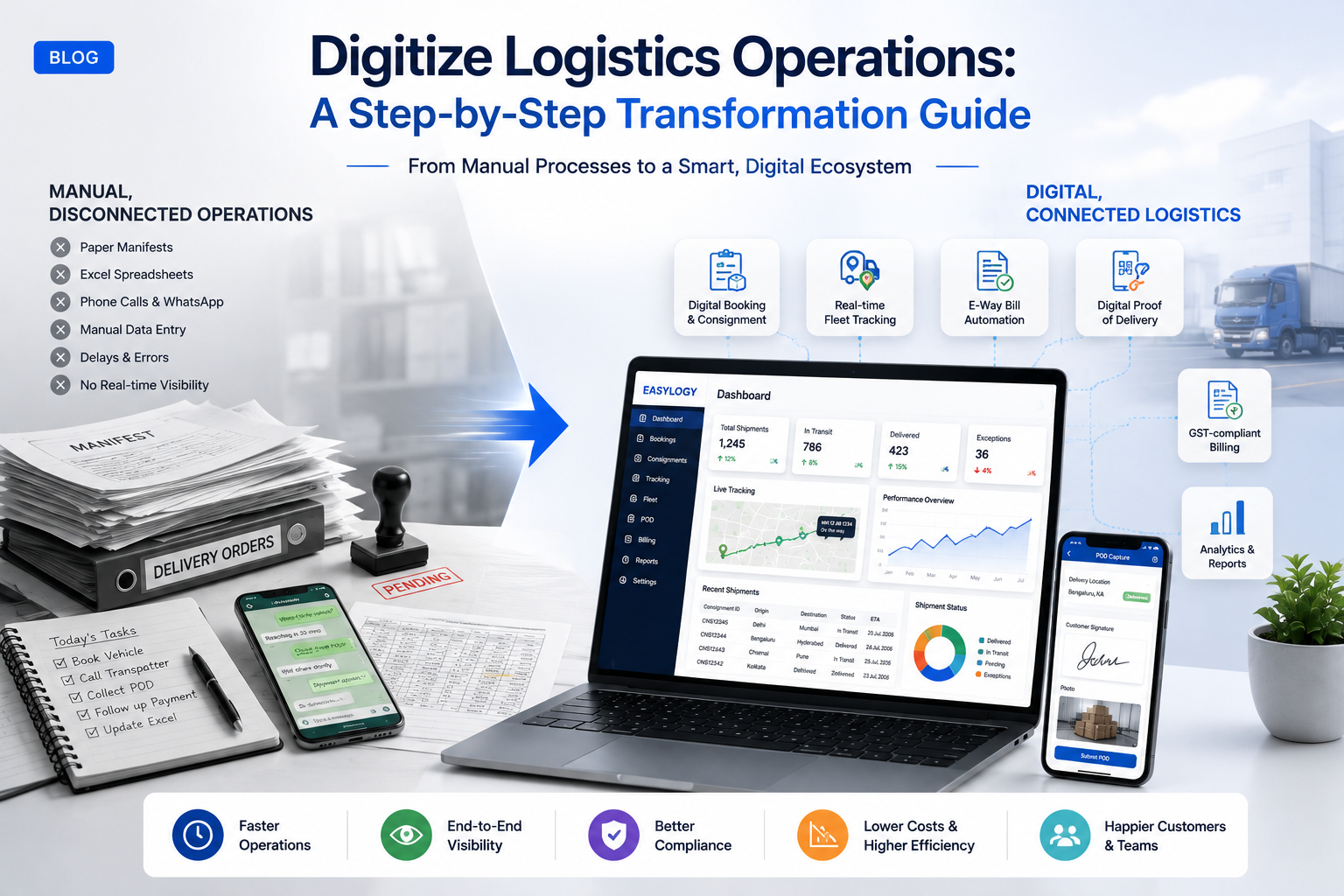
How to Digitise Your Logistics Operations in India: A Step-by-Step Guide
Learn how Indian logistics companies can digitise operations step by step — from booking and real-time fleet tracking to E-Way Bill automation, digital POD, billing, and reporting.