How Indian QA Teams Help AI-Powered Platforms Ship New Features Without Breaking Existing Workflows
See how QA teams can protect existing workflows when new features are added to AI-powered platforms with connected portals, automated processes and AI agents.
 By Ankit Rawat·Published: September 9, 2026 at 5:53 PM IST
The regression risk multi-module platforms don't see coming
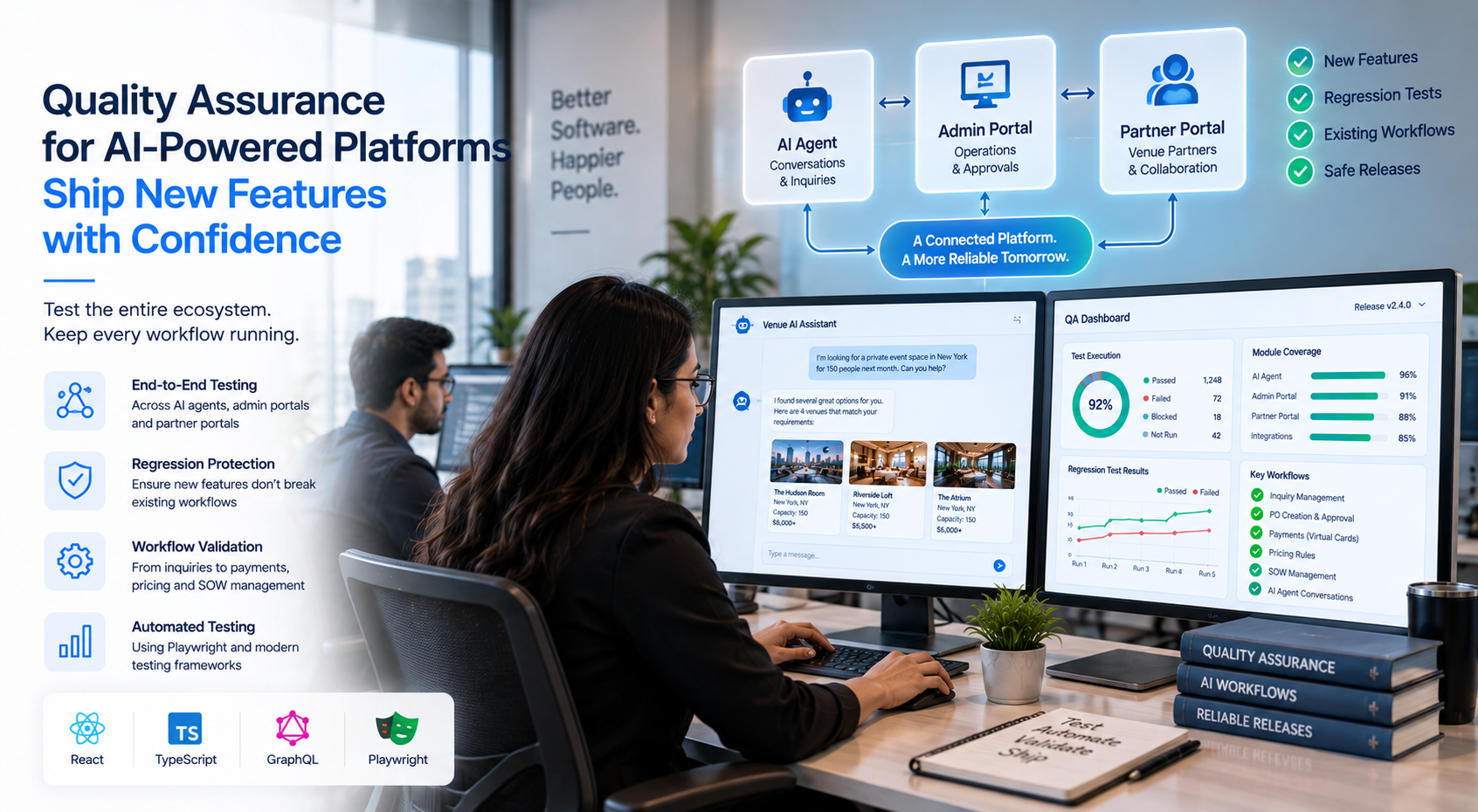
Platforms that are made from multiple connected components, like an AI agent that handles conversations, an internal admin portal and an external partner portal, face a bigger testing challenge that single-module products don’t face. A small change in one part can silently affect something in another part. That risk can be greater when the workflows that depend on manual coordination between different systems get automated and brought into a single platform. Because all the modules are connected and making changes to one module can affect the reliability of others.
What QA leadership actually looks like across an AI-powered, multi-module platform
In a recent engagement, an AI-powered venue and event management platform shows this by treating QA as a connected process in its admin portal, venue portal and AI agent, instead of testing everything separately. The QA team tested the AI venue agent’s conversation tracking and interactions to make sure inquiries get processed correctly through other workflows. The team tested:
- Inquiry management
- Purchase order management
- PO approval workflows
This helps to understand that the request moved correctly through each stage of approval and fulfilment.
Payment workflows, including central pay virtual cards, were tested along with pricing rules and SOW management. Feature testing was performed through both the admin portal and the venue portal, covering the requirements for administrators and external venue partners to work efficiently.
What made this engagement hard, and what it delivered
The main problem was not testing new functionality; it was proving that new functionality did not break the existing work. The team ran regression and backwards-compatibility testing to protect existing users, chats, events and ongoing processes from disruptions caused by new releases.
Even a small change can affect multiple connected systems; the testing covered:
- Inquiry management
- Purchase order management and approval
- Payments
- Pricing
- SOW management
- AI agent conversations
It is built on a stack of React, HTML, and TypeScript on the frontend, GraphQL as the API layer, and Playwright for test automation. The engagement has been active since 2025 and it continues in 2026.
How EICE Technology leads QA across multi-module, AI-powered platforms
As an IT company, we led this QA effort with a lead QA analyst directly testing across all 3 connected modules. Regression and backward compatibility testing were treated as core requirements rather than something added before release.
Our delivery discipline is shaped by ISO 27001 and ISO/IEC 20000 certifications, with CMMI Level 3 and ISO 9001. So the same structure helps maintain the same focus on quality across the whole engagement. See our Services Page.
Frequently asked questions
Q. Why is regression testing important for AI-powered platforms?+
A. AI-powered platforms often connect multiple modules and workflows. A change to one component can affect another, making regression testing important for verifying that existing functionality continues to work after new releases.
Q. What should QA teams test in a multi-module AI platform?+
A. Testing can include the AI agent, admin portal, external portal and the workflows connecting them. In the supplied case study, this included inquiries, purchase orders, approvals, payments, pricing, SOW management and AI agent conversations.
Q. What is backward compatibility testing?+
A. Backward compatibility testing checks whether new changes continue to support existing users, workflows and functionality instead of introducing problems for processes that previously worked.
Q. What technology stack did EICE Technology use for this QA engagement?+
A, Technologies used are React, HTML and TypeScript on the frontend, GraphQL as the API layer and Playwright for test automation.
Q. How long has EICE Technology supported this AI platform QA engagement?+
A The engagement has been active since 2025 and continues in 2026.
Adding AI to a Multi-Module Platform?
Explore how EICE Technology can provide QA leadership across AI agents, connected portals and enterprise workflows while protecting existing functionality.