SaaS Development in India: What Multi-Tenant Architecture Needs
Building a SaaS product for multiple customers requires more than adding user accounts. Learn how multi-tenant architecture affects data isolation, customer settings, usage tracking, security and scalability—and what to plan before development begins.
 By Ankit Rawat·Published: October 12, 2026 at 3:45 PM IST
Many of the Saas products start with a single setup and just one customer, but as soon as more customers start to join, things get complex. Every customer has their data, settings, and usage, and everything has to be managed well. This is the place where multi-tenant architecture plays an important role. In this blog, we will look at what businesses should go for when planning Saas development in India, before the product starts serving customers.
Why Multi-Tenant Architecture Matters for SaaS in India
India’s Saas market is growing very fast. As per the report by Bain & Company India SaaS 2021, shared by the Government of India’s IndBiz portal, in 2021, the investments in Indian Saas has reached $4.5 billion. This is a 170% increase from 2020. By 2025, it is expected to reach the market growth to $30 billion in revenue. It is making up around 8-9% of the global Saas market.
These numbers are from 2021, and the number for 2025 is just a prediction for the future instead of a confirmation. We have not verified the actual market size. It is very important to choose the right early setup as more businesses building Saas products. It will cost a lot and take time to change this later.
What Multi-Tenant Architecture Has to Decide
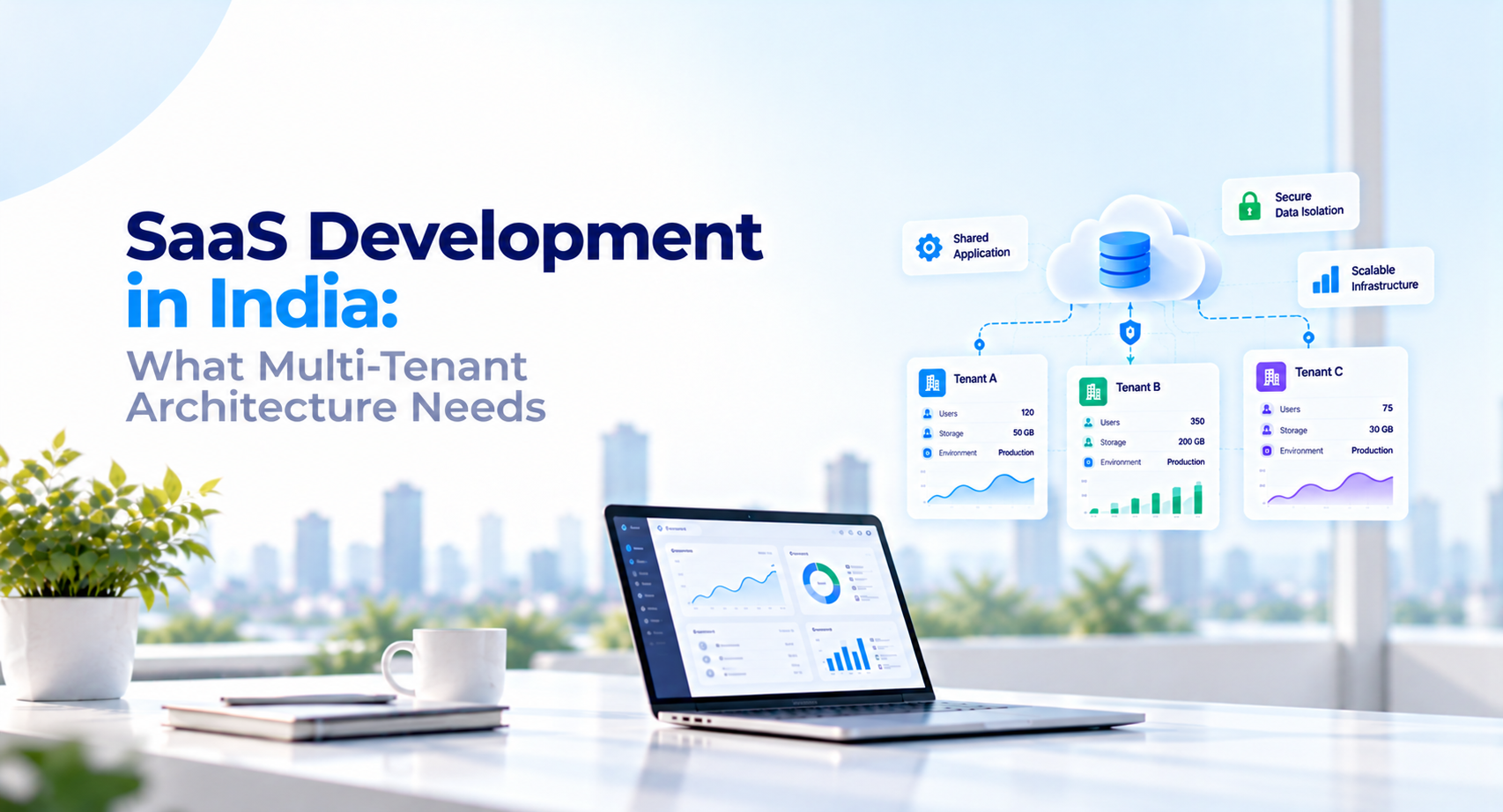
This section shows our view. A multi-tenant system is a system that many people use from the same application; there are some points to plan.
- Where customer data is stored: In a shared table, you can give every customer their own separate database or storage. It is expensive to have a separate database, but it keeps the data more separate; a shared table is not expensive, but it needs more care in handling data.
- How customer data is protected: The system should be able to handle things like, one customer's data not being visible to another customer.
- How customer settings work: Every customer may need to have different user roles, settings, and branding. It should be easy to do, without building new software according to customer needs.
- How usage is tracked: If you are charging customers based on their usage or users, it is important to track this in the system from the beginning.
The next problem is the “noisy neighbour issue”. This happens when a customer uses a lot of resources and because of this, the system slows down for others. So, planning for this beforehand will be a better choice.
What to Ask Before You Hire for SaaS Development in India
Before choosing a development team, ask them these questions:
- Which setup do you recommend for our customers, and why?
- How will you keep each customer's data separate and test that it works?
- How will you manage customer settings and billing?
- Which cloud platform will you use?
- How will you protect the system, and which security standards will you follow?
- If a customer grows, can we move their data to a separate database later?
These questions will help you understand the team and whether they are able to create a clear plan for building and growing your SaaS product.
How We Approach SaaS Development in India
Our app development services include SaaS platforms, web applications, and chatbots. We build SaaS products with subscription management, usage tracking, and an API-first approach. We work with cloud platforms such as AWS, Azure, and GCP.
Our security practices follow OWASP guidelines, encrypt data, and use role-based access to control who is able to see or change information. We work in two-week sprints and share live demos so clients can review progress regularly. We can also help you with platform planning and design, connecting APIs, payment gateways, and CRM systems, and moving applications from on-premises systems to the cloud.
We focus on building platforms that are able to support multiple customers, stay available, and perform well as usage grows. If your team is planning SaaS development in India and wants to plan multi-tenant architecture first, we’d be happy to talk. See more on our Services page.
Frequently asked questions
Q. What is multi-tenant architecture in SaaS?+
A. Multi-tenant architecture allows multiple customers to use the same software application while keeping each customer's data, settings and access appropriately separated.
Q. What is the difference between single-tenant and multi-tenant SaaS?+
A. A single-tenant setup dedicates an application environment or resources to one customer, while multi-tenant architecture allows multiple customers to share an application or parts of its infrastructure. The degree of isolation depends on the design.
Q. How should a SaaS platform store customer data?+
A. Common options include shared tables with tenant identifiers, separate schemas or separate databases for each tenant. The choice depends on isolation requirements, cost, scale and operational complexity.
Q. How much does SaaS development cost in India?+
A. Costs vary with product complexity, tenant architecture, integrations, security, billing requirements, cloud infrastructure and ongoing support. A reliable estimate requires a defined scope and technical assessment.
Q. Can a multi-tenant SaaS platform move a customer to a separate database later?+
A. Yes, if the platform is designed to support tenant migration. The process requires planning for data movement, application routing, validation, downtime and rollback.
Build a SaaS Platform Ready to Scale
Explore how EICE Technology can help plan and build SaaS platforms with customer access controls, usage tracking, API integrations and cloud infrastructure suited to your requirements.