Chatbot KPIs in India: Metrics Beyond Conversation Count
A high number of chatbot conversations does not necessarily mean customers are getting help. Discover five practical chatbot KPIs that measure task completion, transfer quality, resolution time, containment, and failed intents.
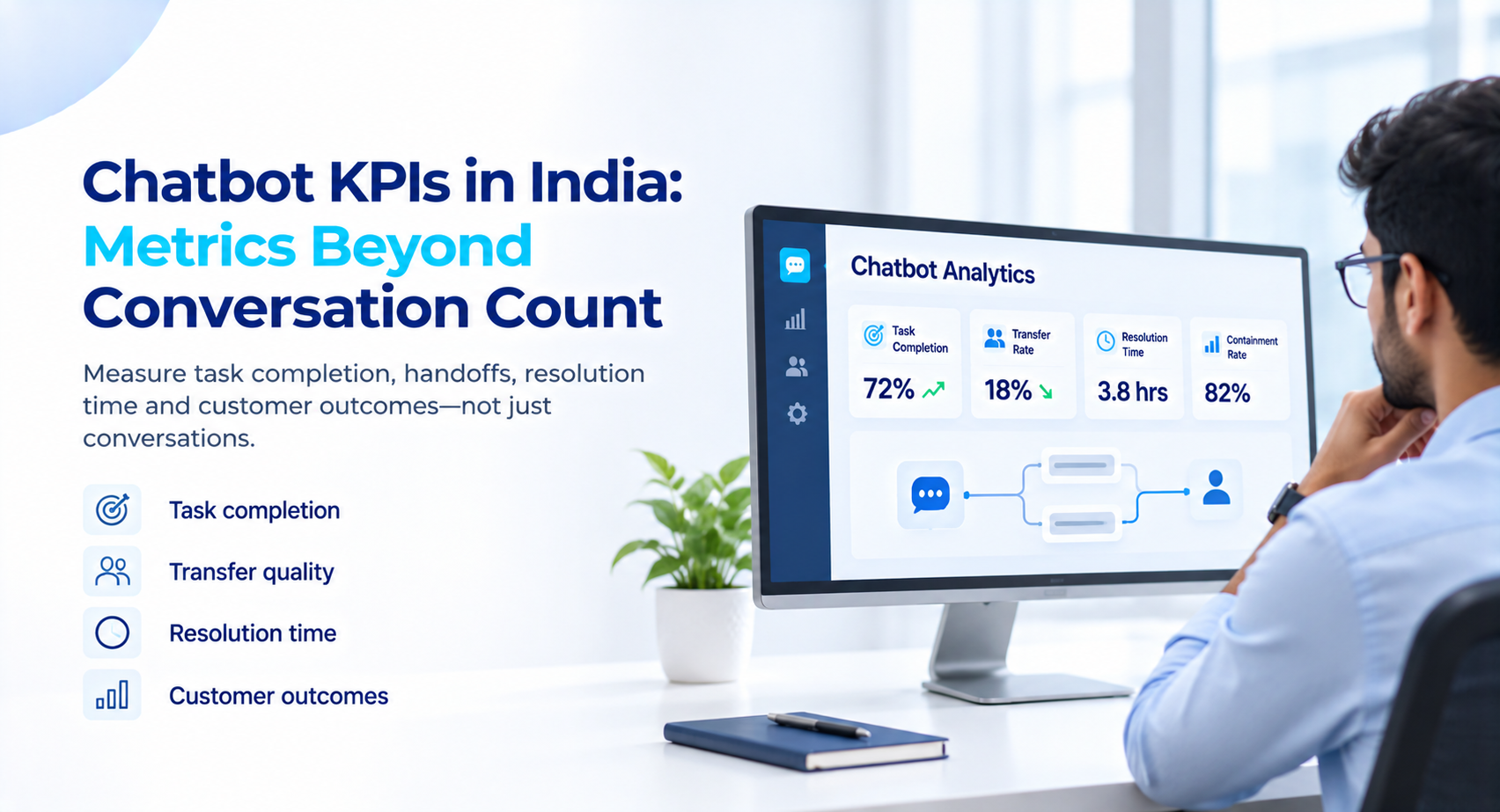
 By Ankit Rawat·Published: November 7, 2026 at 5:31 PM IST
Having a dashboard showing 40,000 conversations may indicate a busy chatbot but doesn’t give any insight into whether the customers were actually helped. Chatbot KPIs should be used to answer this. The first number to drop is raw conversation count.
What the India data says
The ServiceNow 24th March 2025, datelined 25 March India Customer Experience release states that they surveyed 5000 individuals aged 18+ in India. The survey was carried out online between 1st and 15th November 2024 and weighted using population data from the Ministry of Statistics and Programme Implementation. They also surveyed 204 customer service agents in India. The results showed that 80% of them use AI chatbots to check the status of their issue or complaint, receive suggestions or be directed to self help. However 39% are still on hold/queue and 36% have been frustrated by being transferred between people and departments. Agents estimate that simple issues take around 30 mins to resolve but customers perceive this to take an average of 3.8 days.
The ServiceNow survey can be biased, as they sell service software. There are inconsistencies with the data. It says that 5 out of 6 use AI tools to resolve their query. This doesn’t align with the 80% figure. The survey is looking at customer sentiment and perception. While this shows the need for better measurements, there are no benchmarks.
Chatbot KPIs that show whether the bot helped
The difference between 30 mins and 3.8 days is a big one. The customer will be measuring from the moment they send their first message until they actually have their resolution.
Task Completion Rate. How many people completed tasks? Break down what tasks you want to be completed. An example could be checking order status, changing address or making a booking. You should measure based on the outcome.
Transfer Rate & Quality. How often is the chatbot transferring? Is the agent seeing the history? This is where the frustration comes from in the survey, as customers have to repeat themselves.
Resolution Time. How long until resolution?
Containment (with follow up). Not always a win if they don’t transfer. Add in a follow up question or re-contact rate in a few days.
Failed Intent Log. Look at the intents the chatbot didn’t understand in the last week. This is the cheapest way to improve.
What to ask before you set chatbot KPIs
- What are the top 3 tasks you want to be completed? What is considered completion?
- Where are they being directed to if the chatbot can’t help?
- Are agents seeing the full chat history?
- How do we identify recontacts for the same issue?
- Who looks at failed intents and how often?
- What KPIs will we remove if they aren’t helping us make decisions?
How We Approach Chatbot KPIs
We have a Chatbot Development service under our App Development service. We use NLP and CRM integration. This is important as we will only be able to see transfers and recontacts if the chatbot and customer are integrated. We will agree with you on what tasks you want to complete and how we will define success. Once we have built it, we will look at the chatbot conversations and compare them against the tasks and success criteria.
Frequently asked questions
Q1. What are chatbot KPIs?+
Chatbot KPIs are measurable indicators used to evaluate how effectively a chatbot helps users complete tasks, resolve queries, and reach the right support channel. They help businesses assess performance beyond the total number of conversations.
Q2. Which chatbot KPIs should businesses track?+
Useful metrics include task completion rate, transfer rate and quality, resolution time, containment with follow-up, and failed intent frequency. The right metrics depend on what the chatbot is designed to achieve.
Q3. What is chatbot task completion rate?+
Task completion rate measures the percentage of chatbot interactions in which users successfully complete a defined task, such as checking an order status, changing an address, or booking an appointment.
Q5. Why is chatbot transfer rate important?+
Transfer rate shows how often conversations move from the chatbot to a human agent. Businesses should also assess transfer quality, including whether the agent receives the complete conversation history and relevant customer information.
Q7. Can payroll software be part of a hotel ERP?+
Businesses can review failed intents and conversation samples weekly, while tracking broader performance trends regularly. Review frequency should reflect chatbot usage, customer volume, and the importance of the tasks it handles.
Q8. How does CRM integration improve chatbot analytics?+
CRM integration can connect chatbot conversations with customer records, lead information, and follow-up outcomes. This helps teams understand transfers, repeat contacts, and whether chatbot interactions contribute to business goals.
Measure What Your Chatbot Actually Delivers
EICE builds chatbots with NLP and CRM integration, helping businesses define measurable tasks, track customer interactions, and evaluate chatbot performance.