What Is an AI Center of Excellence? A CTO’s Guide to Building One in India
Discover how an AI Center of Excellence helps enterprises standardize AI adoption, manage governance, develop engineering capabilities and measure AI's impact across software teams.
 By Ankit Rawat·Published: October 9, 2026 at 9:55 PM IST
Why an AI center of excellence matters in India
As per Deloitte’s State of AI in the Enterprise: India Insights report from April 2026, around 40% of the Indian respondents say they use AI to a significant or full extent. This is more than the average of 28% across 15 markets. These findings are from Business Today. India is leading the active use of AI for strategic decision-making. But the number of people who have AI expertise is still very low. As compared with the global average of 8.3%, India has 4% of respondents who have high expertise in generative AI. The figure for agentic AI in India is 0%, while globally it is 2.6%. On the same side, 94% of the Indian respondents have expectations that their organisation’s AI spending to increase next year.
Institutions, not just technology, decide the next phase
According to Deloitte, just having AI technology is not enough for the future. Organisations need a strong internal process, clear rules and people who can adapt as AI changes. This is the place where an AI Center of Excellence (CoE) can help you. This provides a structured process to use AI, build skills, and manage risks.
What an AI Center of Excellence is
These are our explanations, not from the above report’s findings. An AI Center of Excellence is a small and dedicated team that helps different kinds of organisations build and use AI with consistency. It has common rules, shares tools, and reusable components. These are helpful for the team in choosing the right AI projects and training employees. This does not mean taking over other teams' work. CoE supports this so the team doesn’t have to solve the same problems again and learn the same lessons separately.
What a working AI center of excellence needs
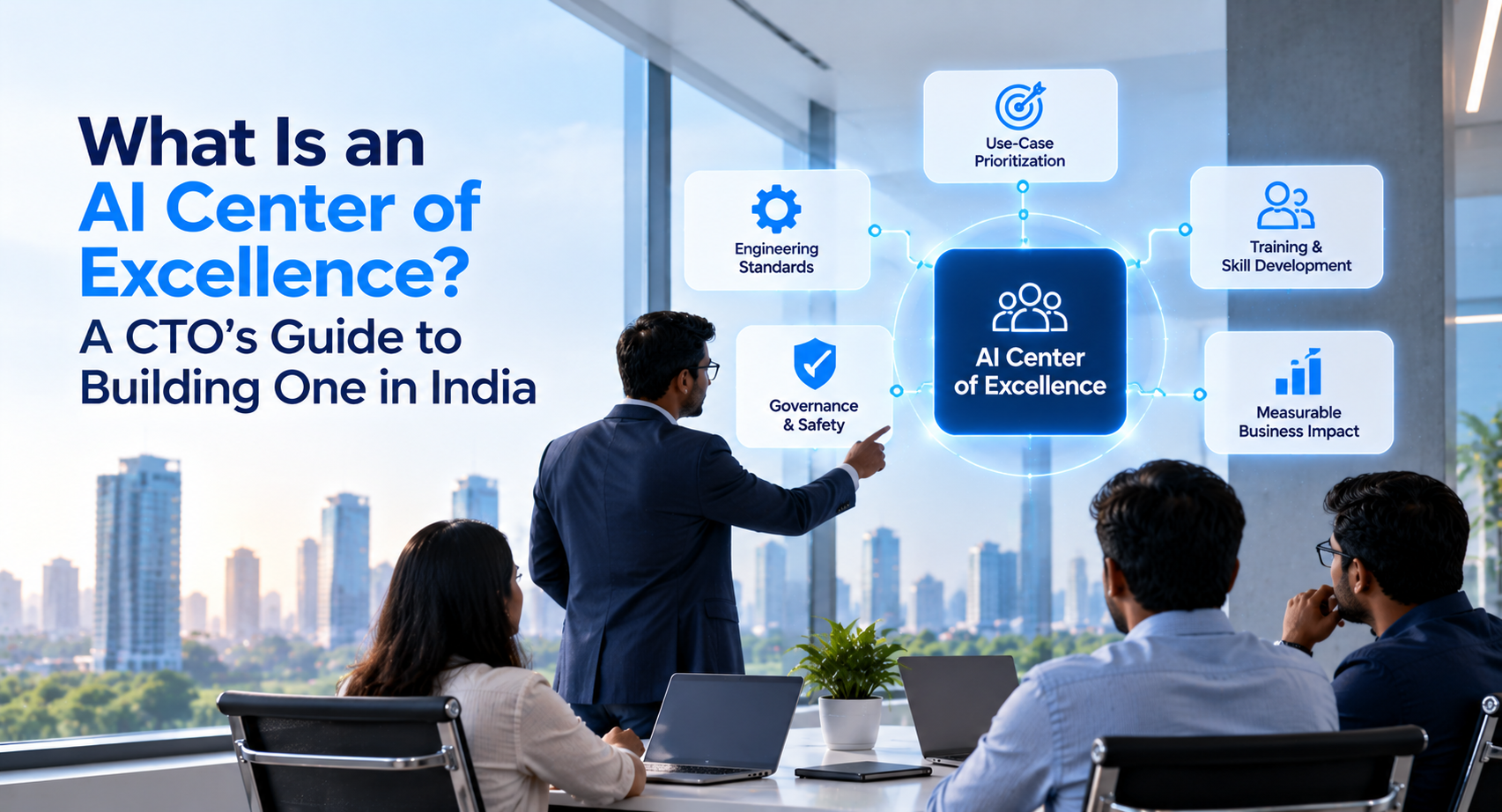
This is also our general explanation. A working CoE also generally focuses on 5 things:
- Choosing the right use case: selecting the right AI projects for supporting business goals.
- Shared tools and engineering practices: this helps teams to have consistency in building or using AI.
- Governance and safety: creating and setting rules for security, privacy and AI output checks.
- Training and skill development: helping both the staff, business and technical teams to understand how to use AI.
- Measuring results: checking that the AI is giving valuable results or just increasing costs.
It is very important to measure results for the software teams. Maybe the developers are already using AI tools separately, but it is without shared records. Leadership does not know how much these tools will actually save time and effort. A CoE can give leadership a full picture of AI’s impact while tracking this information.
Where a CTO should start
A CTO does not have to create a very big AI team from the start. It can build step by step later, so it will be best to start with less. You can start with just one or two use cases where the required data is already there and can assign an owner who is responsible for the results. After this, decide how an AI project will move from testing to actual use. Setting the rules first, like security, privacy, and early risks, is better to do before going live because doing it after will become very hard.
You also have to make plans about hiring people with the right skill sets who can train your current team or provide the expertise shown in the Deloitte finding. After all this, decide: how will you decide success before the start? This can give you hints about how the CoE will work and what results it delivers, instead of just counting the projects and their deliverables.
How EICE Technology runs an AI center of excellence
We run an AI-Enabled Engineering Excellence Center for large organisations; this manages many custom software applications across distributed engineering teams. Currently, we are operating the center for a global energy services company; this covers six main areas:
- Common engineering standards: it includes creating software design and deployment, and achieving more consistency across teams.
- Delivery governance: This is managing how software will be delivered, with formal risk checks before going live.
- Quality audits: Reviewing the software's overall quality across the organisation. Currently, the center covers 82 applications.
- Engineer onboarding: Putting every new engineer through a structured onboarding process.
- Continuous improvement: Keeping a plan to improve the way teams work and testing new tools and AI-based methods in a sandbox.
- Tracking AI usage and savings: Keeping records of how AI tools are used in tasks and how much effort it saves. This provides actual proof instead of relying on personal opinions or stories.
We follow 5 stages in our engagements: assess, design, embed, operate, and evolve.
The center works with your current engineering teams; it supports and improves work instead of completely taking full responsibility. If an AI center of excellence is on your agenda this year, we’d welcome the conversation. See more on our Service page.
Frequently asked questions
Q. What is an AI Center of Excellence?+
A. An AI Center of Excellence is a dedicated team or organisational function that helps establish common AI practices, select use cases, develop skills, manage risks, and measure outcomes across an organisation.
Q. Why do enterprises need an AI Center of Excellence?+
A. An AI CoE helps enterprises coordinate AI initiatives, reduce duplicated effort, establish governance, support employees, and evaluate whether AI investments deliver meaningful business value.
Q. How do you build an AI Center of Excellence?+
A. Start with measurable use cases, assign ownership, establish governance, define shared engineering practices, develop employee skills, and implement performance measurement. Expand the operating model as the organisation's needs grow.
Q. What are the main responsibilities of an AI CoE?+
A. Common responsibilities include use-case prioritisation, shared tooling, AI governance, training, reusable components, deployment guidance, and tracking AI performance and business outcomes.
Q. How does an AI Center of Excellence measure AI productivity?+
A. It can track AI tool usage, task-level effort, time saved, quality outcomes, adoption, and costs. Measurements should use clearly defined baselines and consistent methods rather than relying solely on employee perceptions.
Q. Does an AI Center of Excellence replace existing engineering teams?+
A. Not necessarily. An AI CoE can support existing teams with standards, governance, shared capabilities, and expertise while delivery ownership remains with the teams responsible for individual products.
Q. What is the difference between an AI CoE and an AI development team?+
A. An AI development team typically builds or maintains specific AI solutions. An AI CoE has a broader cross-organisational remit, helping standardise practices, manage governance, share expertise, and coordinate AI adoption across multiple teams.
Q. How does EICE Technology support an AI Center of Excellence?+
A. We operate an AI-Enabled Engineering Excellence Center that supports engineering standards, delivery governance, quality audits, onboarding, continuous improvement, and task-level AI usage and effort-savings tracking.
Build an AI Center of Excellence That Delivers Measurable Results
Establish consistent engineering standards, govern AI adoption, and track task-level AI impact across your software teams with EICE Technology.
Related in AI & Digital Transformation
Chatbot Development Services in India: What Separates a Useful Bot from a Frustrating One
Discover what makes a business chatbot useful, from accurate answers and CRM integration to multilingual conversations, human handoffs and ongoing performance monitoring.