Self-Healing Test Automation with AI in India
Frequent UI changes can break automated tests and increase maintenance effort for QA teams. Discover how self-healing test automation with AI can identify locator changes, suggest repairs and reduce repetitive work while keeping human validation, test reliability and governance at the centre of the process.
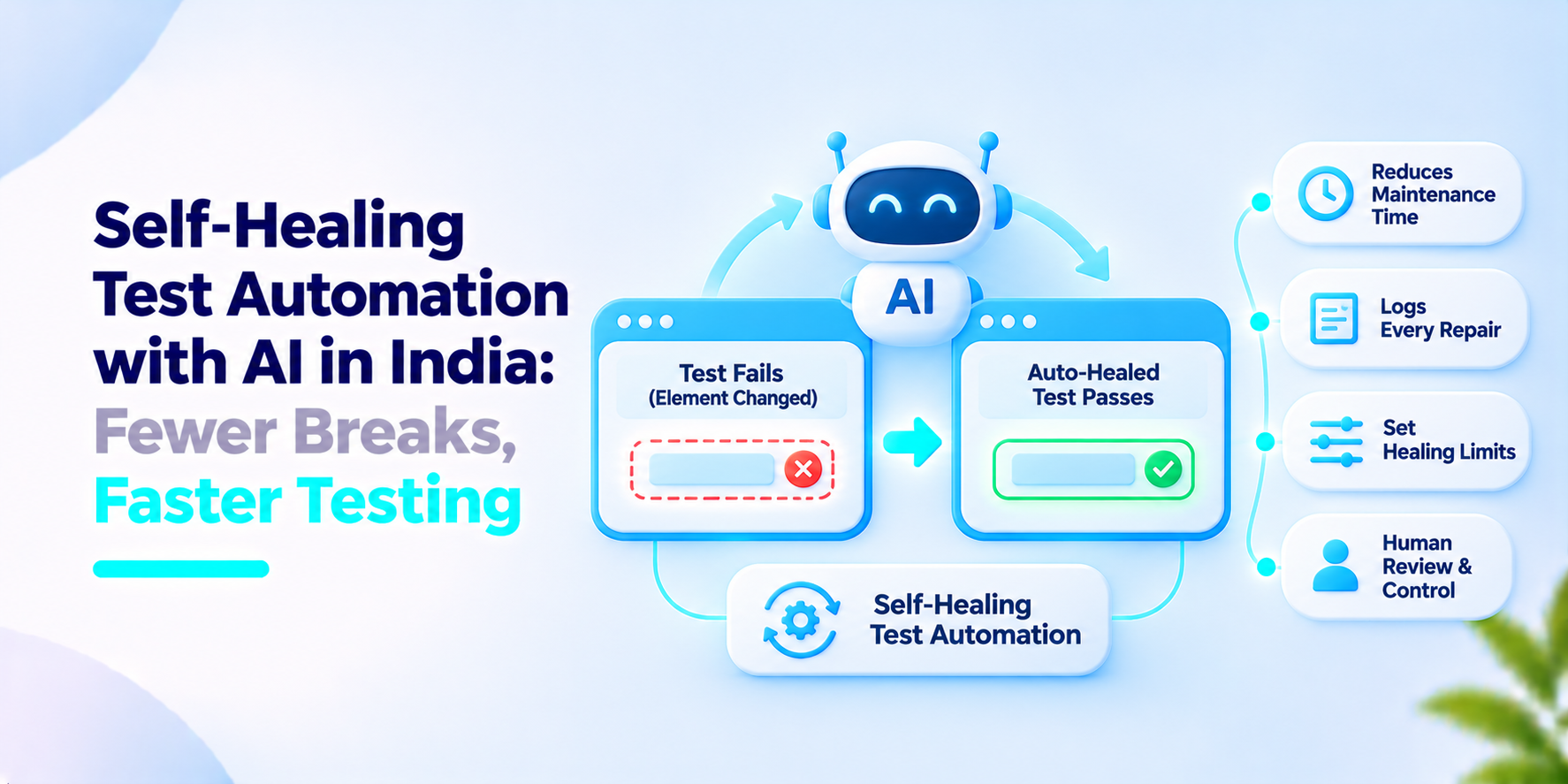
A button moves, an ID changes and fifty automated tests fail for no reason. Someone spends the morning fixing scripts or finding bugs. Self-healing test automation tries to repair those breaks by itself. This post covers what self-healing test automation can do and where it needs a person.
What the data says
CXOtoday, a technology news site, reproduced on 14 November 2025 the announcement of the World Quality Report 2025 from OpenText with Capgemini. The report looked at more than 2,000 senior executives in 22 countries and 10 sectors. It says 90% of organisations use generative AI in quality engineering, but only 15% have rolled it out at scale. The average productivity gain is 19%. About a third saw only small gains. The main challenges were data privacy (67%), integration complexity (64%) and unreliable output (60%).
Three cautions. The numbers are global. Do not give an India breakdown. The article is a vendor press release. It does not explain how the gain was measured. It also does not mention self-healing test automation, so it talks about AI in testing in general, not about this technique.
Self-healing test automation: our view
This section is our view. A self-healing test automation notices when an element changes, finds a match and keeps going. That saves time. It also carries a risk.
The risk is a repair. If self-healing test automation heals onto the element, the test will pass while the real fault remains hidden. Treat every heal as a suggestion until a person confirms it.
Keep a log of each repair, with the old and the new locator. Review the log after each release. A rising number of heals on one screen often means the design is unstable, which is worth knowing.
Set limits. Allow self-healing test automation to fix changes and make the test fail loudly when the change is large. Teams in India that adopt self-healing test automation should make failures easier to read, not hide them.
Start narrow. Pick one suite, such as login and checkout and measure maintenance time before and after. Self-healing test automation works best where a team already knows what a passing test means.
What to ask before you adopt self-healing test automation
- How much time do we spend fixing broken tests today?
- Does the tool log every repair for review?
- Who approves a heal that changes what a test checks?
- Can we turn healing off for flows?
- How does it handle data privacy for our test data?
- What do we measure to know it helped?
How We Approach Self-Healing Test Automation
EICE Catalyst is our enterprise AI platform. Its AI-enabled engineering capability supports engineering teams and its responsible AI and governance capability covers oversight of AI use. We start from where your team loses time in testing today and we agree with you on where a person must stay in the loop.
If your team is exploring self-healing test automation, we would welcome the conversation.
Frequently asked questions
What is self-healing test automation?+
Self-healing test automation uses automated techniques, sometimes supported by AI, to detect changes that break test scripts and identify possible repairs so that tests can continue running.
How does AI-powered self-healing test automation work?+
It can analyse changes to page elements, locators, attributes or visual information and identify a replacement for an element that a test can no longer find. The proposed repair should be validated before it is trusted.
Does self-healing test automation eliminate manual testing?+
No. It can reduce repetitive automation maintenance, but human testers are still needed to validate business logic, expected outcomes and application behaviour.
Can self-healing automation hide genuine application bugs?+
Yes. If a tool repairs a test using the wrong element or changes its intended behaviour, the test may pass even though a genuine issue remains. Repair validation and audit logs are important safeguards.
What is the difference between locator healing and test logic healing?+
Locator healing finds another way to identify the same intended UI element. Test logic healing changes the actions or expected results of the test, which carries a much higher risk and requires stricter review.
Make Test Automation More Reliable with EICE Catalyst
Reduce repetitive test maintenance with AI-enabled engineering while keeping your quality checks and human oversight in place. Explore how EICE Catalyst can support your software engineering workflows.