How Indian QA Teams Help US Law Firms Validate AI-Powered Legal Search Rollouts
See how independent QA teams validate AI-powered legal search platforms for US law firms across semantic search, document repositories, permissions, integrations and UAT.
 By Ankit Rawat·Published: September 9, 2026 at 6:20 PM IST
Why rolling out AI search inside a law firm is higher stakes than it looks
Rolling out an AI-powered search platform inside a law firm is not the same as rolling one out in other environments. The platform has to understand the legal language, respect document permissions and can work efficiently with the system that the firm is already using; it includes the document management system, SharePoint, iManage and other internal databases. The risk is greater than a bad search result if something goes wrong before going live. The wrong person could see the wrong document; lawyers could lose trust in a tool that is designed to make legal knowledge and precedents easier to find and reuse.
What independent QA validation of an AI search rollout actually looks like
In a recent engagement, a US law firm’s knowledge and research service team adopted a third-party AI-powered enterprise search platform to improve how the information was organised and reused across matters. The firm has brought in an independent QA team to test the platform before a firm-wide rollout, instead of treating integration as a simple list.
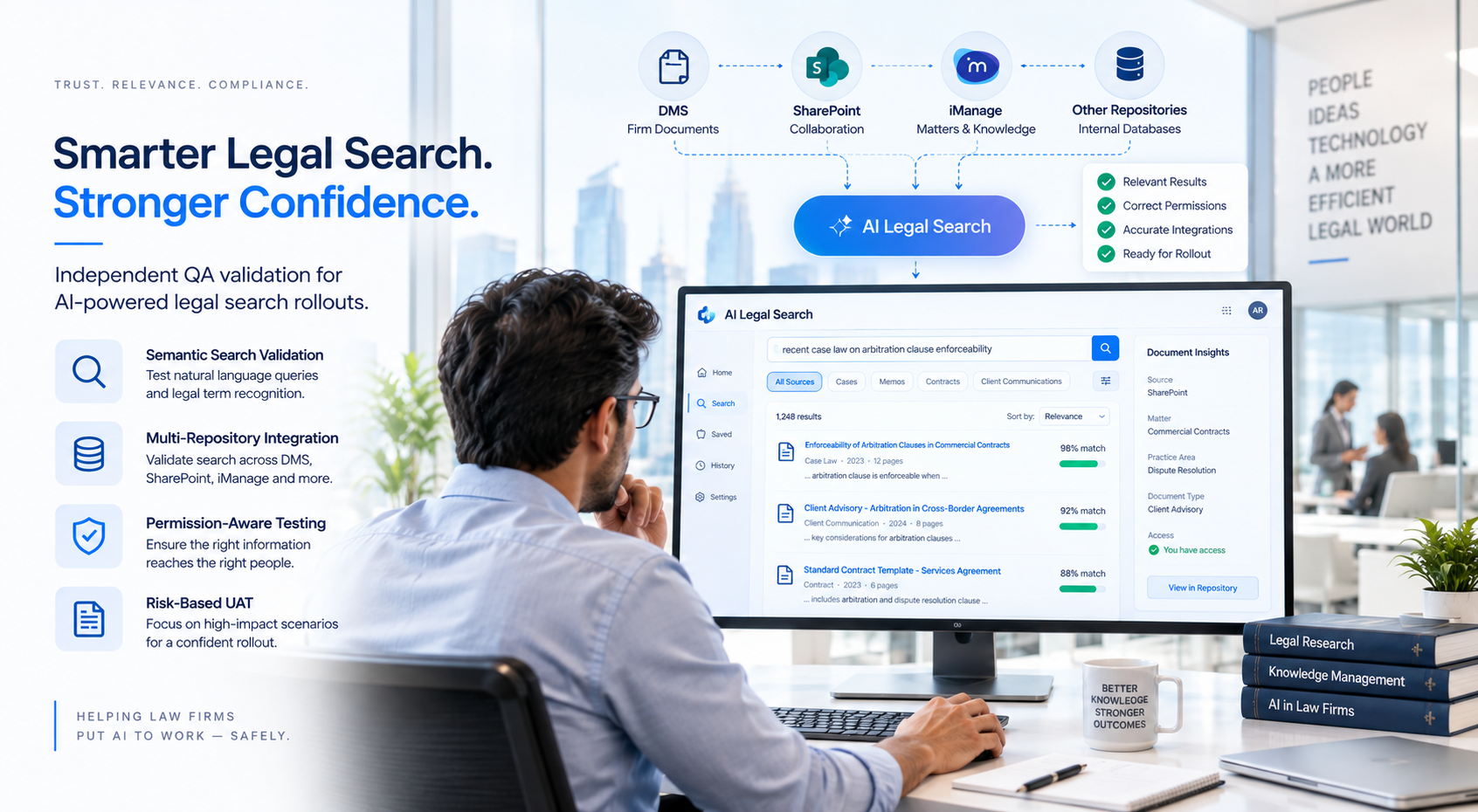
The validation covered semantic search, checking whether, instead of just relying on keywords, the platform is able to understand context and meaning. The team also checked:
- Plain-English natural language queries without requiring special syntax.
- Ability to recognise legal terms, clauses, and legal-writing nuances.
- Integration with the firm's DMS, SharePoint, and iManage.
- Intent-based and permission-aware ranking are properly scoped and prioritised.
- The ability to search and recommend related documents across the connected repositories.
Document ingestion was also tested across work product, briefs, memos, client communications, and other common file formats. To make sure the results were accurate and returned through a single, unified search interface.
What this validation delivered under real-time constraints
During the UAT phase, given time constraints, testing was prioritised based on risk. The team focused on SharePoint, iManage with integrated reliability and security objectives, before lower-priority test cases.
The engagement delivered:
- Verified integration in the firm's DMS, SharePoint, and iManage.
- Validated the semantic search and legal-specific term recognition.
- Confirmed document ingestion accuracy across the firm's most-used repositories
- Full documentation of test plans, test cases and test data maintained in the firm's own Teams-integrated repository.
The engagement is currently in the UAT phase and is still ongoing.
How EICE Technology leads independent QA for AI-powered legal search rollouts
As an IT company, we led the testing and validation for this rollout. The AI search platform is built by the third-party vendor; our role was to independently check its integration, functionality and security within the law firm’s environment. We did not develop the underlying AI technology. This distinction is important because the QA team independently validates how the existing AI platform works with the firm’s environment. Our processes are shaped by ISO 27001 and ISO/IEC 20000 certifications, with CMMI Level 3 and ISO 9001. This is helpful in maintaining the same security and process discipline required for quality validation. See our Services Page.
Frequently Asked Questions
Q.Why does AI-powered legal search require specialized QA testing?
A. Legal search systems need to handle legal terminology, document permissions and multiple internal repositories. QA therefore needs to validate not only search relevance but also integration, access controls and document retrieval within the firm's environment.
Q. What does AI legal search testing include?
A. Testing can include semantic search, natural-language queries, legal terminology recognition, document ingestion, search ranking, related-document recommendations, repository integration and permission-aware search.
Q. Does EICE Technology develop the AI legal search platform?
A. No. In this engagement, the underlying AI search platform was developed by a third-party vendor. EICE Technology's role was to independently validate its integration, functionality and security within the law firm's environment.
Q. How does EICE Technology approach UAT for AI search?
A. The supplied engagement uses a risk-based approach during UAT, prioritizing higher-risk areas such as SharePoint, iManage, integration reliability and security objectives before lower-priority test cases.
Rolling Out AI Search Across Your Law Firm?
Explore how EICE Technology can independently validate AI search integrations, functionality and security before wider deployment.
Related in Artificial Intelligence
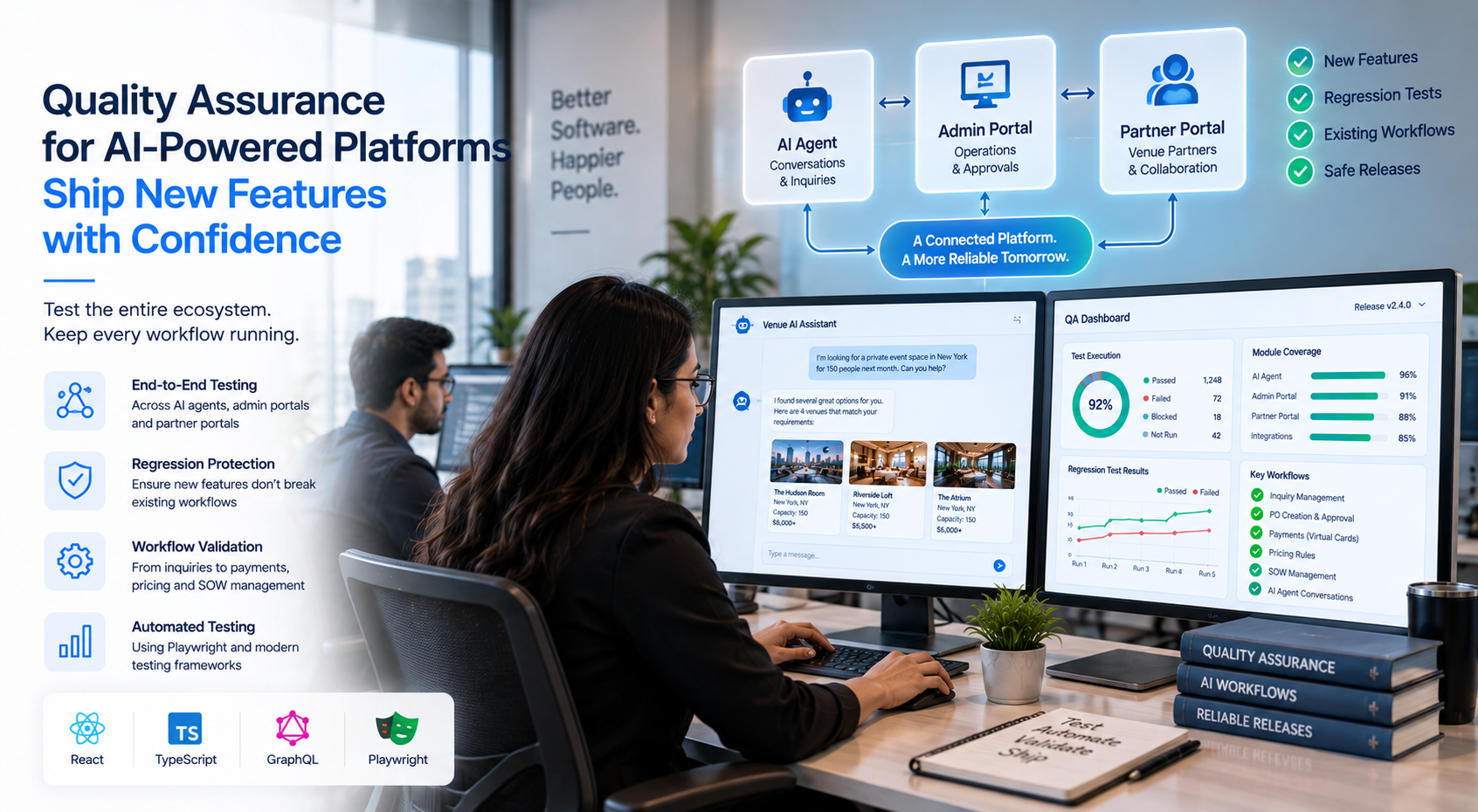
How Indian QA Teams Help AI-Powered Platforms Ship New Features Without Breaking Existing Workflows
See how QA teams can protect existing workflows when new features are added to AI-powered platforms with connected portals, automated processes and AI agents.