RPA Governance in India: Who Owns the Bot When a Process Changes
When a business process changes, who is responsible for updating the bot that runs it? Learn how RPA governance in India can define business and technical ownership, connect application changes to bot reviews, secure credentials and retire obsolete automations.
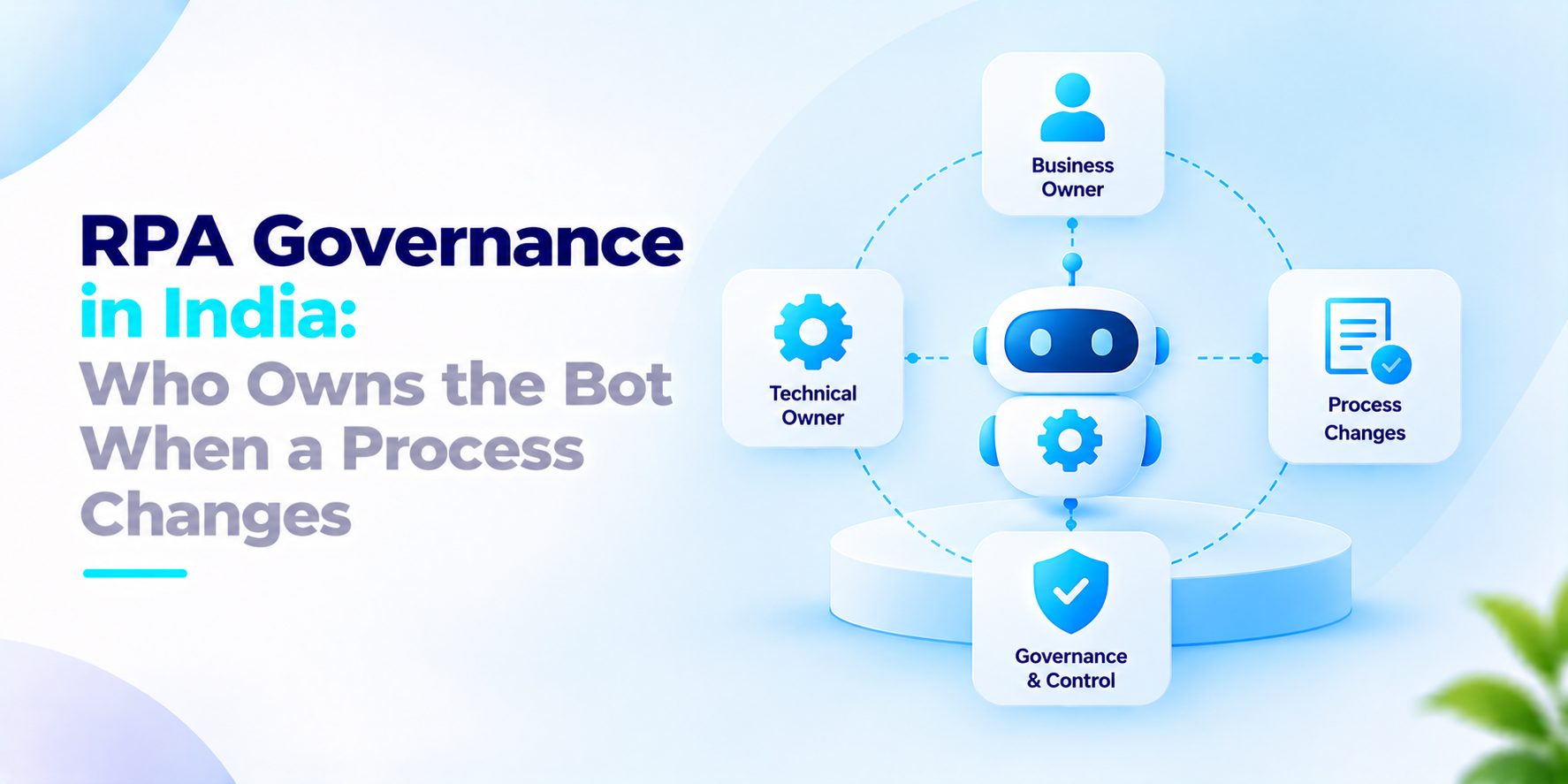
A bot is created to match the version of a process. Later if a form is altered, a portal is refreshed or a policy is rewritten, it is unclear who must correct the bot. RPA governance India clarifies that responsibility before an incident occurs.
What the India data says
Deloitte India released a page called "Risk Management for and by the BOT" that's part of the Secured BOT Series and is dated 2018. The page identifies a change‑management process for Bot configurations as a risk. It warns that automating a process without built‑in controls can enable manual overrides or unauthorized changes that often go undetected. The page also states that bots possess credentials for applications, frequently granting wide access.
Three cautions. First, the page dates back to 2018, so tools and practices have evolved. Second, it contains no survey data, no samples and no figures. Third, the page is a marketing page from a firm that also sells risk services so it has a stake in the subject. The page does not specify who should own a bot.
Three ownership rules for RPA governance in India
This section reflects our perspective. Ownership is often assigned to the person who first notices a failure, which's not the correct approach.
Assign one business owner to each bot. That owner is responsible for the process, not the code. The owner receives notification when the process changes. Must sign off on the bot’s behavior after the change.
Assign one owner to each bot. The technical owner owns the build the credentials, the schedule and the fix. If the technical owner departs, the bot is reassigned within the week.
Tie every process change to a bot check. A change ticket for the underlying application should ask: does a bot interact with this? Without that connection, bots may fail silently. Worse, continue operating on incorrect assumptions.
Maintain an inventory well. A bot that is not listed cannot be owned, reviewed or retired. Provide each bot with its credentials instead of a shared login so that its actions can be traced.
Bots also require a retirement rule. When a process concludes or moves to another system, someone must turn the bot off. Delete its credentials because an unused bot with active access poses a risk.
What to ask before you set up RPA governance in India
- Is there a list of every bot, including those built by business teams?
- Who is the business owner and who is the owner for each bot?
- How does a change, to an application or policy reach the bot owner?
- Do bots use their credentials and who rotates those credentials?
- Can we trace what a bot did to a record and when it did it?
- What happens to work in the queue when a bot is paused?
How We Approach RPA Governance in India
We begin with the process and its owners, not with the tool. Before a bot goes live, we agree on who owns it and how changes reach that owner and we document it. Then we review the list of bots with your team on a schedule.
If your team is setting up RPA governance in India, we welcome the conversation.
Frequently asked questions
What is RPA governance?+
RPA governance is the framework of roles, policies and controls used to manage automated processes throughout their lifecycle. It typically covers ownership, development standards, access permissions, change management, monitoring and retirement.
Who should own an RPA bot?+
A practical model assigns a business owner who is accountable for the underlying process and a technical owner who manages the bot’s implementation, credentials, scheduling and maintenance. The organisation should document both roles and define escalation responsibilities.
What happens when an application used by a bot changes?+
The application change should trigger an impact assessment to identify affected bots. Relevant owners should review the automation, test it against the updated process and approve its return to production where required.
Why is a bot inventory important?+
A bot inventory helps an organisation identify its automations, owners, business purpose, connected applications, access requirements and current status. It also supports reviews, incident response and retirement of obsolete bots.
Should every RPA bot have its own credentials?+
Where supported by the platform and security architecture, unique identities for individual bots or processes improve traceability and accountability. Access should be limited to what each automation needs, and credentials should be securely stored and managed.
Give Every Bot a Clear Owner
Build a practical RPA governance framework with defined responsibilities, controlled process changes, secure bot access and a clear retirement process.