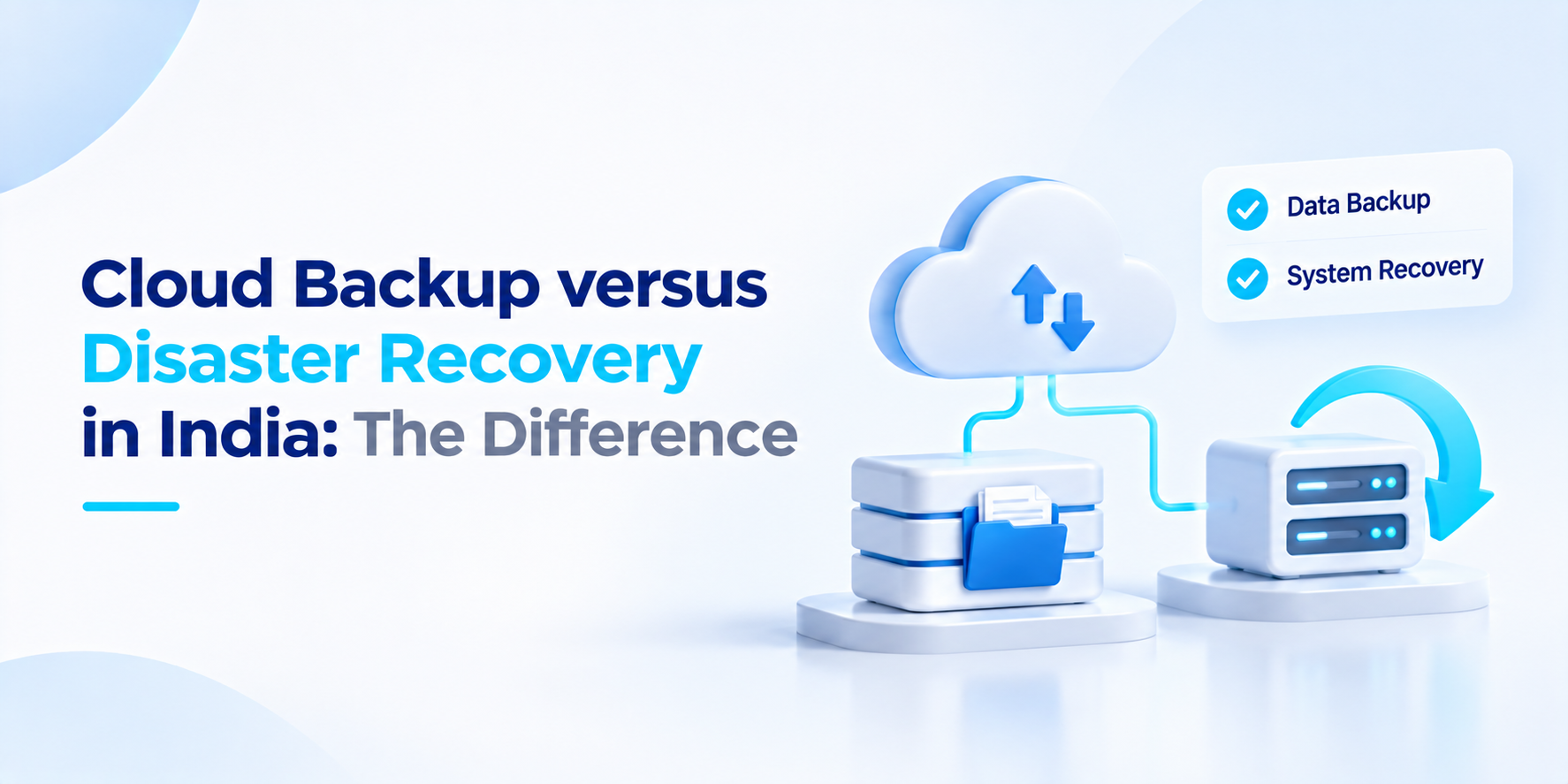
Cloud Backup versus Disaster Recovery in India: The Difference
Cloud backup and disaster recovery serve different purposes. Learn how RPO, RTO, secure backups, and recovery planning help businesses protect data and restore critical operations.
 By Ankit Rawat·Published: November 8, 2026 at 6:01 PM IST
Many teams say "we have cloud backup" and think disaster recovery is covered. It is not the same thing. The cloud backup versus disaster recovery question comes down to this: one keeps copies of your data the other gets your business running again.
What the India data says
CXOtoday reported on 26 February 2024 on Think Teal's "2024 State of BCDR India" report. Think Teal is an enterprise IT analyst firm. The article says it drew on more than 220 CIOs and IT decision-makers at organisations with at least 500 employees. It says 50 percent review their business continuity and disaster recovery strategy only once every three years; nearly 40 percent have no detailed plan and 65 percent run security and backup functions in isolation. It also says 86 percent name ransomware mitigation as a reason for having a strategy and quotes Think Teals research that more than 85 percent of ransomware attacks target backup repositories.
Three cautions. This is a news desk report of an analyst study, not the study itself. The article describes the method as both interviews and a survey. Gives no India-only breakdown by sector. It says nothing on recovery time or recovery point targets or on how plans are tested.
Backup versus disaster recovery: the working difference
This section is our view. Backup is a copy of data you can restore from. Disaster recovery is a plan, with systems, people and order of steps for bringing a service within a target time.
Two measures separate them. The recovery point objective (RPO is how recent data you can afford to lose. The recovery time objective (RTO) is how long the business can be without the service. Backup mainly answers the first. Disaster recovery has to meet the second.
A nightly backup of a database gives an RPO of up to a day. If restoring it, rebuilding servers and repointing applications takes two days the RTO is two days.
The article's figure on security and backup teams is worth acting on. If backups sit where an attacker with admin credentials can delete them, they may not survive the event they exist for. Keep a copy that's separate, access-controlled and tested.
Test restores on a schedule. Test the whole recovery order for the few systems that matter most not every system.
What to ask before you compare backup versus disaster recovery options
- Which systems must be back first and what are their RPO and RTO?
- Can one admin account delete both production and backups?
- When did we last restore a system, not a single file?
- Who runs the recovery steps? Are they written down?
- What does the provider's disaster recovery tier actually restore?
- How is cost split between storage and standby capacity?
How We Approach Cloud Backup versus Disaster Recovery
Our Cloud Services cover Backup and DR, Cloud Security and Monitoring and Reporting across AWS and Azure. We start by listing your systems, agreeing recovery targets for each and checking whether the current backup setup can meet them. Where it cannot, we show you the gap before proposing changes.
If your team is untangling cloud backup versus disaster recovery, we'd welcome the conversation.
Frequently asked questions
Q1. What is the difference between cloud backup and disaster recovery?+
Cloud backup creates copies of business data so they can be restored when needed. Disaster recovery is a broader plan for restoring systems, applications, infrastructure, and business operations after a disruption.
Q2. Is cloud backup enough for disaster recovery?+
No. Having backups does not automatically mean a business can restore its operations quickly. Disaster recovery also requires documented recovery steps, assigned responsibilities, suitable infrastructure, and regular testing.
Q3. What is RPO in disaster recovery?+
Recovery Point Objective (RPO) is the maximum amount of data a business can afford to lose, measured in time. For example, an RPO of four hours means the business aims to recover data no more than four hours older than the disruption.
Q4. What is RTO in disaster recovery?+
Recovery Time Objective (RTO) is the target time within which a system or service should be restored after a disruption. It helps businesses decide how quickly critical applications must become available again.
Q5. How often should businesses test cloud backups?+
Businesses should schedule restore tests based on the importance of their data and systems. Testing should confirm that files, databases, and applications can actually be restored, rather than simply checking whether backup jobs completed successfully.
Q6. What should a disaster recovery plan include?+
A disaster recovery plan should identify critical systems, recovery priorities, RPO and RTO targets, responsible personnel, recovery procedures, communication steps, and a regular testing schedule.
Prepare Your Business for Faster Recovery
EICE Cloud Services help businesses review backup environments, define recovery targets, and plan disaster recovery across AWS, Azure, and GCP.