Cloud Monitoring in India: What to Track After Go-Live
Cloud migration does not end at go-live. Businesses need continuous visibility into application performance, infrastructure, dependencies, security events and cloud costs. Learn what to monitor after migration and how to build an effective alert and response process.
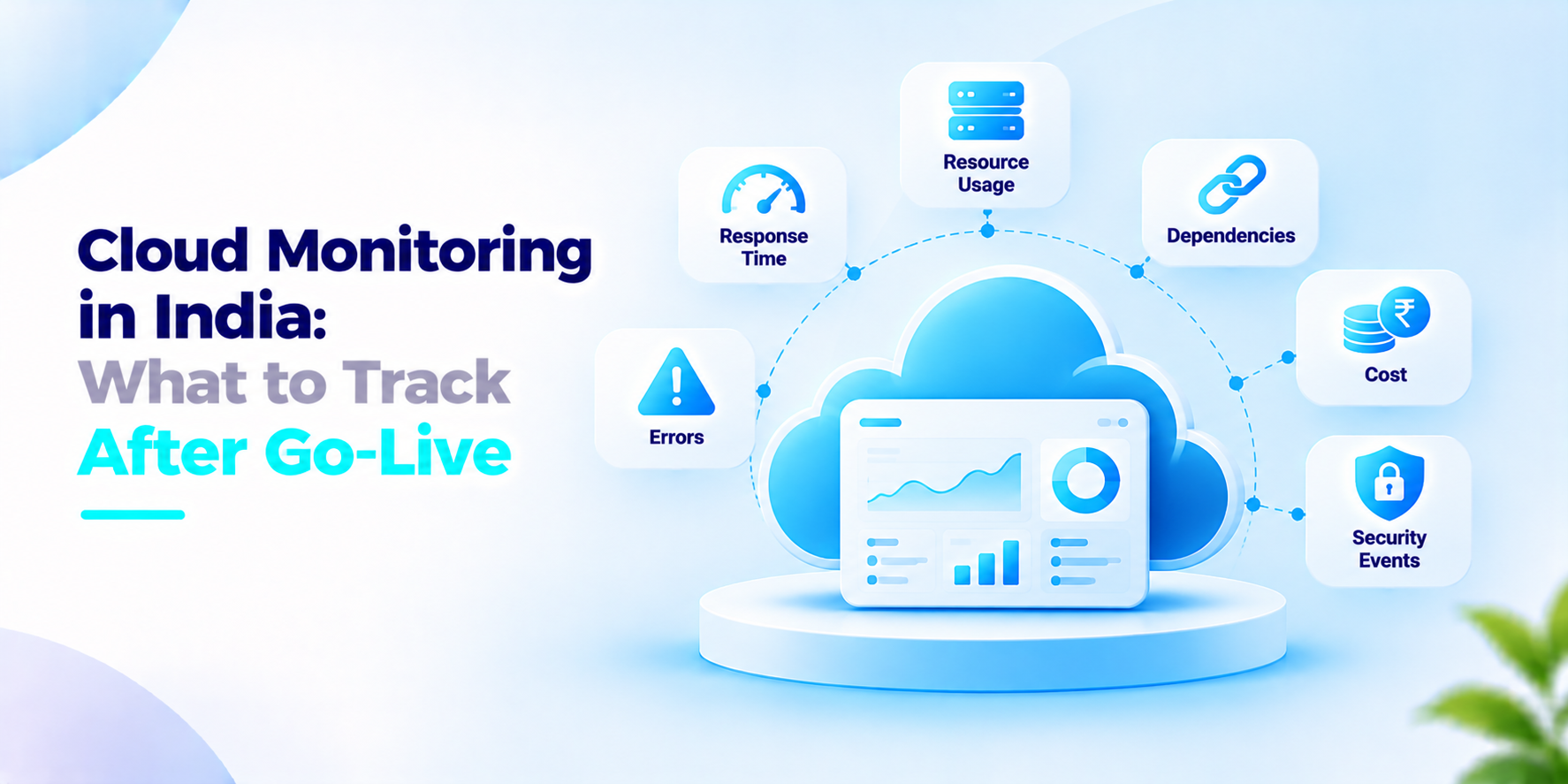
Go‑ is not the end of a migration. Systems that once ran in a data centre now run on shared services and failures appear in places. The way cloud monitoring teams in India set up in the weeks after go‑live will decide if problems are found by staff or by customers.
What the India data says
New Relics 2025 Observability Forecast, reported by Media Infoline on 17 September 2025, states that the median annual cost of high‑impact outages for surveyed organisations is $76 million, the same as the figure. The report says 39 per cent of respondent’s report outages at least once a week and 45 per cent value those outages at $1 million to $3 million per hour. The report also says 44 per cent cite a technology stack as their challenge.
Three cautions. New Relic sells observability tools so it has an interest. The report covers 1,700 respondents in 23 countries and the article does not state how many were in India. We read a news report, not the report itself so check the original before quoting a number.
What cloud monitoring in India teams should track
This section reflects our view. Start with what users feel, then work downwards.
Response time. Can users reach the service? How fast does it answer?
Errors. Failed requests, failed jobs and failed logins.
Resource use. Compute, memory, disk and network usage compared to the baseline you set before the move.
Dependencies. Databases, queues and third‑party services that your system calls.
Cost. Spend by service and by team. A forgotten resource can run for months without notice.
Security events. Logins from places that changed permissions and disabled logging.
Set alert levels based on your baseline, not on a default. Many alerts cause people to ignore them so route each alert to a named owner. Agree on what happens within the first fifteen minutes. Review the list one month after go‑live, then each quarter and remove alerts that nobody acts on.
What to ask before you plan cloud monitoring in India
- Which three user journeys must never fail without us knowing?
- Who is. Who is the backup?
- Do we have a baseline from before the migration to compare with?
- Are logs kept long enough for our audits and for incident review?
- Can we report uptime against what the contract promises?
- Who reviews cost and usage each month?
How We Approach Cloud Monitoring in India
Monitoring and reporting as part of cloud monitoring in India is one of the areas in our Cloud Services work alongside migration, security and backup and disaster recovery on AWS, Azure and GCP. We start from the journeys and systems you cannot afford to lose, agree on what to measure and who responds, then set up the dashboards and alerts.
If your team is planning cloud monitoring in India across sites and providers, we would welcome the conversation.
Frequently asked questions
What is cloud monitoring?+
Cloud monitoring is the continuous observation of cloud-based applications, infrastructure and services to understand their performance, availability, resource usage and operational health.
Why is cloud monitoring important after migration?+
After migration, applications depend on new infrastructure, configurations and external services. Monitoring helps teams detect performance issues, failed services, resource problems and unexpected costs before they cause larger disruptions.
What should businesses monitor in a cloud environment?+
Businesses should monitor application response times, errors, server and container resources, databases, network performance, third-party dependencies, security events and cloud spending.
What is the difference between cloud monitoring and cloud observability?+
Cloud monitoring tracks defined metrics and conditions to identify known problems. Observability combines metrics, logs and traces to help teams investigate system behaviour and understand less obvious issues.
What are the three main pillars of observability?+
The three commonly recognised pillars are metrics, logs and distributed traces. Together, they help teams measure system health, investigate events and follow requests across connected services.
Stay Ahead of Cloud Performance Issues
Monitor application health, infrastructure, dependencies and cloud usage with a monitoring approach built around your business-critical systems.