Hybrid Cloud Storage for Indian Enterprises: Why Regulated Industries Are Moving Beyond Public Cloud Alone
Explore how Indian enterprises can use hybrid cloud storage to balance data residency, security, centralized control and the flexibility of cloud-based collaboration.
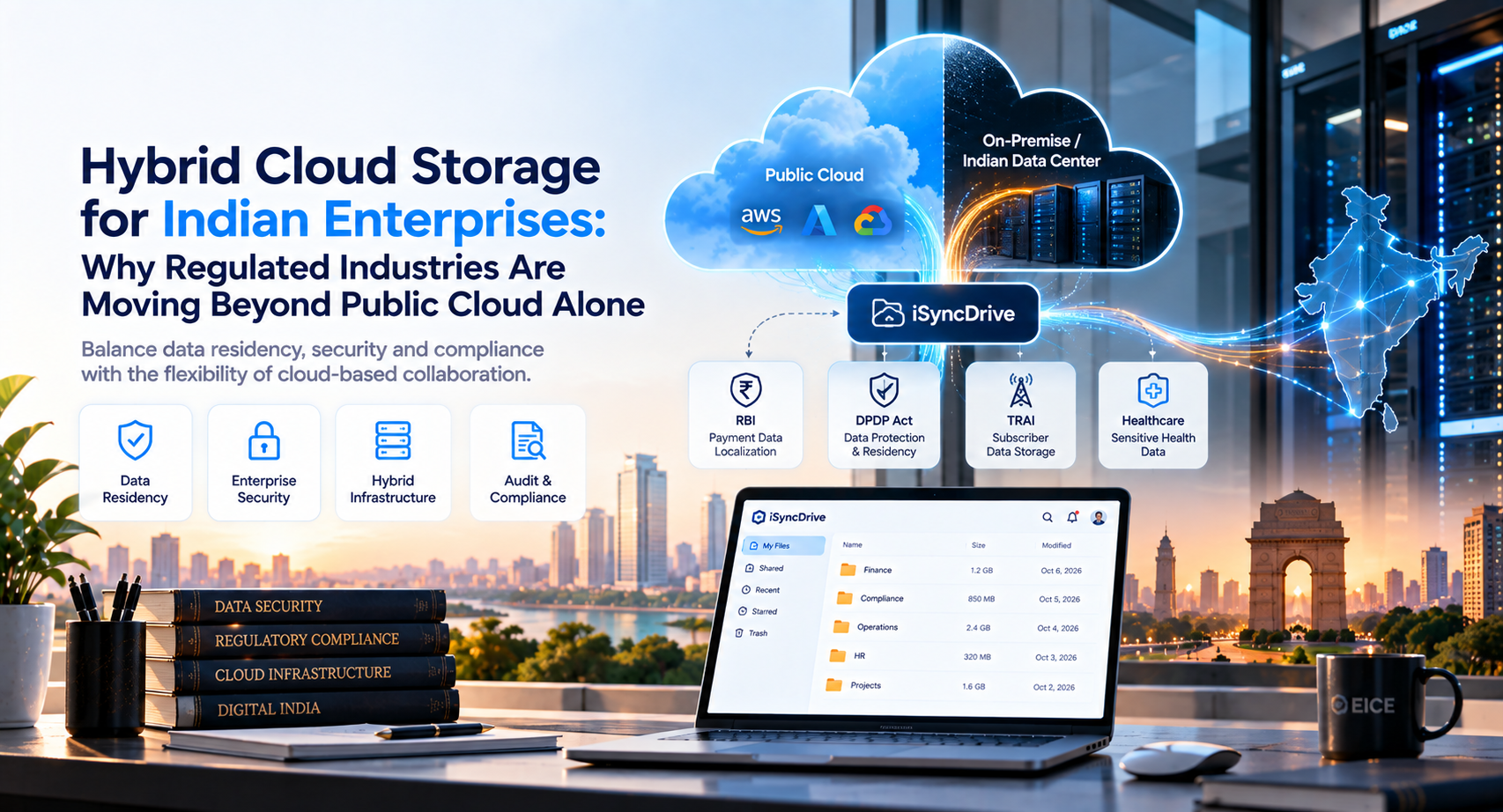
 By Ankit Rawat·Published: October 5, 2026 at 6:10 PM IST
India's data infrastructure market is growing fast, and compliance is a direct driver of it
India’s data center colocation market is very big and growing fast. In 2026, the market was valued at $7.31 billion; between 2021 and 2025, it grew at a 22.5% CAGR. By 2030, it is expected to reach $15.22 billion, with a 20.1% CAGR during the second half of the decade. This is not only because many companies are using the cloud. The market data also shows compliance-driven investment in domestic data infrastructure across regulated sectors, linked to the Digital Personal Data Protection (DPDP) Act, 2023. In simple language, some companies need to keep certain data inside India because of regulatory requirements, not just because it is convenient.
What the law actually requires, sector by sector
Keeping the data in India is generally supported by the DPDP Act, while allowing transfers to countries that the government may approve based on data protection standards. It can also restrict transfers for national security or sovereignty reasons. But the actual requirements can be different across sectors.
The Reserve Bank of India (RBI) has one of the strictest requirements. The Payment Data Localization policy has been in place since 2018; payment system operators like payment gateways and banks must store all payment-related data within India. This includes transaction details and customer information.
For some purposes, foreign processing is allowed, such as fraud detection, but it is important to have a copy of the data in India. Telecom regulations from TRAI also require operators to store subscriber data, including call records, within India. In healthcare, regulations under the National Digital Health Mission suggest localized storage of sensitive health data. So, for financial services, telecom, and healthcare, it is not enough to just say that “the data is stored in the cloud,” but where the data is stored matters a lot.
Why hybrid, not pure public cloud, fits this requirement
This is the place where hybrid cloud storage can be useful. The hybrid model combines the cloud with on-premises or dedicated infrastructure for data that has to stay in a specific location. This helps to companies to use cloud features, like Synchronisation, access management, and collaboration for general file operations, while keeping regulated data, like payment records, subscriber data, and health records. On infrastructure, it controls and can show that it is physically located in India. The data center market also lists hybrid multi-cloud infrastructure as a growth driver. On the other hand, companies like AWS, Google, Microsoft Azure, and Oracle are expanding their data center capacity in India; this also includes Mumbai, Chennai, Hyderabad, and Pune.
What this actually means for an enterprise choosing a storage platform
The question is not just “cloud or on-premises?” for a regulated company. The company also needs to know:
- What data must stay in India?
- Which regulation applies to that data?
- Can the storage platform keep that data in the right place?
The platform also needs real access controls and audit trails. A policy is not enough in itself. It should support role-based access control, encryption in transit and at rest, and centralized administration that can show where the data was actually stored.
How EICE Technology supports Indian enterprises with hybrid cloud storage
Our iSyncDrive is a hybrid cloud storage and synchronization platform; it is designed for these types of requirements. It supports Windows, macOS, Linux, and web access. It also provides AES-256 encryption and role-based access control for User, Admin, and Super Admin levels. It can connect with S3, Blob, and Ceph storage. This helps allow enterprises to have regulated data on infrastructure they control while managing other files through one central system; it includes audit reporting and administration. If your organization needs to manage DPDP, RBI, or TRAI data-residency requirements while still using the benefits of cloud services, we'd welcome the conversation.
Frequently asked questions
Q. What is hybrid cloud storage?+
A. Hybrid cloud storage combines cloud-based storage with on-premises or dedicated infrastructure, allowing organisations to manage different categories of data across different storage environments.
Q. Why is hybrid cloud storage important for regulated industries in India?+
A. Some regulated organisations may have specific requirements around where certain data is stored, processed or accessed. A hybrid architecture can provide greater control over where selected data resides while retaining cloud capabilities for other workloads.
Q. What is data residency in India?+
A. Data residency refers to the physical location where data is stored or processed. Depending on the applicable law, regulation or sector-specific requirement, organisations may need to account for where certain categories of data are located.
Q. Is hybrid cloud more secure than public cloud?+
A. Not automatically. Security depends on the architecture, configuration, access controls, encryption, monitoring and operational practices used by the organisation and its technology providers.
Q. Can hybrid cloud storage support RBI data localization requirements?+
A. A hybrid architecture can provide infrastructure and storage-location controls that may support applicable data-localization requirements. However, whether a particular solution satisfies RBI requirements depends on the specific use case, data and applicable regulatory obligations.
Q. Does iSyncDrive support hybrid cloud storage?+
A. Yes. iSyncDrive is designed as a hybrid cloud storage and synchronization platform and can connect with S3, Blob and Ceph storage while providing centralized administration, access controls and audit reporting.
Q. Which operating systems does iSyncDrive support?+
A. According to the product information provided, iSyncDrive supports Windows, macOS, Linux and web access.
Secure Your Enterprise Storage Strategy
Manage sensitive data with hybrid cloud storage, centralized access controls, encryption, synchronization, and audit visibility through iSyncDrive.