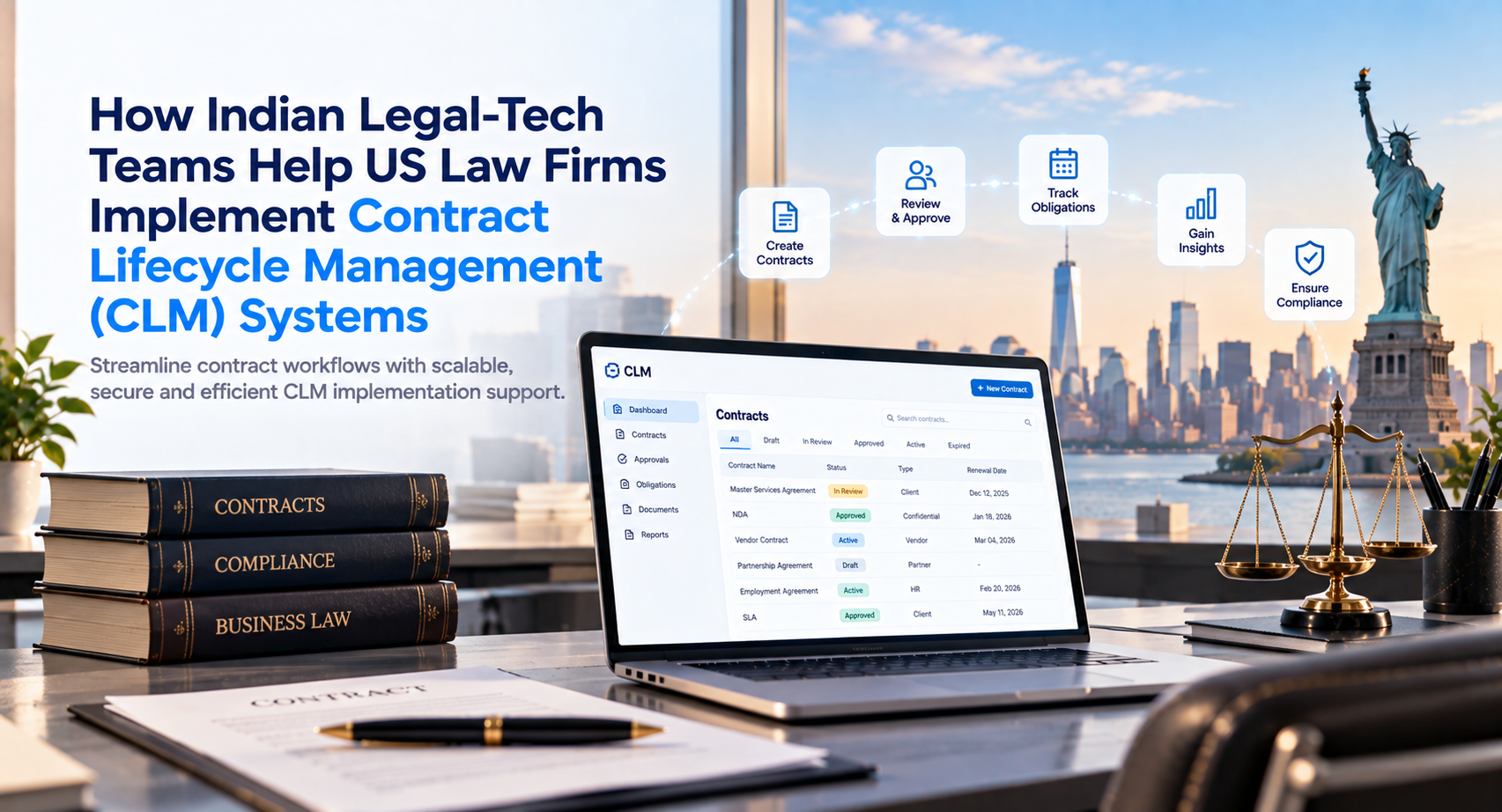
How Indian Legal-Tech Teams Help US Law Firms Implement Contract Lifecycle Management (CLM) Systems
Explore what US law firms need to implement CLM systems, from workflow configuration and contract migration to integrations, testing and technical support.
 By Ankit Rawat·Published: October 1, 2026 at 6:35 PM IST
The CLM market is growing faster than most legal technology categories
In legal technology, contract lifecycle management is one of the fastest-growing areas in technology. According to Fortune Business Insights, in 2025, the global CLM market was $1.84 billion; in 2026, it will reach $2.07 billion; and in 2034, it is expected to reach $5.09 billion, with an 11.90% CAGR. In 2026, cloud-based CLM solutions have already made up 48.24% of the global market and they are becoming the main direction of growth. Also, this matches the wider trend that 94% of enterprises use cloud computing services in some form. The largest regional share is held by North America at 35% in 2025, which is $0.64 billion. By 2026, the US CLM market is expected to reach $0.33 billion. This is proof that adoption of CLM in US law firms and corporate clients is an active buying decision instead of just an early-stage experiment.
Why legal and compliance specifically drives this market
According to the report, legal and compliance are the largest segment driving CLM demand. Especially because the sector manages a large amount of legal data that has to be managed in a structured and auditable way. This matches the regular work in law firms, such as where contracts should be reviewed, drafted, and managed regularly. Inside the CLM tool, another driver is AI and machine learning, which is growing fast. These tools can help automate contract review and clause extraction and provide ways for risk flagging that were not available some years ago.
The real obstacle isn't interest; it's budget and implementation capacity
According to the data, there is a gap between wanting a CLM and implementing a CLM, and 66% of the respondents have budget constraints as a main problem in adopting new technologies. So, the main issue is not understanding how the CLM can help, but it is having enough budget and technical capacity to implement the platform. It can include integrating CLM with existing practice management and document management systems, moving historical contract data into the new system, and training the people who will use it every day. These kinds of tasks need different skills from practising law. This can be difficult if the internal team of the firm is busy with other priorities.
What a CLM implementation actually requires
Implementing a CLM is much more than simply turning on a subscription. First, the firm has to map its current contract workflow and approval processes. After that, the CLM system can be configured around the workflows. Historical contract data also needs to be migrated and well-structured so that, after migration, it can be used and searched properly. CLM platform may also need to be integrated with the firm’s existing practice management and document management systems. If the CLM system uses AI-assisted clause review or risk-flagging features, they should be checked for accuracy before staff start relying on them in live matters. If any of these steps are skipped, the firm will have a CLM system that becomes just a system that people in the firm will not use.
Why more US law firms are bringing in outside implementation capacity
Budget and implementation capacity are important challenges for firms adopting CLM. This is a reasonable read to expect more US law firms to use technical teams from outside for implementing CLM and data migration. This allows the firm's IT and legal operations teams to focus on their regular work when a dedicated team handles the technical implementation.
How EICE Technology supports US law firms implementing CLM systems
As an Indian IT company, we work with US law firms on the technical side of legal technology projects. This includes CLM implementation, contract data migration, and integration with existing practice management tools. We follow a structured process that is shaped by ISO 27001 and ISO/IEC 20000 certifications, along with CMMI Level 3 and ISO 9001. See more on our services page.
Frequently asked questions
Q. What is CLM implementation?+
A. CLM implementation involves configuring a contract lifecycle management platform around an organisation's contract workflows, migrating relevant contract data, integrating existing systems and preparing users for adoption.
Q. What does a CLM implementation for a law firm involve?+
A. It can involve workflow mapping, platform configuration, historical contract migration, system integrations, testing, AI-feature validation and user training.
Q. Why is contract data migration important during CLM implementation?+
A. Historical contracts need to be transferred and structured correctly so they can be searched, managed and used effectively within the new CLM system.
Q. Can CLM systems integrate with existing law-firm systems?+
A. Depending on the platforms involved, CLM systems may need to integrate with existing practice management, document management and other business systems.
Q. What should a law firm consider when choosing a CLM implementation partner?+
A. Law firms should evaluate CLM experience, workflow expertise, data migration capabilities, integrations, security practices, QA processes and relevant certifications.
Q. Does EICE Technology provide CLM implementation support?+
A. We Support US law firms with technical legal-technology work, including CLM implementation, contract data migration and integration with existing practice management tools.
Modernize Your Contract Management Workflow
Get technical support for CLM implementation, contract data migration, system integration, and QA.
Related in Legal Technology
How Indian E-Discovery Teams Help US Law Firms Modernize Document Review with Relativity
Explore how Indian e-discovery teams can support US law firms with Relativity workflows, document-review QA, AI-assisted review validation and litigation-support capacity.