Connect S3, Azure Blob and Ceph to One File Platform
Managing files across Amazon S3, Azure Blob and Ceph can create fragmented access and administration challenges. Discover how a unified file platform can simplify file access, centralise user management and help organisations work with existing hybrid cloud storage without unnecessary data migration.
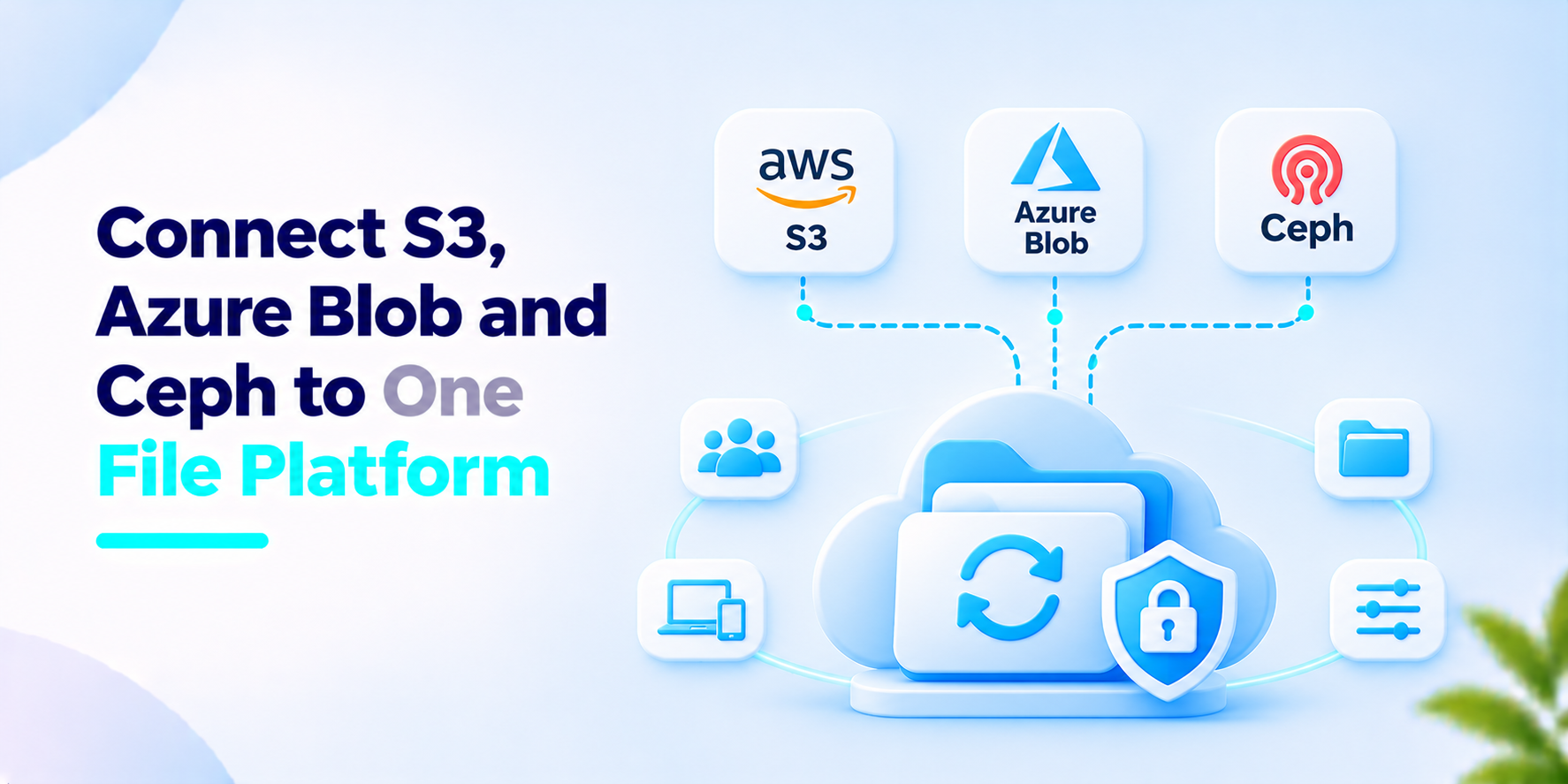
Many companies find they have files in multiple locations. They will have an S3 storage bucket created by a team, Azure Blob storage from another project, and a Ceph cluster within their data centre. Whilst these are all great solutions, nobody knows who owns what. By connecting them together into one file platform, you can give your employees a single working environment whilst giving your IT a central management point. In this post we'll look at what you'll want to consider.
What the India data says
On the 19th August 2026, ThePrint reported a press release from Stornox regarding the launch of a geo-distributed S3 compatible cloud object storage solution for Indian enterprises. It mentions that this could be used for application data and analytics, with increasing concerns around data residency. The article also mentions that the solution has been designed to be compatible with popular S3 based applications.
We should note that this is an advertorial from VMPL. As there are no stats, no information on location of storage, no proof of any data residency, and we are only looking at one vendor's S3 storage solution. However it does show that S3 style storage is being sold to the Indian market.
Choosing one file platform for S3, Azure Blob and Ceph
Object storage is a great way to store your data; however, your employees will not be using buckets. They will require folders, syncing to laptops and shareable links. You may want to use a file platform.
Leave your storage as is. It is slow and risky to move everything somewhere else. By connecting your existing storage, you can get organisation without the need to move data.
Document Ownership. You should document who owns each bucket, container, or pool. What type of data is stored and who should have access. This can cause many issues if nobody owns the storage.
Define roles. If you're using role based access control on the platform, you'll have one rule to manage for all 3 backends.
Confirm Physical Location. If you have a rule or contract that states data must be stored in India, confirm what region each storage is in.
What to ask before you connect S3, Azure Blob and Ceph
- Who owns each bucket/container/Ceph pool?
- Where is personal/regulated data stored?
- What region is each storage in?
- What roles need access to what folders?
- How will desktop users access and we can remove access?
- Are we moving any data?
How We Approach S3, Azure Blob and Ceph in One Platform
Our hybrid cloud storage and file sync platform, iSyncDrive, can connect with S3, Blob and Ceph. It provides AES-256 encryption, role based access (User, Admin, Super Admin) and a centralised dashboard for admins. We'll begin by creating a list of your storage and owners. We'll then discuss what rules you want for your access.
If you're looking to connect S3, Azure Blob and Ceph with one platform, we'd love to chat.
Frequently asked questions
Can Amazon S3, Azure Blob and Ceph be managed through one platform?+
Yes, a compatible file management platform can provide a unified access and administration layer for multiple storage backends. The exact operations supported depend on the platform's integrations.
Do we need to migrate existing files to connect different storage systems?+
Not necessarily. Some platforms can connect to existing storage without requiring a full migration. However, the integration method and supported operations should be checked first.
What is the difference between object storage and file storage?+
Object storage organises data as objects inside buckets or containers, while file storage organises data in folders and directories. A file platform can provide a more familiar file-access experience over supported object storage systems.
Is Ceph compatible with Amazon S3?+
Ceph Object Gateway provides an S3-compatible REST API that supports a large subset of Amazon S3 operations. Compatibility is not necessarily identical across every S3 feature.
Does connecting multiple storage systems automatically ensure data residency compliance?+
No. Organisations must verify the physical storage location, replication, backups, processing locations and applicable contractual or regulatory requirements.
Bring Your Storage Systems Together with iSyncDrive
Connect your existing S3, Azure Blob and Ceph storage through a central file platform. Simplify file access, manage user roles and give your IT team a unified administration experience.