RBAC for File Sharing in India: Least-Privilege Access
Shared folders can retain unnecessary access long after projects end or employees change roles. Learn how RBAC and least-privilege access help Indian businesses organise file permissions, review user access and improve visibility into file activity.
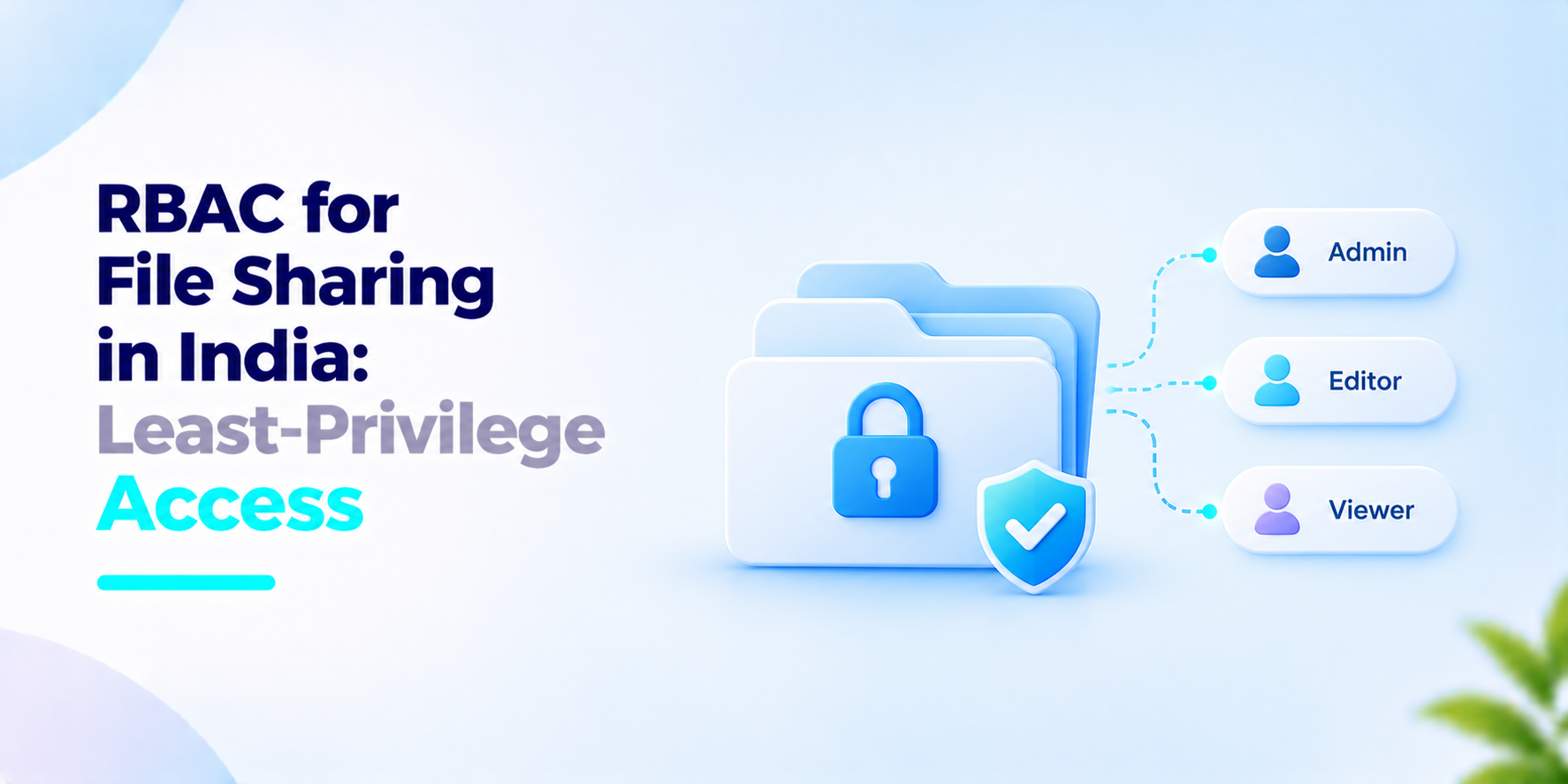
Shared drives grow quietly. A folder opened for one project stays open for years. Nobody can say who still needs it. RBAC for file sharing fixes this by tying access to a role, not to a person so each user sees what the job requires.
What the India rules say
India's Digital Personal Data Protection Rules, 2025 as reproduced on the dpdpa.com rules page for Rule 6, require a data protection program with "reasonable security safeguards”. The listed measures include " measures to control access to the computer resources" used by the fiduciary or its processor and "visibility on the accessing of such personal data through appropriate logs, monitoring and review”. The same rule asks for logs and personal data to be retained for one year unless another law requires otherwise.
Three cautions. The page is a third‑party reproduction, not the Gazette notification. It gives no effective date. Its metadata date (2023) and title (2025) do not match. The rule asks for access control and logs but does not name roles or any specific model so RBAC is one way to meet it, not a stated requirement.
Four role rules for RBAC for file sharing
This section is our view. Good role design is mostly restraint.
Start from job functions. Create roles such as finance reviewer or project contributor. Attach folders to roles. Avoid granting access to named individuals because those grants never expire.
Give the access that works. Most people need to read and upload. Few need to delete or change permissions. Keep those rights with a small admin group.
Separate the administrators. One role should manage users and a different role should manage the platform and its settings. This limits what a single compromised account can change.
Review on a calendar. Every quarter, export who holds which role and ask each folder owner to confirm. Remove anyone who changed teams. Access reviews are dull. They are what stops permission creep.
Log reads as well as edits. If the rule asks for visibility on access, the audit trail needs to show who opened a file, not only who changed it.
What to ask before you set up RBAC for file sharing
Which roles exist today and who approves one?
Can a role be limited to a folder, a team or a data type?
Who can change permissions. Is that action logged?
How is access removed when someone leaves?
Can an auditor see who accessed a file and when?
Does it work across our existing storage or only a new store?
How We Approach RBAC for File Sharing
iSyncDrive is our hybrid cloud storage and file sync platform. It uses three role levels, User, Admin and Super Admin and a centralized admin dashboard where access is managed in one place. We start by mapping your teams and folders to roles, agree who holds the rights and then set up the structure with you before files move.
If your team is planning RBAC for file sharing, we would welcome the conversation.
Frequently asked questions
What is RBAC in file sharing?+
Role-Based Access Control (RBAC) is an access management approach in which permissions are assigned to roles, and users receive access through the roles assigned to them. It helps organisations manage file and folder permissions consistently.
What is the principle of least privilege in file sharing?+
Least privilege means giving users only the access they need to perform their responsibilities. For example, a project contributor may need to view and upload files but not delete folders or change other users' permissions.
Does India's DPDP Act require RBAC?+
No. Rule 6 of the DPDP Rules, 2025 requires appropriate access-control measures and visibility into access to personal data through logs, monitoring and review. It does not explicitly mandate RBAC. Organisations may use RBAC as one way to implement access controls.
How often should file-sharing permissions be reviewed?+
Quarterly reviews are a practical starting point for many organisations, although the frequency should depend on data sensitivity, employee turnover and business risk. Access should also be reviewed when employees change roles or leave the organisation.
What is the difference between RBAC and individual permissions?+
RBAC assigns permissions to defined roles and then assigns users to those roles. Individual permissions grant access directly to specific users or accounts. RBAC can simplify administration, but organisations may still need carefully governed exceptions.
Give Every User the Right Level of File Acces
Organise business files with structured permissions, centralised administration and access controls designed around your teams and workflows.