AES-256 Encryption Explained for Indian Enterprises
AES-256 is a widely used encryption standard, but the algorithm alone does not tell you how securely a product handles business data. Learn what AES-256 protects, why key management and access controls matter, and which questions to ask vendors during an enterprise security review.
Security reviews often end with one line: data is encrypted with AES 256. Few people in the room can say what that covers. This post offers AES 256 encryption explained in terms so that Indian enterprises can use to ask better questions of vendors and of their own teams.
AES 256 Encryption Explained: What the Standard Says
The US National Institute of Standards and Technology (NIST), in November 2001, published Advanced Encryption Standard (AES) as FIPS 197. According to this, AES is a symmetric encryption method that is helpful in encrypting and decrypting any information. It supports 128, 192, and 256 bits key lengths and it can process data in 128 bits blocks. The NIST website has shown that the real data was withdrawn on May 9, 2023 and has been replaced with the new version of FIPS 197.
There are some points to note. NIST is a US organization. According to this, it is not an Indian source and it does not show any Indian legal requirements. All the explanation was based on NIST's catalogue page instead of the full technical standards. The page does not cover the key management and encryption modes. It does not describe the use of AES in the product.
AES 256 Encryption Explained: What It Does and Does Not Cover
This section is our view. Symmetric means one key both locks and unlocks the data. The 256 refers to length. A key makes guessing harder but strength also depends on how the key is made, stored and shared.
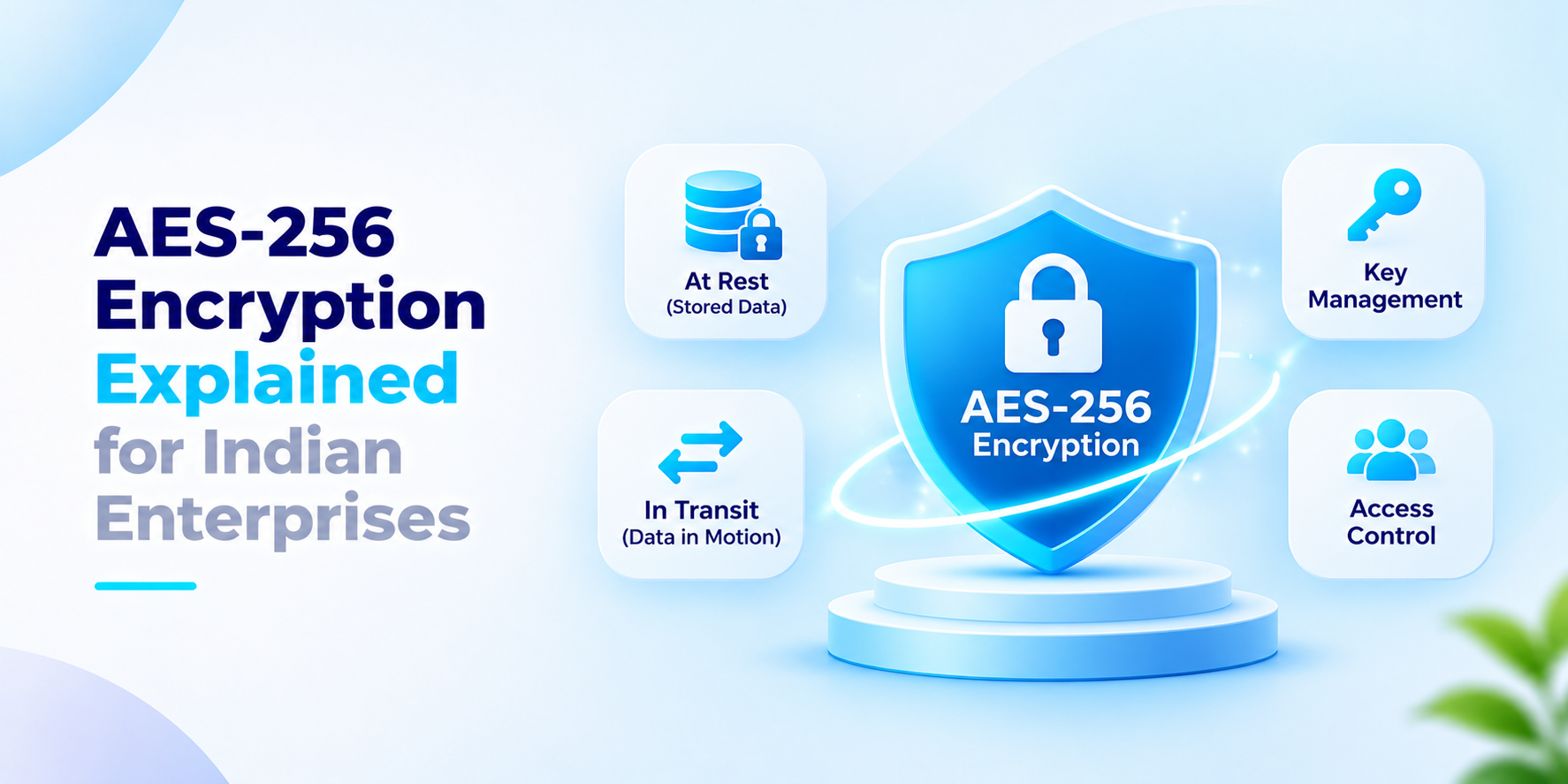
At rest. In transit. Encryption at rest protects files on disks and in storage. Encryption in transit protects them on the network. A product may do one and not the other so ask which.
Key management. If the key sits beside the data or many people can reach it, the cipher adds little. Ask where keys live, who can use them and how they are rotated.
Access control. Encryption does not stop a user with credentials from opening a file. Role based access and logging still matter.
Mode of use. AES is a building block. The mode is a product. How it checks that data was not altered affects the result. A vendor should be able to say which. Any supplier’s AES 256 encryption explanation document should cover all four points above.
What to Ask Before You Accept AES 256 Encryption Claims
- Is data encrypted at rest, in transit or both?
- Where are the keys stored and who can use them?
- How are keys rotated or revoked?
- Which mode of operation does the product use?
- Are encrypted files still exposed to anyone with a role?
- Is access to encrypted data logged?
How We Approach AES 256 Encryption
iSyncDrive, our cloud storage and file sync platform, uses AES 256 encryption alongside role based access at User, Admin and Super Admin levels. It has an admin dashboard and integrates with S3, Blob and Ceph storage. We treat encryption as one control among several. Agree with you on who holds access and how it is governed.
If your team is working through AES 256 encryption explained for a review, we'd welcome the conversation.
Frequently asked questions
What is AES-256 encryption?+
AES-256 is a version of the Advanced Encryption Standard that uses a 256-bit cryptographic key and processes data in 128-bit blocks. It is a symmetric encryption algorithm, meaning the same secret key is used for encryption and decryption.
What does the 256 in AES-256 mean?+
The number 256 refers to the key length in bits, not the size of each data block. AES-128, AES-192 and AES-256 all use 128-bit blocks.
Is AES-256 enough to secure enterprise data?+
AES-256 is a strong encryption algorithm when properly implemented, but it does not guarantee overall product security. Key management, access controls, secure implementation, logging and system configuration also matter.
What is the difference between encryption at rest and in transit?+
Encryption at rest protects stored data, while encryption in transit protects data travelling between systems. Enterprises should verify where each protection applies and how it is implemented.
Why is encryption key management important?+
Encryption depends on protecting the secret key. If an unauthorised person obtains the key, encrypted information may be exposed. Businesses should understand key storage, access permissions, rotation, revocation and recovery procedures.
Look Beyond the Encryption Label
Review how your business files are encrypted, who can access them and how storage permissions are managed. Explore iSyncDrive to understand its encryption and access-control capabilities.