Self‑Service Analytics in India: Data Without Waiting for IT
Self-service analytics in India can help business teams explore trusted data without waiting for every report from IT. Learn why data governance, role-based access, dashboard design and user training are essential for a successful rollout.
A sales manager wants month’s numbers by region. She submits a request and waits a few days. Then receives a spreadsheet that answers last week’s question. Self‑service analytics that Indian teams adopt is designed to fix that wait: business users explore approved data on their own. It no longer becomes the bottleneck for every report.
What the India data says
YourStory reported on an Accenture and Qlik study, "The impact of data literacy." The study surveyed about 9,000 full‑time employees in nine countries; it includes thousands from India. India ranked first for data literacy with 46 percent of employees in reading, questioning and working with data. Yet 85 percent of employees said they felt overwhelmed or unhappy when working with data. The study estimated about 69.5 lost hours per employee each year.
Three cautions. Qlik sells analytics software, so it has a stake in the findings. The answers are. The lost‑time figure is a modelled estimate. The YourStory page shows no date, though its web address points to February 2020. The study measures data confidence, not use of self‑service analytics tools. Read it as a sign that giving people data's not enough on its own.
How self‑service analytics in India can work: our view
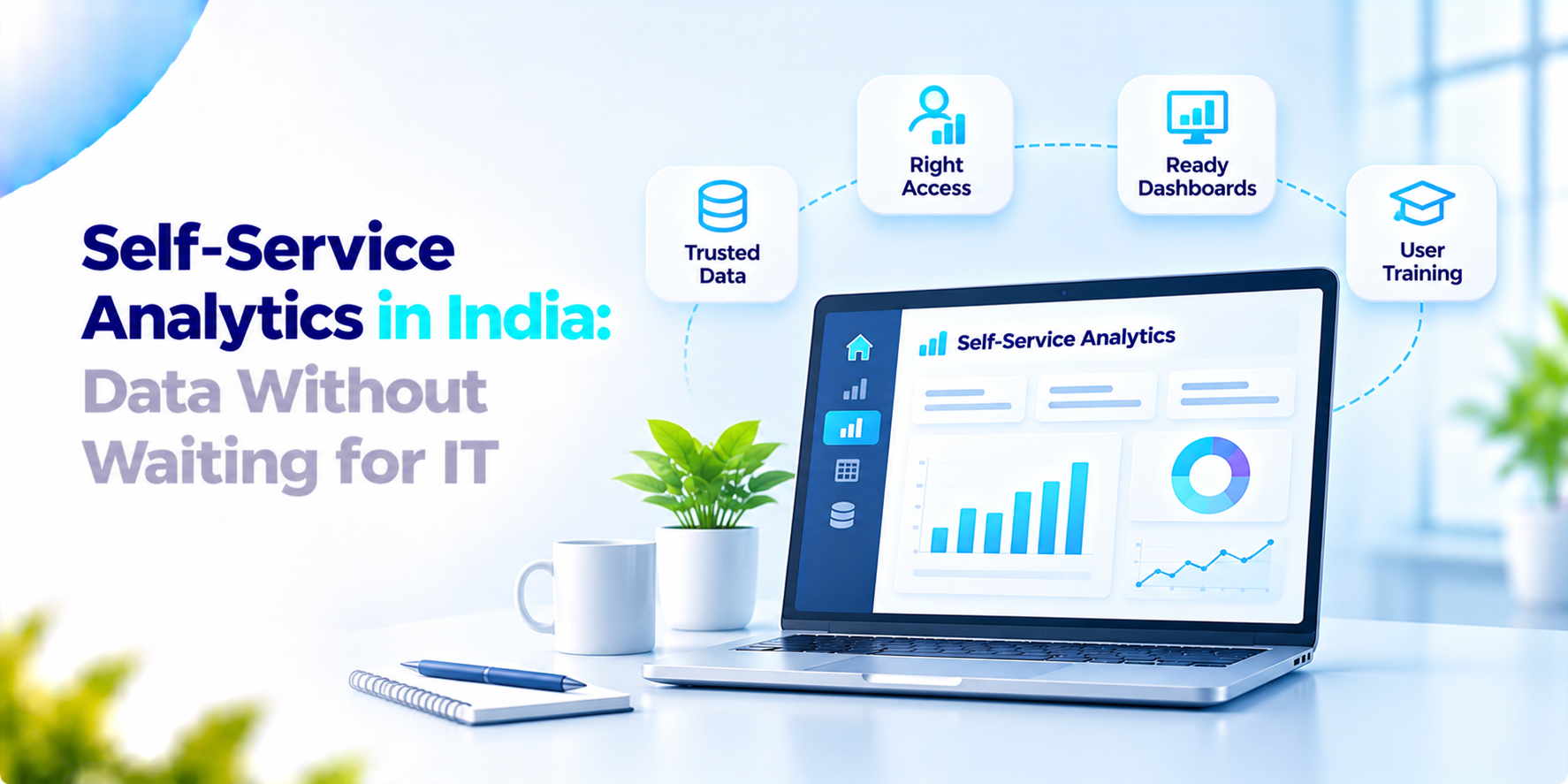
This section is our view. Self‑service analytics does not mean that every user queries everything. Self‑service analytics works when IT builds the foundation and business users work inside self‑service analytics.
Trusted data first. Agree on one definition for each measure, such as "active customer" or "net sales" before anyone builds a dashboard.
Curated access. Give each team the tables they need with permissions that match their role. Sensitive fields stay restricted.
Ready‑made starting points. Give users a few dashboards they can filter, then let them build on those.
Training. The survey result above suggests that tools alone leave people uneasy. Short sessions on reading a chart, spotting an average and asking a good question help.
An owner for each dataset. Someone must fix a number when it looks wrong.
Without these, self‑service becomes a set of conflicting spreadsheets. Two teams show revenue for the same month and trust falls. Start with one department and one decision, such as a sales review and widen only when that works.
What to ask before you roll out self‑service analytics in India
- Which decisions are delayed today by waiting for reports?
- Who owns each key measure?
- Which data must stay restricted? Who should have access?
- Can users trace a figure back to its source?
- What training will business users get?
- How will we know people use it and trust it?
How We Approach Self‑Service Analytics in India
We start from the decisions your business teams make, agree on the data and definitions they need and set permissions before building any dashboards. We then work with one team first so you can judge the result before it spreads.
If your team is planning self‑service analytics, in India we would welcome the conversation.
Frequently asked questions
What is self-service analytics?+
Self-service analytics allows business users to explore approved data, filter reports and answer routine questions without depending on IT for every request. IT and data teams still manage the underlying infrastructure, governance and access controls.
How does self-service analytics help businesses in India?+
It can reduce delays in routine reporting and help teams access relevant information when decisions need to be made. The results depend on data quality, dashboard design, permissions and user adoption.
What is the difference between self-service analytics and traditional BI?+
Traditional BI workflows often rely on specialist teams to prepare reports. Self-service analytics gives authorised business users more freedom to explore curated datasets and answer their own questions. Both approaches can operate within the same BI platform.
Does self-service analytics eliminate the need for IT?+
No. IT and data teams remain important for integrations, data pipelines, access management, security, data quality and platform maintenance.
How can businesses protect sensitive data in self-service analytics?+
They can use role-based permissions, restricted datasets, access reviews and appropriate data governance controls. Users should only see the information they are authorised to access.
Give Your Teams Faster Access to Trusted Data
Empower business users to explore approved data, monitor key metrics and make informed decisions through governed dashboards and self-service analytics. Discuss how we can help you plan a practical rollout.