Ansible vs Puppet vs Chef - Configuration Management in India
Choosing between Ansible, Puppet and Chef involves more than comparing features. Understand their agent requirements, configuration models, execution approaches and language requirements to identify the right configuration management tool for your infrastructure team.
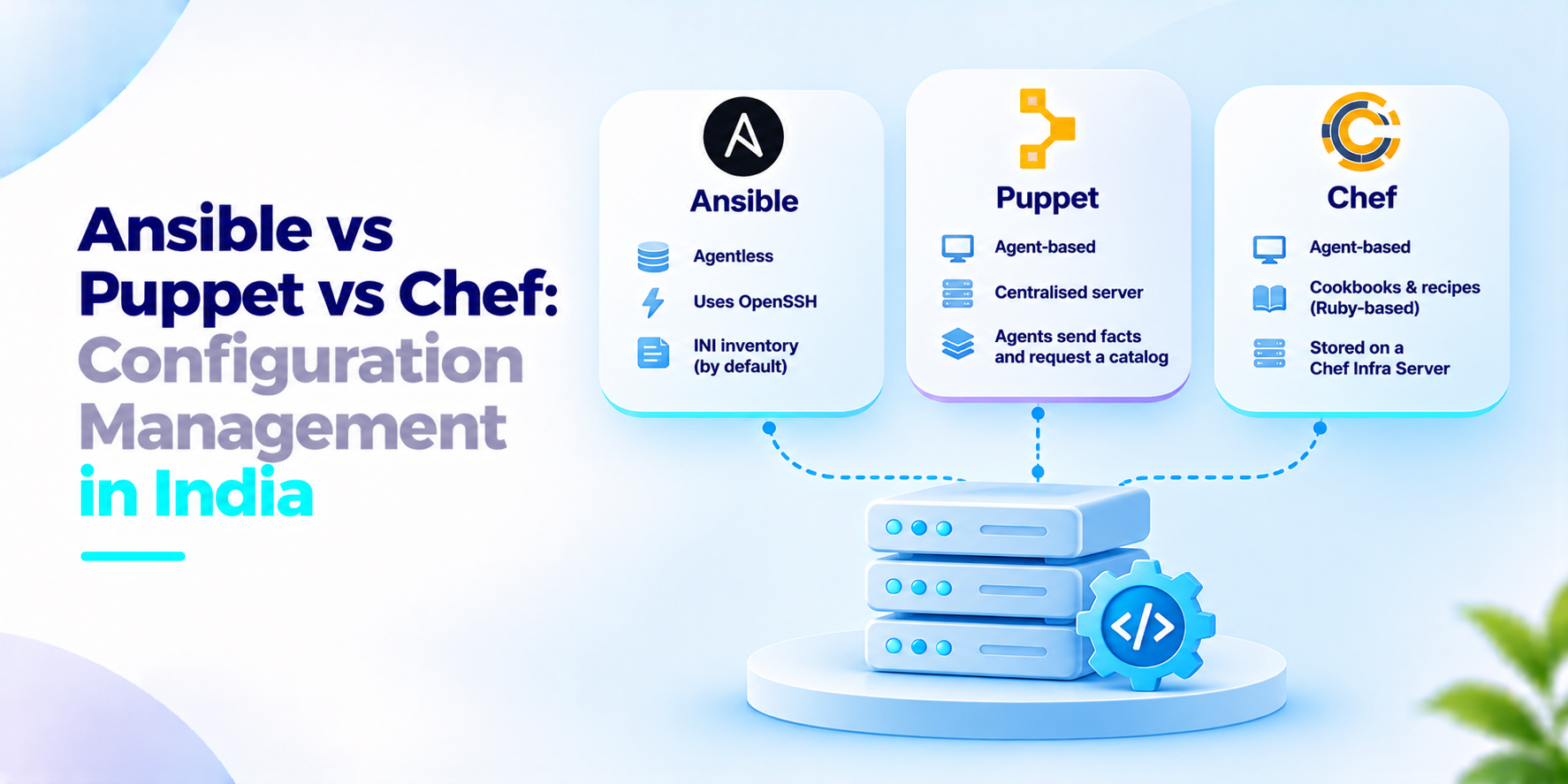
Configuration management tools ensure that the servers are in the desired state. However, when looking into configuration management tools, teams in India and elsewhere will encounter the three tools. This note will quickly show you how each tool works to determine what is required from your team.
What the vendor documentation says
Ansible. How Ansible works (published 18th May 2023). The documentation from Red Hat states that ‘Ansible is agentless and uses OpenSSH. It is controlled from a control node, and no applications or services are required to be installed on the managed node. By default machines are stored in an INI inventory.’
Puppet. Puppet Core 9.1.0 (published 27th October 2026). ‘A centralised server that manages configurations for a group of managed agent nodes. The agent will send facts to the server and request a catalog.’
Chef. Chef Infra Client 19. The documentation states that ‘An agent is installed on every managed node. Cookbooks and recipes are written using a Ruby-based language. These are stored on a Chef Infra Server.’
Note: All three documents are from the vendor and therefore are biased. None of them provide any information regarding their adoption in India. They also don’t mention any other methods that can be used for each tool.
Ansible vs Puppet vs Chef: how to choose
In reality, the key differences are minimal.
Agent-based: Ansible doesn’t require any agents on the target, making the initial implementation easier. Puppet and Chef require an agent to be installed on every node. This means there is a central server but it can be good if you have a large and long lasting fleet of nodes that self check-in.
Language. Chef requires your team to understand a Ruby-based language. Ansible states that their playbooks are ‘easy to get started with’. Decide which one your team will actually be managing.
Knowledge. Usually if your team knows how to use a tool then this will win out. You will have to invest in retraining and this will slow down your first quarter.
Don’t go for features. Try doing a small task using the tool you’re considering. For example harden one server image and see how long it takes to review and roll back.
What to ask before you settle Ansible vs. Puppet vs Chef
- How are we currently managing our servers? How many will we have in 2 years?
- Can we install an agent on all our targets? Even locked down ones?
- What language does our team know?
- Do we need drift fixing or ad-hoc runs?
- How will we review/test/roll back changes?
- Who will manage the code if the original author leaves?
How We Approach Ansible vs Puppet vs Chef
We provide configuration management as one of the 6 areas within our DevOps service. We provide Ansible, Puppet and Chef. We will look at the environments you’re running and the knowledge your team has and decide on which tool to use and how we will review changes.
If your team is considering Ansible vs Puppet vs Chef, we’d love to have a chat.
Frequently asked questions
What is configuration management?+
Configuration management is the practice of defining, applying and maintaining the desired configuration of servers, applications and infrastructure. It helps teams keep systems consistent across environments.
What is the main difference between Ansible, Puppet and Chef?+
Ansible is agentless by default and generally executes tasks remotely from a control node. Puppet uses an agent-server architecture in which agents request and apply configuration catalogs. Chef uses Chef Infra Client on managed nodes to apply cookbooks and recipes.
Is Ansible better than Puppet and Chef?+
Not universally. Ansible can be attractive when teams want agentless automation and straightforward remote execution. Puppet can suit environments that need ongoing desired-state enforcement. Chef can suit teams that prefer programmable infrastructure configuration using Ruby-based recipes.
Does Ansible require an agent?+
Ansible does not require its own agent on managed nodes. However, managed nodes generally need a supported connection method and Python for many modules, depending on the platform and task.
Do Puppet and Chef require agents?+
Both use software installed on managed nodes. Puppet uses Puppet Agent, while Chef uses Chef Infra Client to retrieve and apply configuration.
Choose the Right Configuration Management Approach
Assess your infrastructure, automation requirements and team's capabilities before choosing Ansible, Puppet or Chef. Our DevOps team can help plan and implement a maintainable configuration management approach.