Multi-Language Voice Ordering in India: How Restaurants Are Automating Orders Across Regional Accents
Discover how AI voice ordering can help Indian restaurants handle regional accents, mixed-language instructions and menu-specific vocabulary while integrating with existing POS systems.
 By Ankit Rawat·Published: October 9, 2026 at 11:53 PM IST
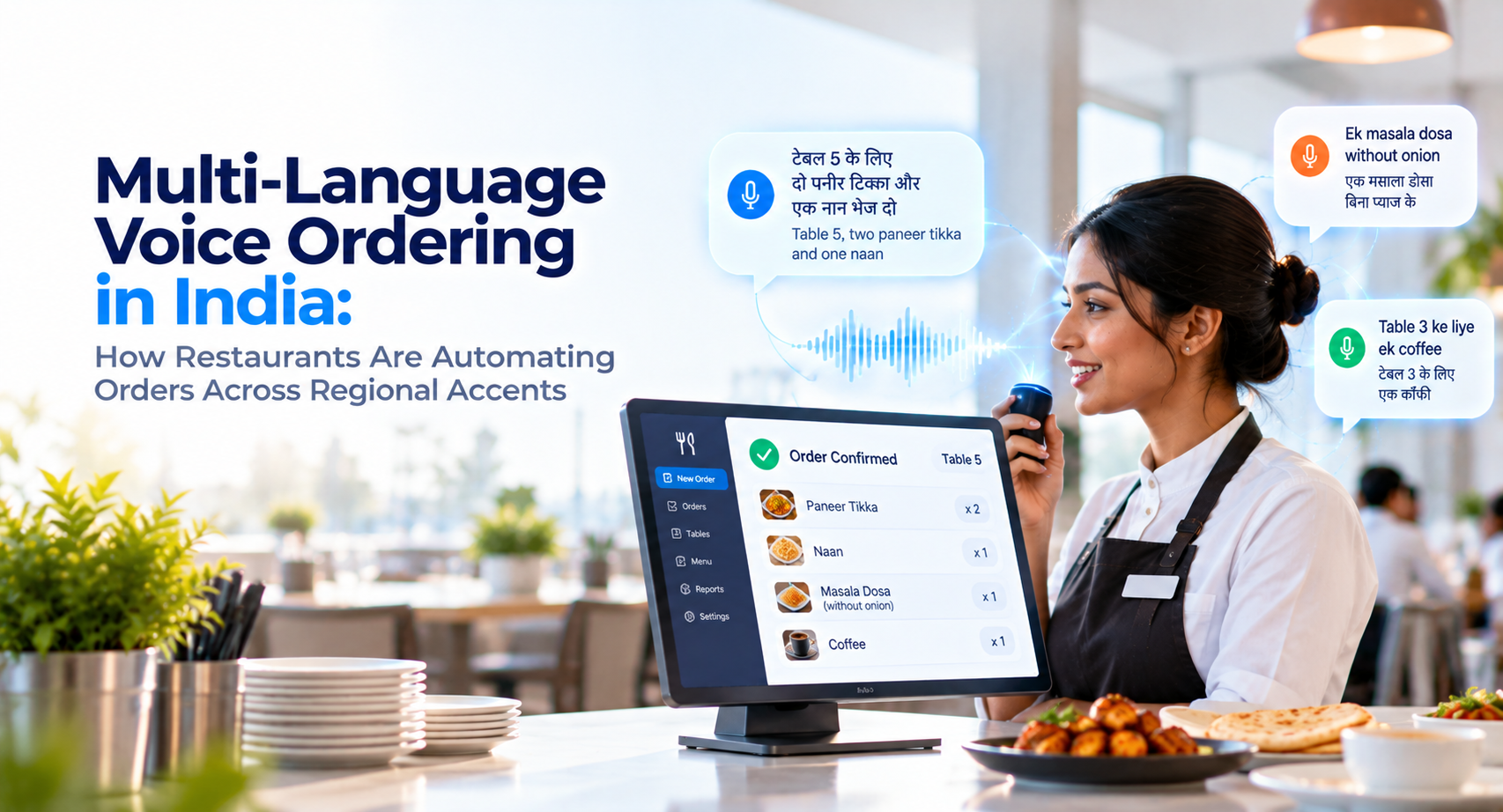
In India, customers in restaurants may use different languages in the same order. A customer can use multiple languages, such as speaking in Hindi, ordering a dish name in English, and adding some instructions in another language. This is why multi-language voice ordering can be challenging for restaurants. Let’s look at the language problems, what businesses should check before choosing a system, and how voice technology can help.
The food services market is growing, and ordering is going digital
As per the Redseer Consulting report, which is summarized by IBEF, in FY26, India’s food services market is approx. US$90 billion, and this is expected to reach in FY31 to US$150 billion. The online food service share is expected to grow in FY26 to 11% and in FY31 to 18%. In metro cities, the online food delivery transactions also grew from about 30 crores in FY21 to about 106 crores in FY26. As a lot of orders come from multiple channels, makes it hard to enter orders fast and correctly for the restaurant staff.
Why language is the hard part in India
India is a country of languages, and it has 22 official languages and hundreds of dialects, according to Professor Pushpak Bhattacharyya of IIT Mumbai, as reported in a BBC report and summarised by Multilingual magazine. It is hard to build AI for these languages; many of them don’t have high-quality digital data. So, a lot of data is available in Hindi and English. But there is some government support, like Bhashini; it supports 22 languages and helps reduce this gap. One of the reasons is the lack of data; this is why general speech tools can struggle with different people, different accents, and real situations.
What makes restaurant order-taking different for multi-language voice ordering
This is our analysis, not the findings from the reports we have talked about above. In hotels and restaurants, staff usually take orders by phone, at tables, or at the counter and then enter that information into the POS terminal. It is time-consuming and can create mistakes. Restaurant orders are generally limited to words such as table numbers, menu items, modifiers, and quantities. Staff can also make mistakes due to mixed languages and accents, with their own kitchen shorthand. A normal speech system can also have confusion in understanding the dish name. A system trained specifically on hospitality vocabulary has a smaller and more focused problem to solve. Speed also matters; if the system responds slowly, staff would lose trust and can start their work manually.
What to ask before adopting multi-language voice ordering
Before choosing any voice ordering system, ask these questions:
- Which languages and accents has the multi-language voice ordering system been tested with?
- Can it understand staff who mix languages in the same sentence?
- How quickly does it respond?
- Does it replace your point-of-sale system, or does it work on top of it?
- How much manual re-entry will still be needed?
- How is an order confirmed before it goes to the kitchen?
- Can staff change or cancel an order?
- Is every voice instruction logged?
- Where does the voice processing happen?
The last question is very important because a property with poor or unreliable connectivity may need a different setup from one with a reliable connection.
How Eice Voice supports multi-language voice ordering
Eice Voice is EICE Technology’s staff-facing AI voice layer for hospitality operations. It doesn’t replace your existing POS; it works on top of it. It connects with EICE Rise and third-party system APIs.
Its custom natural language engine is trained on hospitality vocabulary. It can understand table numbers, menu items, modifiers, and quantities in natural speech. It has speech-to-text latency of under 300 milliseconds and supports multiple languages and regional accents. Staff can modify, cancel, and repeat orders just with their voice. Before submitting an order, this is confirmed through read-back or an on-screen display. All the voice instructions are recorded in an audit trail. A central dashboard tracks:
- Voice order volumes
- Peak hours
- Error rates
- Staff usage
The system can be deployed on-premises, in the cloud, or in a hybrid setup. This is built for restaurants, hotels, and cloud kitchens, including multi-property groups. If your team is considering multi-language voice ordering for restaurants, we’d welcome the conversation.
Frequently asked questions
Q . What is multi-language voice ordering?+
A. Multi-language voice ordering uses voice recognition and language-processing technology to capture orders spoken in different languages, subject to the system's supported languages and configurations.
Q. Why is multilingual voice ordering challenging in India?+
A. Customers and staff may mix languages, regional accents, menu names, and local expressions in the same sentence. The system needs to recognise these variations accurately in real restaurant conditions.
Q. Can AI voice ordering integrate with an existing restaurant POS?+
A. Yes, if the solution supports the POS platform's APIs or other integration methods. Integration requirements should be assessed before implementation.
Q. Can restaurant staff modify or cancel voice orders?+
A. This depends on the product. EICE Voice supports voice-based order modification, cancellation, and repetition according to the supplied product description.
Q. How can restaurants reduce errors in AI voice ordering?+
A. Useful controls include testing across relevant accents, confirming orders before submission, allowing staff to correct mistakes, and monitoring error rates after deployment.
Q. Does AI voice ordering replace restaurant staff?+
A. Not necessarily. It can assist staff with order capture and repetitive tasks while employees retain control over confirmation, exceptions, and service decisions.
Q. What is EICE Voice?+
A. EICE Voice is EICE Technology's staff-facing AI voice layer for hospitality operations. It integrates with EICE Rise and third-party system APIs to support voice-driven ordering workflows.
Make Restaurant Order-Taking Faster with AI Voice
Help staff capture, confirm, and manage orders using hospitality-focused voice technology that works with your existing POS.
Related in Hospitality Technology

Multi-Property Hotel ERP in India: What GST-Compliant Billing Across Locations Actually Requires
Learn what multi-property hotel groups in India need from an ERP to manage GST billing, property operations, bookings, POS, inventory and centralized financial reporting.