Agentless IT Infrastructure Monitoring in India: Why Enterprises Are Moving Away from Agent-Based Tools
Learn how agentless IT infrastructure monitoring can reduce monitoring overhead while providing visibility across servers, networks, industrial equipment and heterogeneous enterprise environments.
 By Ankit Rawat·Published: October 8, 2026 at 7:30 PM IST
Downtime is expensive, and most firms cannot say by how much
ITIC's 2024 Hourly Cost of Downtime Survey surveyed more than 1,000 firms in the world between November 2023 and March 2024. According to the survey, for 90% of mid-sized and large enterprises, the cost of one hour of downtime is more than $300,000, and 41% of enterprises said that the cost was between $1 million and more than $5 million. These are not just Indian numbers; these are global numbers, and this shows how much downtime can cost. As per the same survey report, only 22% of the organisations can calculate their own hourly downtime accurately. According to this, a lot of teams are spending less on monitoring without knowing the real cost of the downtime.
What an agent-based approach asks of your team
The following are our analysis, not the findings of the report. Agent-based monitoring installs a small program, called an agent, on every server and device that you want to monitor. It provides full, detailed information about every host and it requires an agent to be installed, upgraded, and patched on every machine. By adding a piece of software to secure wherever the agent cannot run, they also have a coverage gap. A typical Indian enterprise can have head offices, branch sites, plants, and data centres. A lot of devices cannot run an agent in these environments. These include network switches, UPS units, out-of-band management controllers, and industrial equipment.
How agentless monitoring works
This agentless monitoring collects data from the outside, and it uses the protocols the device is already supporting. This includes SNMP for network equipment, SSH for Linux hosts, and WMI for Windows. There is nothing that has to be installed in the monitoring system. This means there is less software that has to be maintained, and it will deploy fast. The trade-off is that you can only see the information that the protocol makes available. So, the main question is how many protocols the platform supports and how well it uses them.
What to look for in a platform
You can ask four questions that can help you tell a useful monitoring program from a noisy program.
- How many protocols and device types can it monitor without agents?
- Can it discover devices automatically, so the inventory stays up to date?
- Can it learn what normal looks like, so alerts show real anomalies instead of only fixed thresholds?
- Can alerts escalate through different steps and channels, so the right person is reached?
Access control becomes important as the monitoring platform is able to see your full IT environment.
How EICE Technology supports agentless monitoring in India
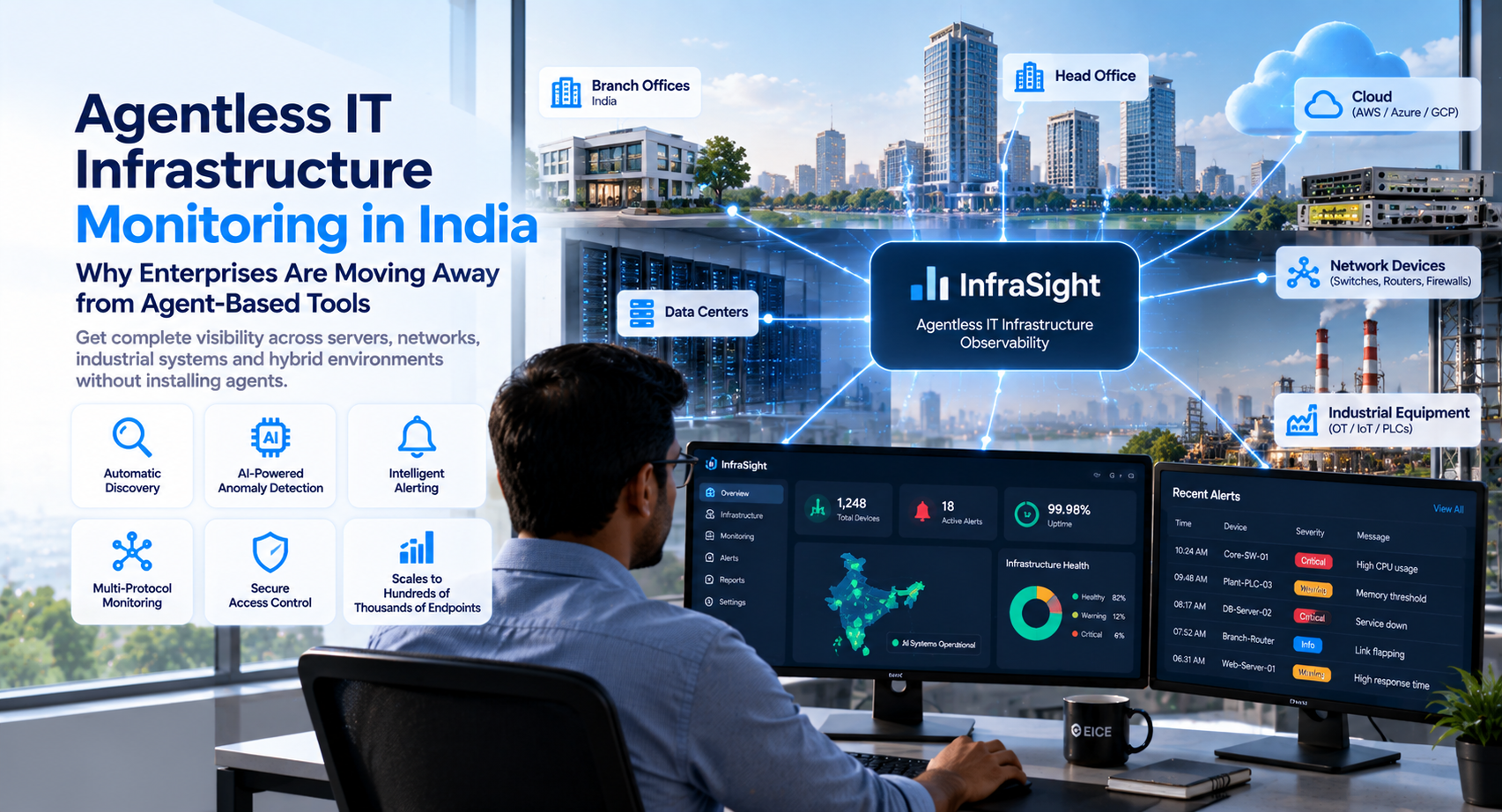
InfraSight is our agentless IT infrastructure observability platform. This collects data from SNMP, IPMI, JMX, SSH, HTTP and HTTPS, ICMP, WMI, Prometheus, MQTT, and Modbus. This can help discover devices automatically and uses AI-based anomaly detection and baselining. The alerts can work with multiple steps using email, Slack, Teams, Telegram, PagerDuty, and webhooks. Access is controlled through LDAP, SAML, single sign-on, multi-factor authentication, and role-based access. This platform can scale to hundreds of thousands of endpoints. If your team is comparing agent-based and agentless monitoring, we'd welcome the conversation.
Frequently asked questions
Q. What is agentless IT infrastructure monitoring?+
A. Agentless monitoring collects infrastructure data through protocols already supported by devices and systems, rather than installing a dedicated monitoring agent on every device.
Q. What is the difference between agent-based and agentless monitoring?+
A. Agent-based monitoring requires software agents to be installed and maintained on monitored systems. Agentless monitoring collects information remotely using supported protocols such as SNMP, SSH and WMI.
Q. Is agentless monitoring better than agent-based monitoring?+
A. Neither approach is universally better. Agentless monitoring can reduce deployment and maintenance overhead and work well across heterogeneous infrastructure, while agent-based monitoring can provide deeper visibility into systems where an agent can be installed.
Q. Which protocols are commonly used for agentless monitoring?+
A. Common protocols include SNMP, SSH, WMI, ICMP and IPMI. Depending on the monitoring platform, additional protocols such as JMX, Prometheus, MQTT and Modbus may also be supported.
Q. Can AI be used for IT infrastructure monitoring?+
A. Yes. AI-based anomaly detection and behavioural baselining can help monitoring platforms identify deviations from normal infrastructure behaviour rather than relying only on predefined thresholds.
Q. What is InfraSight?+
A. InfraSight is our agentless IT infrastructure observability platform supporting multiple monitoring protocols, automatic discovery, AI-based anomaly detection, multi-step alerting and enterprise access controls.
Get Complete Visibility Across Your IT Infrastructure
Monitor servers, networks, industrial systems, and hybrid environments with agentless discovery, AI-powered anomaly detection, and intelligent alerting through InfraSight.