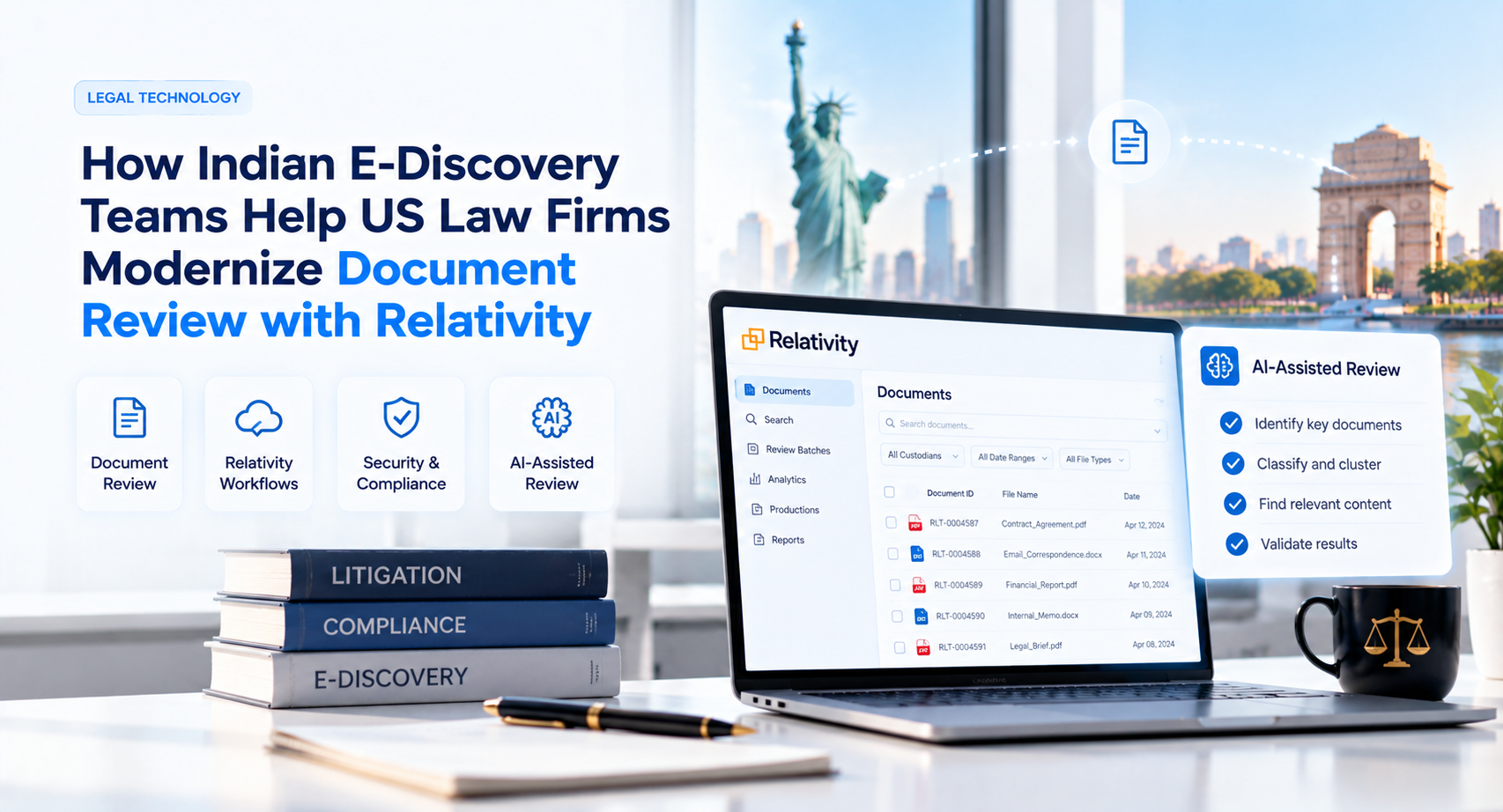
How Indian E-Discovery Teams Help US Law Firms Modernize Document Review with Relativity
Explore how Indian e-discovery teams can support US law firms with Relativity workflows, document-review QA, AI-assisted review validation and litigation-support capacity.
 By Ankit Rawat·Published: September 30, 2026 at 6:35 PM IST
E-discovery has become a genuinely large, fast-growing market
The global eDiscovery market is a big part of law firms’ technology spending now. Fortune Business Insights has reported that the market was $18.73 billion in 2025. It is expected to grow to $20.74 billion in 2026 and $46.06 billion by 2034. The market is growing at a 10.49% CAGR over the decade. The biggest regional share of the market is North America, with 39.41% and $7.38 billion in 2025. In the US, it's expected to reach almost $ 5.68 billion in 2026. 69.93% of the market share is held by large enterprises; it includes most of the US law firms and corporate clients. Cloud-based e-discovery is also becoming very common and is expected to reach 76.65% of the market in 2026. This shows that e-discovery work is happening on cloud platforms such as Relativity, instead of servers managed by a firm's own IT team.
Why the cost of getting this wrong is a real, quantified number
The move to cloud-based review platforms is not just about convenience. Security and compliance are also important. The same report cites IBM's finding that the average cost of a data breach is $4.45 million. It is important for e-discovery because the documents can have sensitive, privileged, and confidential information. Generative AI is also being added to e-discovery platforms. The report shows that Lexbe's January 2024 CoPilot launch was built on Claude and ChatGPT to help with document analysis and review. Because of this, e-discovery teams now have to understand traditional review methods and AI. They have to understand how to set up and go through AI-assisted review, with keyword searches and technology-assisted review (TAR) workflows.
What this actually requires from the team running the review
E-discovery is growing very fast, security is important, and because of AI, the document review methods are changing. A team that is working on many documents has to understand how to set up Relativity; it includes:
- Workspace structure
- Search terms
- TAR protocols
- Production formats
It is also very important for the team to make sure that the generative AI is making the review accurate without creating any new risks. All of this work should be done carefully, as the the documents involved in litigation are sensitive. This kind of work requires legal-technology skills and quality-assurance skills; this is very different from normal software development, and it is not sure that some in-house litigation teams have enough time to work on that while maintaining all of these skills.
Why more US law firms are bringing in outside e-discovery capacity
The AI-assisted tools and Relativity are changing very fast. This is the reason that many of the US law firms may use outside e-discovery specialists to support their internal litigation teams. Those specialists can help with review scaling and platform configuration; because of this, the internal team does not have to keep up with every Relativity update and every new AI-assisted tool review feature on its own. The reason is not just the cost; this is about the technology changing fast.
How EICE Technology supports US law firms on e-discovery workflows
As an Indian IT company, we work with US law firms and their litigation support teams to configure, scale, and validate Relativity-based document review workflows. It includes quality-assurance testing of AI-assisted review outputs before they are being used in live. We follow a structured process that is shaped by ISO 27001 and ISO/IEC 20000 certifications, along with CMMI Level 3 and ISO 9001. See more on our services page.
Frequently asked questions
Q. What is e-discovery?+
A. E-discovery is the process of identifying, processing, reviewing and producing electronically stored information for legal proceedings.
Q. Why do US law firms use Relativity for e-discovery?+
A. Relativity provides a platform for managing and reviewing electronically stored information and supporting e-discovery workflows.
Q. Can Indian teams support US law firms with e-discovery?+
A. Yes. External teams can provide additional capacity for activities such as Relativity workflow support, document-review QA and validation, depending on the engagement requirements.
Q. How is AI being used in e-discovery?+
A. AI-assisted tools can support activities such as document analysis and review. Teams still need appropriate validation and QA processes before relying on AI-assisted outputs in live workflows.
Q.What is TAR in e-discovery?+
A. TAR, or Technology-Assisted Review, uses technology to assist with the review and classification of documents during an e-discovery process.
Q. What should a law firm check before outsourcing e-discovery work?+
A. Law firms should evaluate relevant e-discovery experience, Relativity capabilities, QA processes, security practices, data handling, scalability and independently verifiable certifications.
Q. Does EICE Technology provide e-discovery support?+
A. We support US law firms and litigation-support teams with Relativity-based workflows, configuration support and quality-assurance validation of document-review processes.
Strengthen Your E-Discovery Workflow
Get additional support for Relativity workflows, document-review QA, and AI-assisted review validation.