How Indian QA Teams Help US Law Firms De-Risk Large-Scale Enterprise Intranet Modernisation
See how a risk-based, shift-left QA approach helped a US law firm's large-scale SharePoint intranet modernisation identify defects early, test dependencies in parallel and manage delivery risk.
 By Ankit Rawat·Published: September 8, 2026 at 6:07 PM IST
The real cost of testing bottlenecks in large-scale intranet programs
Large enterprise intranet Modernization does not fail because of a bug; they fail because of the number of connected modules being built, configured, and deployed at the same time. Sometimes deployment can be moved forward before unit testing is completed. Undocumented configuration steps, unclear or poorly communicated timelines, incomplete requirements in the work-tracking tool and testing bottlenecks can become a common problem instead of an exception.
What risk-based, shift-left QA actually looks like in practice
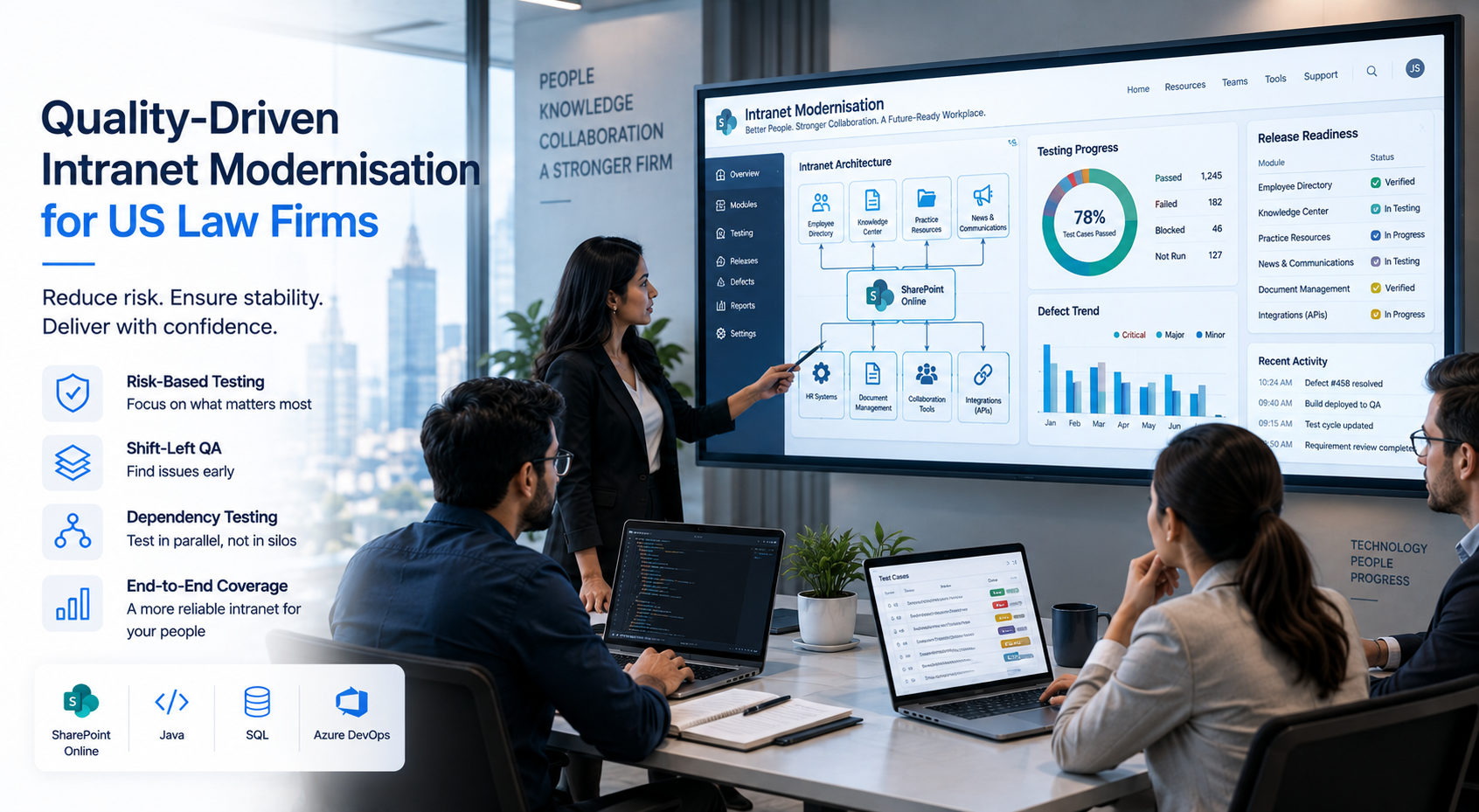
In a recent engagement, a US law firm was modernizing its internal employee intranet on SharePoint Online. Instead of testing each module separately when it became available, the team used a structured QA approach. The team has created a feature dependency matrix and used incremental testing; this helps ensure that available components are tested instead of waiting for complete module delivery. The project milestones are tracked through Azure DevOps dashboards, with a regular communication channel for sharing scheduled changes.
QA was also involved in the development process; the team has participated in:
- Requirement refinement sessions
- Sprint planning
- Release discussions
- Requirement walkthroughs before development began
This helps in finding requirement gaps before letting those turn into defects.
Testing was prioritized using a risk-based framework that considered:
- Business impact
- User impact
- Revenue impact
- Security impact
When the dependent module was still not available, the teams used mocks and stubs to enable parallel testing instead of waiting for the dependency to be completed.
What results this kind of QA discipline actually delivers
As a result of the engagement, 1000+ defects were identified and tracked across the program; the QA team has scaled to 20+ members to support the project. For critical bugs, the team does not treat each defect separately; it performs root cause analysis. The team also performs end-to-end testing across all major modules with a structured gap analysis by comparing its requirements, testing coverage and deployed functionality. The project began in January 2025, with Phase 1 wrapping up roughly thirteen months later in February 2026; Phase 2 launched that same month and is still underway, using the same QA framework.
How EICE Technology brings risk-based, shift-left QA to enterprise programs
As an Indian IT company, we led this QA effort with a senior QA engineer managing a team that scaled to 20+ members. They worked across SharePoint, Java, SQL and Azure DevOps. Our delivery approach is shaped by CMMI Level 3, a maturity model focused on structured processes and quality engineering, with ISO 27001, ISO/IEC 20000, and ISO 9001 certifications. The same focus is on structured quality practices that are used in this engagement, such as dependency mapping, risk-based testing and root cause analysis; it's all part of how we approach quality across programs. See our Services Page.
Frequently asked questions
Q. What is shift-left QA in enterprise software development?+
A. Shift-left QA involves bringing quality activities earlier into the development lifecycle, including requirements refinement, sprint planning and requirement walkthroughs, so potential gaps can be identified before they become development defects.
Q. What is risk-based testing for enterprise applications?+
A. Risk-based testing prioritises testing based on factors such as business impact, user impact, revenue impact and security impact rather than treating every component with the same testing priority.
Q. How can QA teams test when dependent modules are not ready?+
A. Teams can use approaches such as mocks and stubs to simulate unavailable dependencies, allowing testing to continue without waiting for every related module to be completed.
Q. What results did EICE Technology achieve in this QA engagement?+
A. 1,000+ defects were identified and tracked, while the QA team scaled to more than 20 members. The engagement also used root cause analysis, end-to-end testing and structured gap analysis across requirements, test coverage and deployed functionality.
Managing a Large-Scale Software Modernisation Program?
Explore how EICE Technology can provide structured QA leadership, risk-based testing and enterprise quality engineering for complex technology programs.