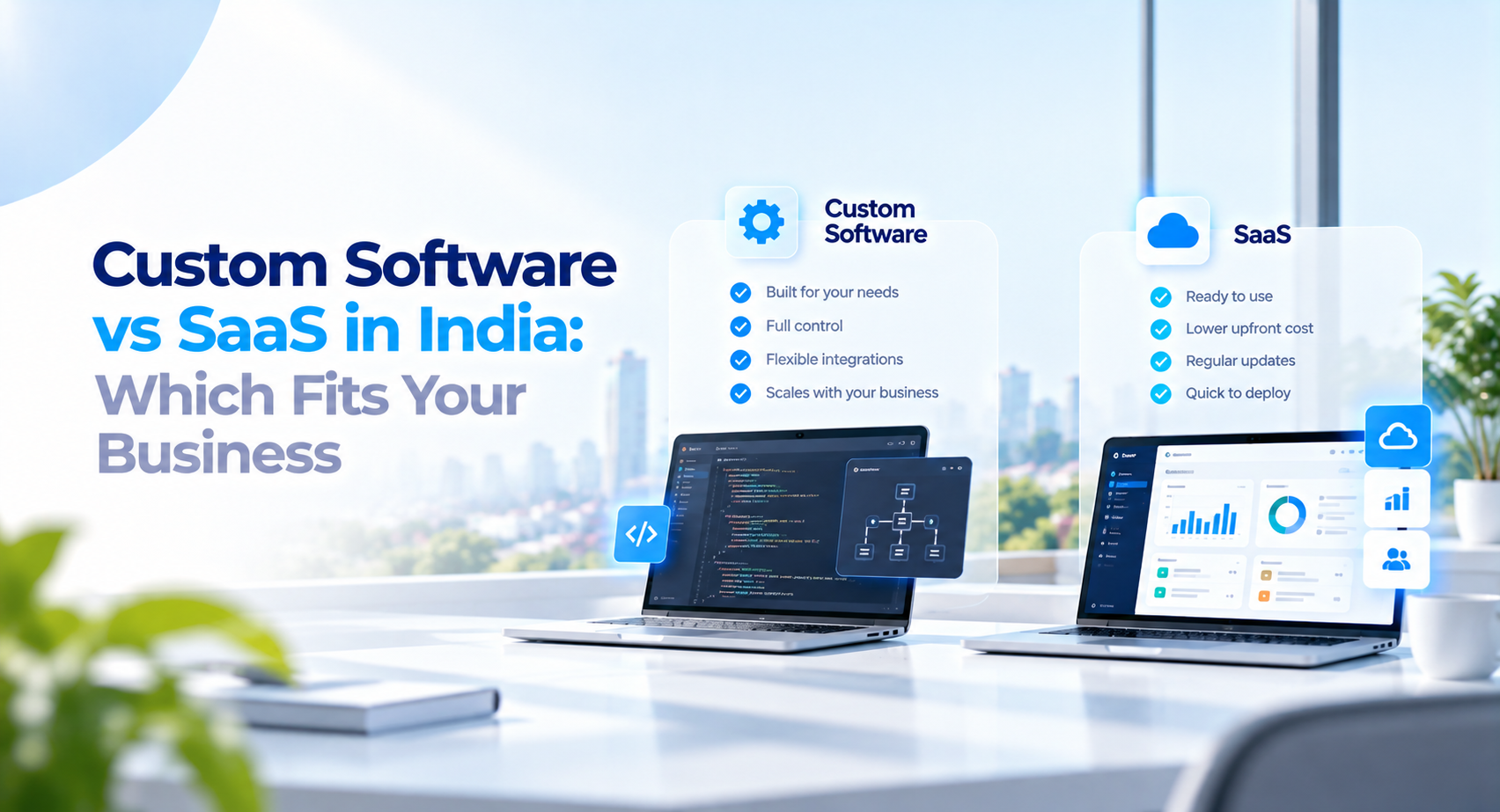
Custom Software vs SaaS in India: Which Fits Your Business
Should your business buy ready-made SaaS or invest in custom software? Compare flexibility, long-term costs, data ownership, integration, and maintenance to determine which approach fits your business needs.
 By Ankit Rawat·Published: October 17, 2026 at 1:37 AM IST
Spreadsheets are not enough to handle daily work as the business grows. At this moment, you have two choices: buy ready-made software or build software for your own needs. It totally depends on your business, choices, and plans to choose between custom software and SaaS in India.
Let's have a look at the latest data and how to choose the right option.
What the Data Says About SaaS and Building
According to a Gartner press release dated 1 June 2026, in 2026, spending on public cloud services in India was expected to reach USD 17.5 billion, growing by 28.1%. Spending on SaaS was expected to reach USD 4.64 billion, growing by 18.9%. Cloud infrastructure spending was expected to grow by 40%, while cloud platform spending was expected to grow by 25.4%.
Gartner linked the slower growth in SaaS spending to companies managing their software licenses more carefully and spending more on cloud infrastructure and platforms. The report, Retool 2026, based on 817 of its customers and builders, found:
- 35% had replaced at least one SaaS tool with custom software.
- 78% expected to build more internal tools in 2026.
There are some points to remember. Gartner’s figures do not show which is the best choice for a business; they show spending trends. Retool helps in providing tools for building internal software, and the survey includes its own customers. The report also has nothing to say about whether the Indian businesses were included or not.
Custom Software vs SaaS in India: How to Decide
This is our view: there are four questions that can help you to choose.
1. Is the work common or special?
For common tasks like payroll, email, and accounting, ready-made software is a practical choice. If your business has a special process that makes you different from others, custom software would be a better choice.
2. Does the software need to match your business?
Ready-made software may not support every feature you need. Custom software is able to be built according to your specific requirements.
3. What will it cost over time?
When your team is small, SaaS can be affordable, but it can increase in cost as more people join. Custom software usually needs more work at the start of the project, with ongoing maintenance. Compare the total cost over three years instead of just looking at the starting price.
4. Who controls your data?
Check whether you can download your data and move it to another system. Also, understand what happens if the software provider changes its prices or terms.
A lot of businesses use both, like buying ready-made software for doing common tasks and, for special requirements, building custom software. To get started, note 5 software tools your team uses most. Then check which handles common tasks and which handles your unique business process. This is helpful in deciding where to buy and where to build.
What to Ask Before Choosing Custom Software or SaaS
Ask these questions before making a decision. This will help you understand the cost and responsibility of both options.
- What will each option cost over three years, including maintenance and staff?
- Can ready-made software meet all our needs?
- Can we download our data whenever we need it?
- Who will own the source code of custom software?
- Can the software connect with our existing systems?
- Who will maintain the software after launch?
How We Approach Custom Software vs SaaS in India
At EICE, we offer both custom software development and ready-made software products. Our development services include SaaS platforms, web applications, and custom business software. We build Saas products with features such as subscription billing, usage tracking, and support for multiple customers on a single platform.
We follow a process that includes planning, design, development, and launch. We work in two-week development cycles and use AWS, Azure, or GCP. We also follow OWASP security practices from the start. At the point where the contract terms are met, the source code and intellectual property are transferred to the client. If you're comparing custom software and SaaS in India, we’d be happy to discuss your requirements and help you find the right approach. See more on our Services page.
Frequently asked questions
Q1. What is the difference between custom software and SaaS?+
Custom software is developed around a business's specific requirements. SaaS is software delivered as a service, typically through a subscription. Custom software offers greater control over functionality, while SaaS can provide ready-to-use features without building the entire solution from scratch.
Q2. Is SaaS cheaper than custom software?+
SaaS can be less expensive to start with because the provider maintains the application. Custom software may require greater upfront investment and ongoing maintenance. Compare licensing, implementation, integrations, support, and maintenance costs over a three-year period.
Q3. When should a business choose custom software development?+
Custom software may be appropriate when a business relies on specialized workflows, needs integrations that existing products cannot adequately support, or requires capabilities that differentiate its operations.
Q4. Can a business use both SaaS and custom software?+
Yes. A business can use SaaS for common functions such as accounting and email while developing custom applications for specialized workflows. This approach can balance implementation speed with flexibility.
Q5. Who owns the source code in custom software development?+
Ownership depends on the development contract and intellectual property terms. Businesses should clarify ownership, licensing rights, third-party components, source-code delivery, and handover obligations before signing an agreement.
Q6. What should businesses compare before choosing SaaS or custom software?+
Compare total cost of ownership, feature requirements, data portability, security, integration options, scalability, maintenance responsibilities, and the ability to change providers or developers.
Choose the Right Software Approach for Your Business
Explore EICE's custom software development services and ready-made software products to find an approach that fits your workflows, budget, and growth plans.
Related in Software Development
API Integration for Indian Enterprises: Connecting Old and New Systems
Connecting legacy systems with modern applications can be more complicated than expected. Learn how enterprises can plan API integration, manage interface failures, address security and keep connected systems working reliably.