How Indian QA Teams Help US Law Firms Validate Large-Scale SAP-to-Microsoft-Fabric Data Migrations
Large-scale SAP to Microsoft Fabric migrations require more than source-to-target comparison. Learn how layered QA validation can verify data integrity, financial reports and downstream workflows across the migration environment.
 By Ankit Rawat·Published: September 23, 2026 at 7:04 PM IST
Why migration risk stays invisible until it isn't
Moving financial data and matter data from a legacy ERP system is risky because problems do not show up on their own. A mistake that has made during the data transformation can stay hidden for a long time until the monthly financial report finds it. It is hard to find out where the problem began compared to catching it during migration. When the different parts of the system use separate flows or interfaces, the risk becomes even higher. This can create difficulties in end-to-end testing and user navigation. Because of this, a large number of migrations need to check whether the data has reached the right destination or not. It is important to follow data through all the steps of transformation and every downstream system that it affects.
What validating a migration layer by layer actually looks like
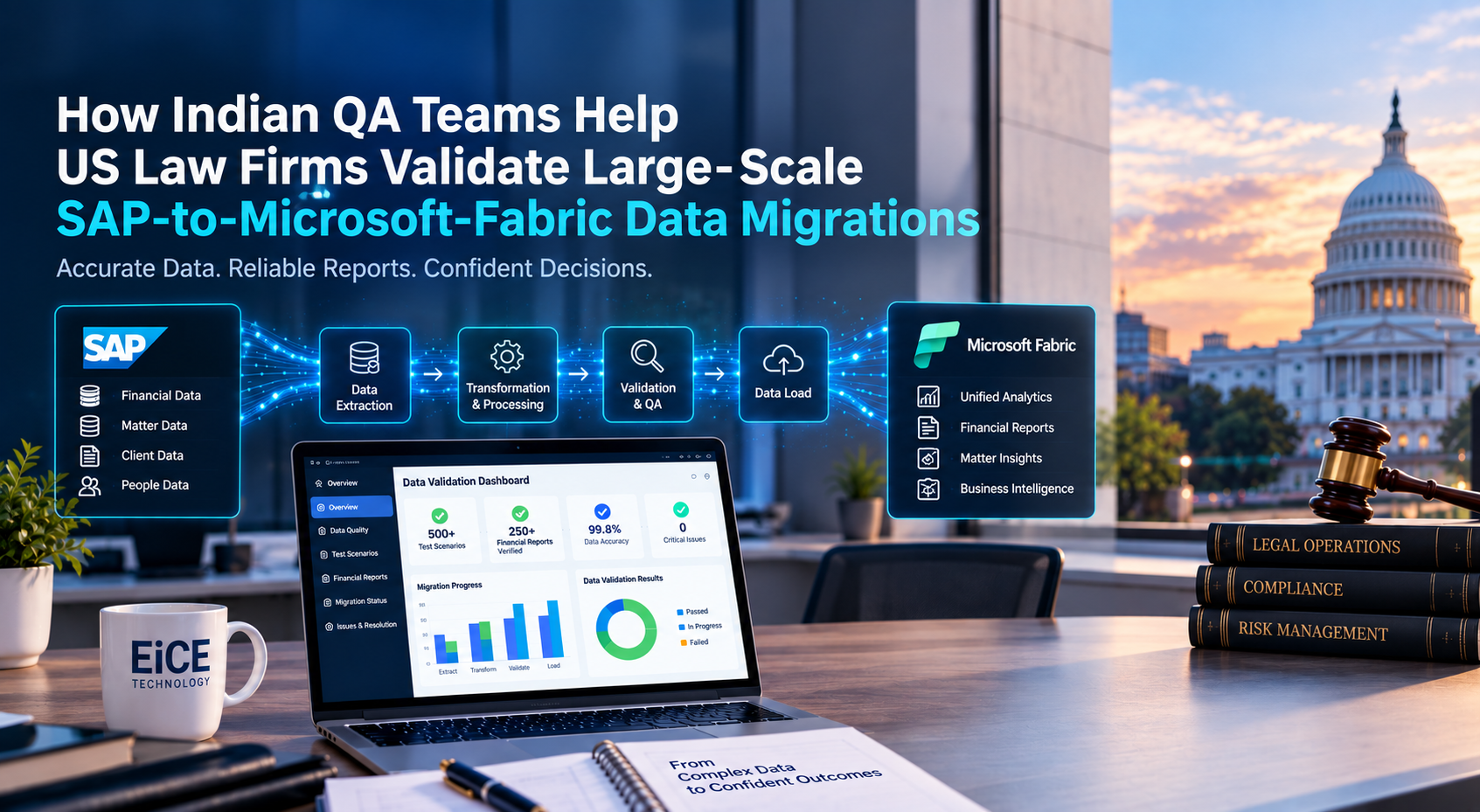
In an engagement, a US law firm is moving its matter, people, client, and financial report databases from SAP to Microsoft Fabric. The validation checks data consistency within multiple layers instead of comparing the source data to the final destination. The data is followed from the SAP source to Microsoft Fabric; it goes through the intermediate processing layers. The teams check the data that how is it looking financial reports and downstream flows. This layering process helps in finding problems that have happened during data transformation and processing; it is not limited to the problems that can be seen at the final destination. The migration also includes specialised flows such as IRM, Clocktimizer, and Exchange Rates. Each of these is tested separately for data integrity and functional accuracy in the new environment. Overall, the validation work includes more than 500 test scenarios and more than 250 migrated financial reports have been verified.
Validating a unified interface end-to-end, not just on the surface
There is a third-party tool that is AAC's Sierra. Sierra provides one unified UI for flows that were previously spread across different interfaces. Testing this setup means checking more than the UI functions; the team also go through the processes that are behind them, the changes to the database and the final outputs.
The focus is confirming that the data is correctly migrated and that the unified interface is shown accurately. This is the ongoing work that is a part of the current phase of the firm’s larger data migration management. It's not a complete project.
How EICE Technology validates large-scale data migrations for US law firms
As an Indian IT company, we are specialised in enterprise data migration testing and financial data validation services. For this kind of migration, we provide QA validation function. The team builds and executes 500+ test scenarios and verifies financial reports across SAP, Microsoft Fabric, and the Sierra UI layer. It uses SQL and structured QA testing techniques for verification of data. SAP and AAC's Sierra are both third-party platforms. Our role is just to rigorously validate the migrated data and the flows that are running through these platforms, instead of the development that are underlying tools. Our work is supported by ISO 27001 and ISO/IEC 20000 certifications, along with CMMI Level 3 and ISO 9001. See more on our Services page.
Frequently Asked Questions
Q. What is SAP to Microsoft Fabric migration testing?
A. SAP to Microsoft Fabric migration testing verifies that data remains accurate, complete and usable as it moves from SAP through the migration and processing layers into Microsoft Fabric and downstream systems.
Q. Why is source-to-target testing not always enough for a data migration?
A. A simple source-to-target comparison may not reveal issues introduced during intermediate transformation and processing. Layered validation allows teams to check data at different stages of the migration.
Q. How is financial data validated during a migration?
A. Financial data can be validated using structured test scenarios, SQL-based checks, data consistency verification and comparison of migrated financial reports and downstream outputs.
Q. How does EICE Technology support enterprise data migration testing?
A. We provide QA validation for large-scale data migration engagements, 500+ test scenarios and verification of more than 250 migrated financial reports across SAP, Microsoft Fabric and the Sierra UI layer.
Need to Validate a Large-Scale Data Migration?
EICE Technology provides structured QA validation for enterprise data migrations, including data integrity checks, SQL-based verification and downstream workflow testing.