How Indian IT Teams Help US Law Firms Modernise Procurement with Coupa
See how an Indian IT team helped a US law firm configure and validate Coupa across procurement, approvals, purchase orders, invoices, vendor management and payment workflows.
 By Ankit Rawat·Published: September 21, 2026 at 5:57 PM IST
The real cost of running procurement without a shared system
Procurement affects almost every department in any large organisation. It's important to have a central system; if there is not, every team will follow their own processes. Purchase requests can come from email or manual forms, tracking approvals in inboxes for lost. Vendor information can also be scattered between multiple spreadsheets with no clear owner. It creates much extra work; creating purchase orders manually can have multiple errors. It can take a lot of time with manual effort in matching invoices to purchase orders and finance teams may not have exact data on what amount the organisation is actually spending. If the invoice approvals are delayed, it can lead to late vendor payments. Unauthorised spending can also be harder to find and prevent. For any law firm, procurement is very important for daily operations and compliance. So, not having clear visibility, its is efficiently issue as well as a control problem.
What a properly configured Procure-to-Pay platform actually does
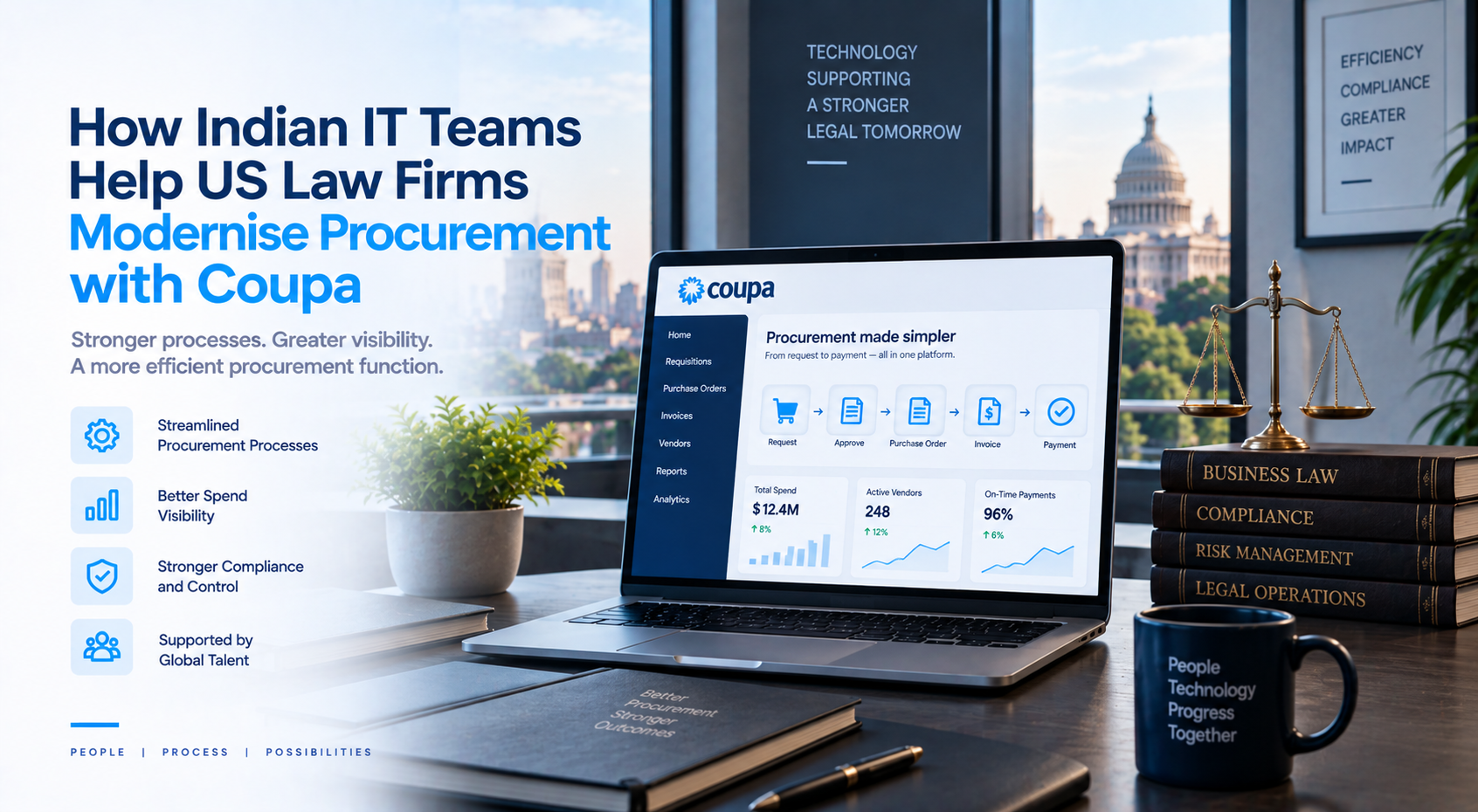
In an engagement, a US law firm moved its procurement to Coupa, it is a third-party procure-to-pay platform. The platform supported the firm's entire purchasing process. An employee can search, can add items to the cart, and enter all the important details to create a requisition. The system sends the details to the right approvers. Once the request gets approval, the purchase order is created and directly goes to the vendor without any manual work. The vendor has to submit the invoice against the purchase order; after this, the invoice gets checked and approved. After checking and approval, the payment process starts.
The platform also supports vendor management; users can create a new vendor and can select any existing vendor. It provides spend visibility dashboards and reports to help with policy compliance and audits. This does not mean replacing a good purchase decision. It is a process that once depended on emails, spreadsheets and manual work and it makes it self-service, trackable, and auditable from request to payment.
Why testing this kind of platform requires more than checking a requirements document
It is part of the work of setting up a platform like this, and the second part is to check: is it doing the actual work the way the business operates, which can be even more difficult. In this engagement, the actual requirements are not fully provided by stakeholders, so the testing is only based on the available document has missed some important gaps. Instead of this, the testing team worked directly with business users and studied the complete purchase-to-pay workflow. Testing focused on requisition creation, approval routing, PO generation, invoice processing, vendor management and payment workflows. This process-based approach found problems that may not have been seen with the documentation alone. This work continues after going live; ongoing BAU support is still provided and an active effort is in progress to integrate the platform with a new ERP system, which is planned to replace the firm's existing SAP setup.
How EICE Technology configures and validates procurement platforms for US law firms
As an Indian IT company, we specialize in procurement process automation and enterprise platform QA testing. For this engagement, we customised and configured Coupa and led the testing and validation work described above. Coupa is a third-party platform which we did not build. We manage the configuration, process analysis and detailed QA that is needed to make the platform work with the actual firm's process. Our work is supported by ISO 27001 and ISO/IEC 20000 certifications, along with CMMI Level 3 and ISO 9001. See more on our Services pages.
Frequently Asked Questions
Q. What is Coupa and how can it help a law firm's procurement process?
A. Coupa is a third-party procure-to-pay platform that can centralize purchasing activities such as requisition creation, approval workflows, purchase orders, invoice processing, vendor management, and payment-related processes. For a law firm, this can make procurement more structured, trackable, and auditable.
Q. What does a Coupa implementation for a US law firm involve?
A. A Coupa implementation can involve configuring the platform around the firm's procurement processes, including requisitions, approval routing, purchase orders, invoices, vendors, and reporting. It also requires understanding how employees, approvers, finance teams, and vendors actually use the process so the configuration reflects real business workflows.
Q. Why is business-process-based testing important when implementing Coupa?
A. Testing only against documented requirements can miss gaps when those requirements do not fully describe how the business operates. Business-process-based testing examines the complete procurement journey and validates workflows such as requisition creation, approval routing, PO generation, invoice processing, vendor management, and payment.
Q. How does EICE Technology support Coupa implementation and testing for US law firms?
A. We support Coupa configuration, procurement process analysis, QA testing, and validation for US law firms. Its teams work with business users to understand actual procurement workflows, test the platform beyond the available requirements documentation, and provide ongoing support after go-live. We also supports integration initiatives involving enterprise systems, with its delivery processes supported by ISO 27001, ISO/IEC 20000, CMMI Level 3, and ISO 9001.
Need Help Modernising Your Procurement Process?
EICE Technology helps organisations configure, validate and support enterprise platforms around their actual business processes, including procurement workflows, QA and system integration.