Measuring AI Impact in India: Productivity, Quality and Risk
Many businesses are investing in AI without knowing whether it delivers measurable results. Learn how to assess AI impact through productivity, output quality, costs, and risk—and what to track before scaling an AI project.
 By Anjali Daksh·Published: October 15, 2026 at 8:20 PM IST
A lot of companies are testing AI, but many of them don’t know if that is helping their business or not. They know how many AI projects they have, but they might not know about the time and cost they are saving. Measuring AI impact in India provides help to businesses understand whether AI is working, what it costs, and whether it is safe to use.
Let’s have a look at what the Indian surveys have to say and what businesses should check.
What the Indian Surveys Say
According to the State of AI in Indian Enterprises 2026 report from ET Edge CIO&Leader, it collected responses from more than 300 technology leaders.
- Only 12% of organisations reported clear, measurable returns from their AI investments.
- Around 60% were still testing or exploring AI after two or more years.
- About 57% had no measurable returns or were not sure if AI was giving them returns.
- Around 55% had faced extra AI costs in the past year or did not track AI spending separately from their IT budget.
According to the report, a lot of businesses are struggling to measure AI results. These numbers were from the news summary; it was not a full report. Also, the article does not have anything about how to calculate the returns.
There is another study also by SAP and Oxford Economics, based on 200 Indian business leaders, that found 93% expected positive returns from AI within three years. Both surveys share 2 different views. Their results may have differences because they ask different questions to different people.
What Measuring AI Impact in India Should Cover
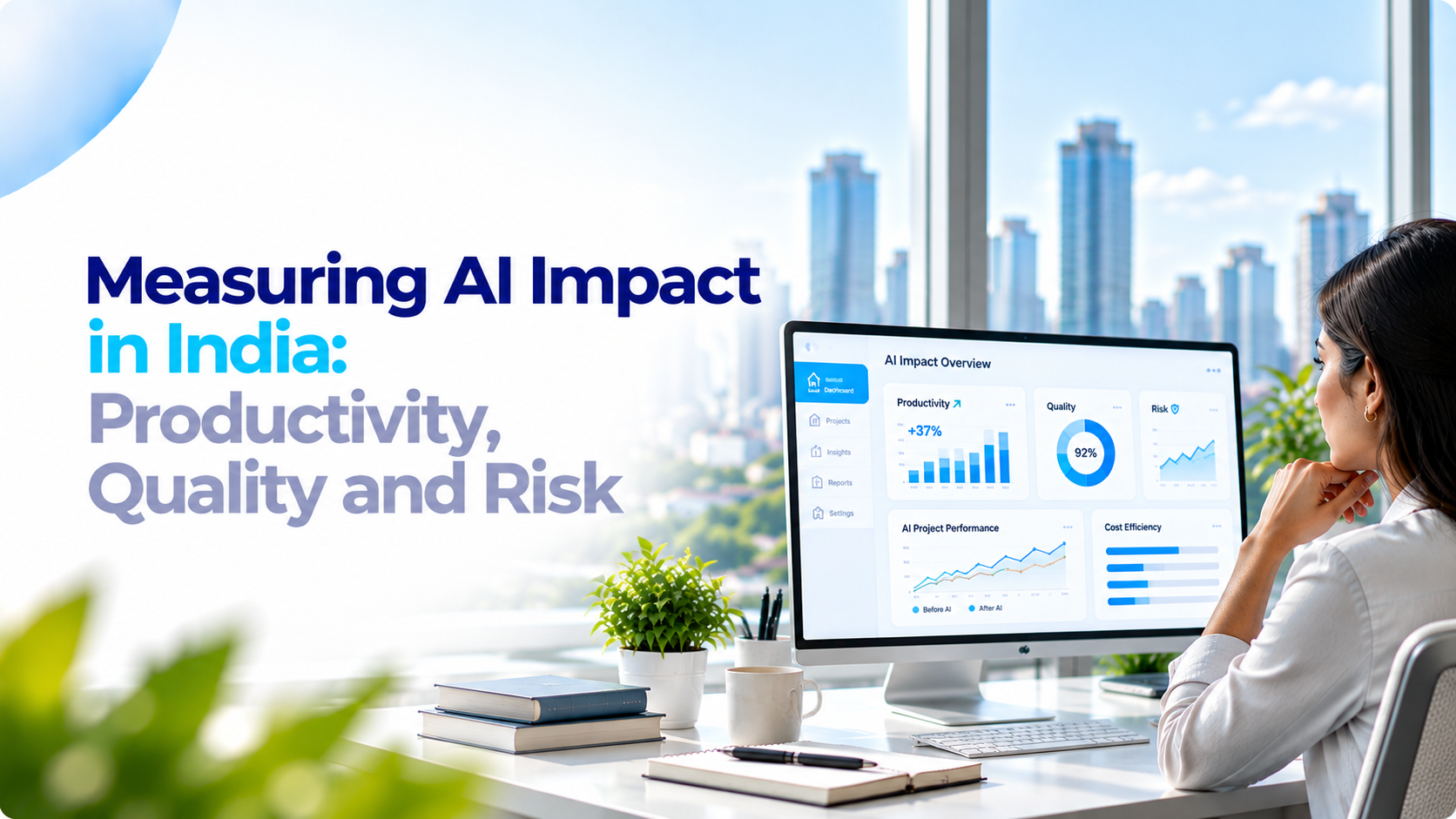
This is our view: businesses should measure these three things.
Productivity. Check whether AI is helpful in finishing work even faster than people. You can check this by the time taken to complete the task, the number of tasks, and the overall time. Record these numbers before using AI; this will help you to measure.
Quality: Faster work is not always better work. Check how often mistakes happen, how much work needs to be corrected, and whether customer complaints increase. AI should save time without reducing quality.
Risk: AI can also create problems if it gives wrong answers, exposes data, or breaks company rules. As well as tracking security issues, incorrect answers, data handling, and compliance.
You should also track AI costs separately. If the cost is mixed with the normal IT budget, it will be hard to tell how much you are spending on AI. First, start with just one project. Keep a record of the work done each day, test AI for a fixed period, and compare the results. Then it would be easy to decide whether to continue, improve, or stop the project. Clear results are more useful than a dashboard full of numbers that nobody understands.
What to Ask Before Measuring AI Impact in India
Ask these questions before starting the project. This will help you understand whether AI is giving real results or not.
- How much time and money does this task cost today?
- Which three results will we measure every month?
- Who will track the results?
- How will we check quality and risk?
- Are AI costs tracked separately in the budget?
- What results would make us stop the project?
- Who will review the results, and how often?
How We Approach Measuring AI Impact in India
EICE Catalyst is our integrated AI platform. One of its six areas focuses on measuring AI value. The dashboard includes productivity, quality, adoption, risk, and business results. It also includes responsible AI and governance features, which help in looking at AI performance and safety. If your team wants to focus on measuring AI impact in India, we’d be happy to discuss your needs and explain how EICE Catalyst can help.
Frequently asked questions
How can businesses measure AI impact?+
Businesses can measure AI impact by tracking productivity, output quality, operating costs, adoption, and risks against a baseline established before AI is introduced.
What metrics should businesses use to measure AI productivity?+
Useful measures include task completion time, tasks completed, time saved, and the amount of human review required. Choose metrics that match the workflow being evaluated.
How can businesses measure the quality of AI output?+
Track errors, rework, correction rates, customer complaints, and the percentage of outputs that meet defined quality standards.
Why should AI costs be tracked separately?+
Separating AI costs from the broader IT budget makes it easier to understand total expenditure and compare the costs with the business outcomes achieved.
What risks should businesses monitor when using AI?+
Businesses should monitor incorrect outputs, data privacy, security incidents, compliance requirements, and failures to follow internal policies.
Is your AI investment delivering measurable business value?
EICE Catalyst helps businesses connect AI engineering, governance, and value measurement so teams can evaluate performance, review risks, and make better-informed decisions.