Hybrid Cloud Storage Solution for Regulated Indian Enterprises
Discover how hybrid cloud storage helps regulated Indian enterprises manage data residency, strengthen access controls, and combine controlled storage infrastructure with convenient file synchronization.
 By Ankit Rawat·Updated: October 9, 2026 at 6:53 PM IST
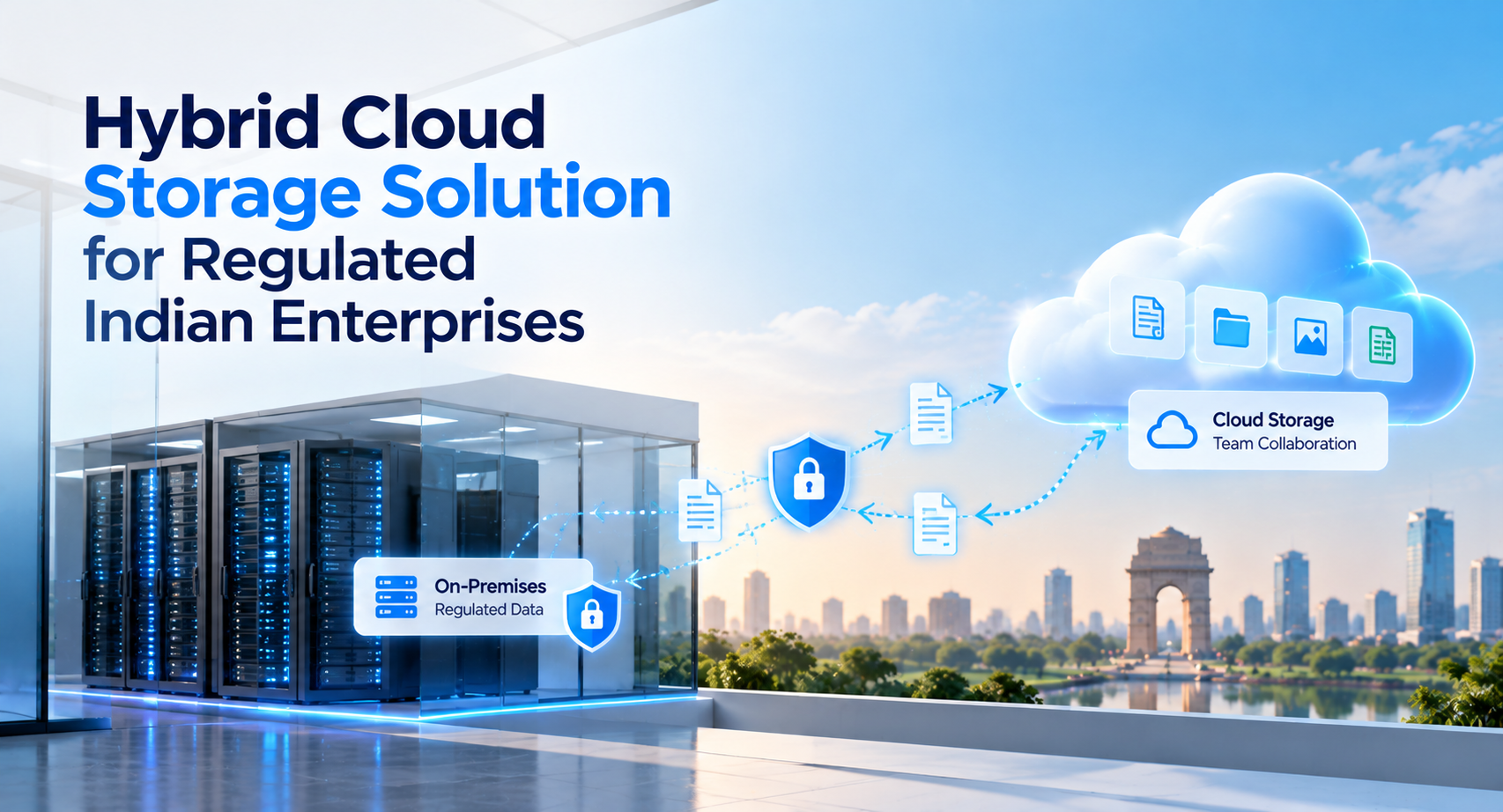
If your company handles payment, telecom or health data, the question is rarely “cloud or not”. It is “which data can sit where”. A hybrid cloud storage solution in India answers that by keeping regulated files in a place you control, while the rest of your teams still get the convenience of cloud sync and sharing. This post explains why regulated businesses are choosing it, and what to check before you pick one.
India’s data infrastructure market is growing, and compliance is part of the reason
Research and Markets values India’s data center colocation market at USD 7.31 billion in 2026 and forecasts USD 15.22 billion by 2030, a 20.1% compound annual growth rate (report dated February 2026). Part of that growth is compliance-linked investment in domestic data infrastructure, including under the Digital Personal Data Protection (DPDP) Act, 2023. More capacity inside India makes it easier to build a hybrid cloud storage solution that keeps data in the country.
What the rules require, sector by sector
Data residency is not one rule. It depends on the sector. The DPDP Act generally supports keeping data in India while allowing approved transfers, and lets the government restrict transfers on grounds such as national security.
For payments, the RBI is specific. Its directive says the entire payment data must be stored in systems located only in India. Its FAQs add that processing abroad is allowed, but the data must be brought back to India within one business day or 24 hours of processing, whichever is earlier. TRAI rules on telecom subscriber and call data, and health-data guidance under the National Digital Health Mission, point the same way. We haven’t checked those two against the primary text for this post, so confirm the current rules with your compliance team.
Why a hybrid cloud storage solution fits better than public cloud alone
This section is our analysis, not a finding from the sources above. Public cloud storage is easy to scale, but a regulated team has to prove where each file sits and who touched it. A hybrid design splits the job. Regulated files stay on infrastructure you choose, in a location you can name, and general working files use cloud storage. Users see one place to work, while administrators decide where each kind of data lives.
The big cloud providers are adding capacity in Mumbai, Chennai, Hyderabad and Pune, so the cloud side of a hybrid setup can also stay in the country.
What to check in a cloud storage solution for regulated data
Again, this is our view. Start with three questions. What data must stay in India? Which regulation applies to it? Can the platform actually keep it in the right place? A policy document is not enough, so look for real controls: role-based access, an audit trail of who opened, shared or changed what, encryption in transit and at rest, and one admin console for the whole estate. Also check that the platform works with the storage you already run, so you aren’t forced into a migration just to comply.
How EICE Technology supports hybrid cloud storage solution needs
iSyncDrive is our hybrid storage and sync platform. It runs on Windows, macOS, Linux, and the web, and uses AES-256 encryption. Access is role-based, with User, Admin, and Super Admin roles. It connects with S3, Blob and Ceph storage, and includes audit reporting. That lets an enterprise keep regulated data where it must be, while employees keep a familiar sync-and-share experience.
Frequently asked questions
Q. What is a hybrid cloud storage solution?+
A. A hybrid cloud storage solution combines cloud services with on-premises or dedicated infrastructure, allowing organisations to manage different types of data across appropriate storage environments.
Q. Why is hybrid cloud storage useful for regulated industries in India?+
A. It can help organisations apply different storage and access controls to different data types, depending on applicable regulatory obligations and their infrastructure requirements.
Q. What is data residency in India?+
A. Data residency refers to the geographic location where data is stored. Depending on the applicable rules, the location of processing and transfers may also matter.
Q. Is hybrid cloud storage automatically more secure?+
A. No. Security depends on architecture, configuration, access management, encryption, monitoring and operational practices.
Q. Can hybrid cloud storage support RBI data-localisation requirements?+
A. A suitably configured hybrid architecture may help support applicable RBI requirements. Compliance depends on the specific payment activity, where data is stored and processed, and the controls implemented. Organisations should verify their obligations with their compliance team.
Q. Does iSyncDrive support hybrid cloud storage?+
A. Yes. iSyncDrive is designed as a hybrid cloud storage and synchronization platform and can connect with S3, Blob and Ceph storage while providing centralized administration, access controls and audit reporting.
Keep Regulated Data Under Your Control
Manage enterprise files with hybrid storage, AES-256 encryption, role-based access and audit reporting through iSyncDrive.