Ransomware Recovery Time in India: What Determines Whether You Restore in Hours or Days
What determines whether an Indian organisation recovers from ransomware in hours or days? Explore backup frequency, versioning, retention, restore speed and recovery testing.
 By Ankit Rawat·Published: October 6, 2026 at 5:53 PM IST
Most Indian organisations recover, but the timeline varies widely
For Ransomware, the main question is not whether an Indian organisation can recover; it is how long the recovery will take. Sophos's State of Ransomware in India 2026 has surveyed 240 IT and cybersecurity leaders from organisations with 100 to 5,000 employees. This survey was conducted from January to March 2026. It is found by the report that 60% of the attacks resulted in data being encrypted, and for recovery, 67% of the Indian organisations used backups. The same report found that in just a week, 58% recovered. While the 10% took between one and six months. The average recovery cost was $1.11 million.
The point is, the recovery time can be different between organisations; two organisations can face the same kind of attack at the same time, but the recovery time will be different for both. A lot of the recovery outcomes depend on the backup setups before the attack.
Attackers often arrive through legitimate access
The report shows that recovery plans should assume that the environment is already compromised. It includes some of the main causes, such as:
- Malicious email: 28%
- Phishing: 26%
- Compromised credentials: 19%
- Exploited vulnerabilities: 11%
In many cases, instead of breaking in from the outside, attackers attack access that looks legitimate. For doing the recovery, the question is not just “Do we have a backup?”, it is also important to ask, “Do we have a backup from before the attacker got access, and is it stored somewhere those same credentials cannot reach?”
What separates restoring in hours from restoring in days
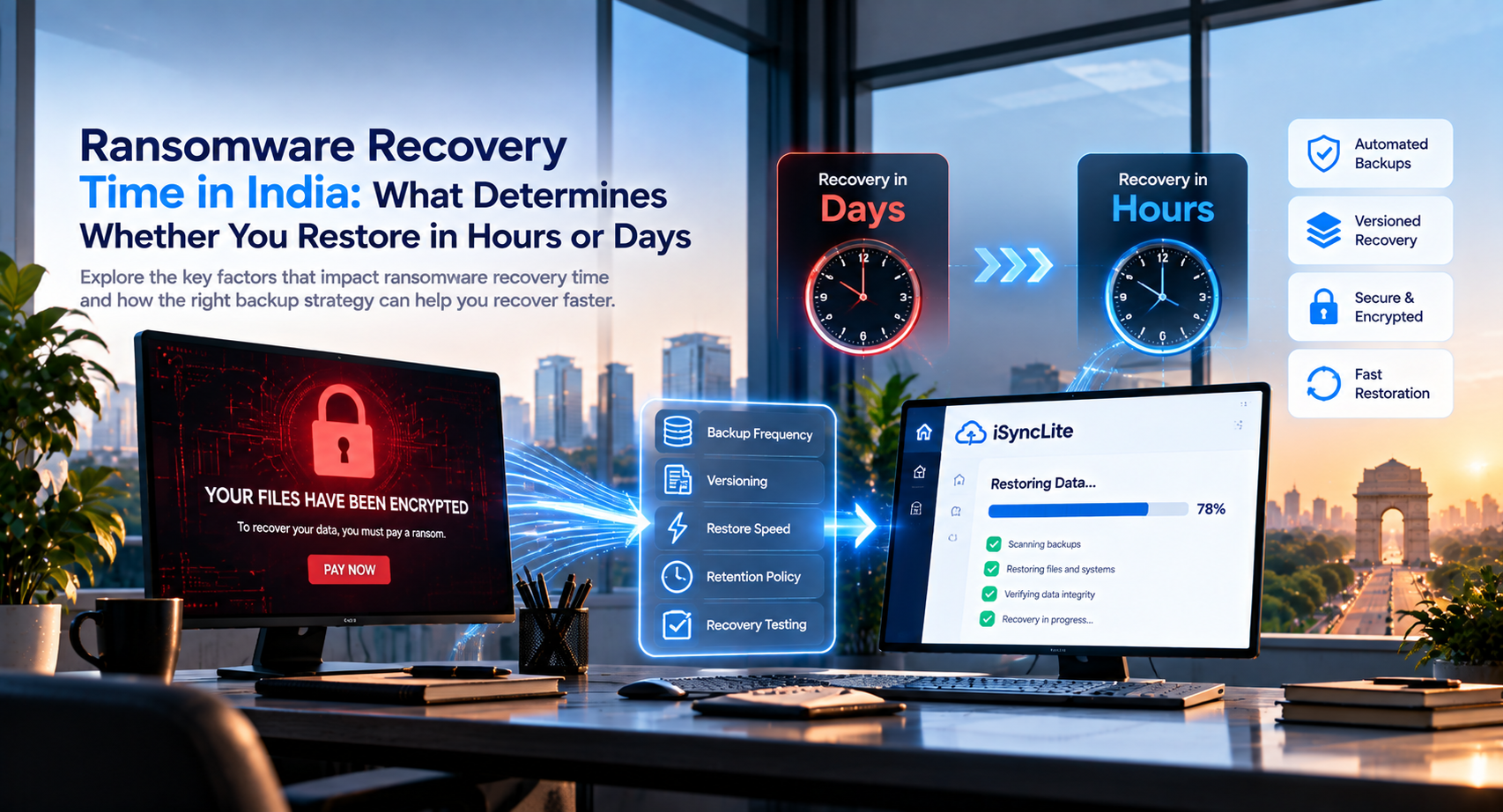
The Sophos survey does not break recovery time down by backup design. So these are the points of our analysis where recovery takes time, not just what the survey directly shows. These four points are important to have:
- Backup frequency
If there are more frequent backups, it can reduce how much data is lost between the attack and the last good backup.
2. Versioning
Incremental and versioned backups give you the option to choose a restore point from before encryption started.
3. Restore speed
If the entire set of data is restored to one place, the recovery will take time. The best and fastest way is to recover the important systems first.
4. Retention policy
If the old versions of the backup are deleted or overwritten, the point of a clean restore will not be available.
Testing is very important in all these four areas. During a real recovery situation, if the backup never restored is not a tested plan, it is just an assumption.
The financial case for getting this right
Downtime is not the only cost of a cyberattack. In 2026, IBM's Cost of a Data Breach research provides the average total cost of a breach in India at INR 25.5 crore. It is 15.9% up from the previous year which is INR 22 crore. These numbers cover data breaches, not ransomware specifically. But it shows how much can be at stake when recovery takes a long time.
How EICE Technology supports ransomware recovery in India
iSyncLite is EICE Technology's enterprise backup and recovery platform. This includes
- Automated, policy-driven backups
- Incremental and versioned backups
- End-to-end encryption
- Fast recovery
- Retention policy management
A lightweight agent helps keep overhead low. iSyncLite can be deployed on-premises, in the cloud, or in a hybrid setup; it depends on where the data needs to be stored. If your team is looking at how quickly this can be restored after a ransomware attack, we'd welcome the conversation.
Frequently asked questions
Q. How long does ransomware recovery usually take?+
A. Recovery time varies significantly between organisations. It depends on factors such as backup availability, backup frequency, versioning, retention, restore speed and whether recovery procedures have been tested.
Q. What determines ransomware recovery time?+
A. Important factors include how frequently data is backed up, whether multiple versions are retained, how quickly data can be restored, how long backups are retained and whether the recovery process has been tested.
Q. Why is backup versioning important for ransomware recovery?+
A. Versioning provides multiple restore points, which can help organisations identify a version of their data from before ransomware encryption occurred.
Q. How often should businesses back up data to prepare for ransomware?+
A. There is no single frequency that applies to every organisation. Backup frequency should reflect the importance of the data, acceptable data-loss window and recovery requirements.
Q. Why does backup retention matter for ransomware?+
A. If older backup versions are deleted or overwritten too quickly, an organisation may lose access to a clean restore point created before the ransomware attack.
Q. What is iSyncLite?+
A. iSyncLite is EICE Technology's enterprise backup and recovery platform supporting automated backups, incremental and versioned backups, encryption, recovery and retention policy management.
Strengthen Your Ransomware Recovery Strategy
Protect critical data with automated backups, versioning, retention controls, and fast recovery through iSyncLite.