DevOps vs Traditional IT Operations: What Changes in India
DevOps changes how development and operations teams build, release and maintain software. Explore the differences between DevOps and traditional IT operations, including CI/CD, infrastructure automation, monitoring, security and shared ownership, before planning your transition.
 By Ankit Rawat·Published: October 12, 2026 at 11:55 PM IST
In a regular IT setup, developers usually write code and give it to the operational teams. If something goes wrong, the result will be both teams blaming each other. DevOps vs. traditional IT operations is about how these teams will work together. DevOps brings development and operations closer, helping teams build, release, and manage software together. Let’s go through the main differences and the business considerations before changing anything.
What the Research Says About DevOps Performance
DORA’s State of DevOps research looks at how well software teams perform. According to the 2019 report, that is summarized by Devclass and it is based on more than 31,000 professionals, it is found that top-performing teams release software about 208 times more often than low-performing teams. They also make changes faster, fix errors, and have fewer failed changes.
These numbers are from global research that was published in 2019, not only Indian companies. In the studies, they have compared the top and bottom groups, but the genuine result depends on your team and way of working.
DevOps vs Traditional IT Operations: Where the Differences Show
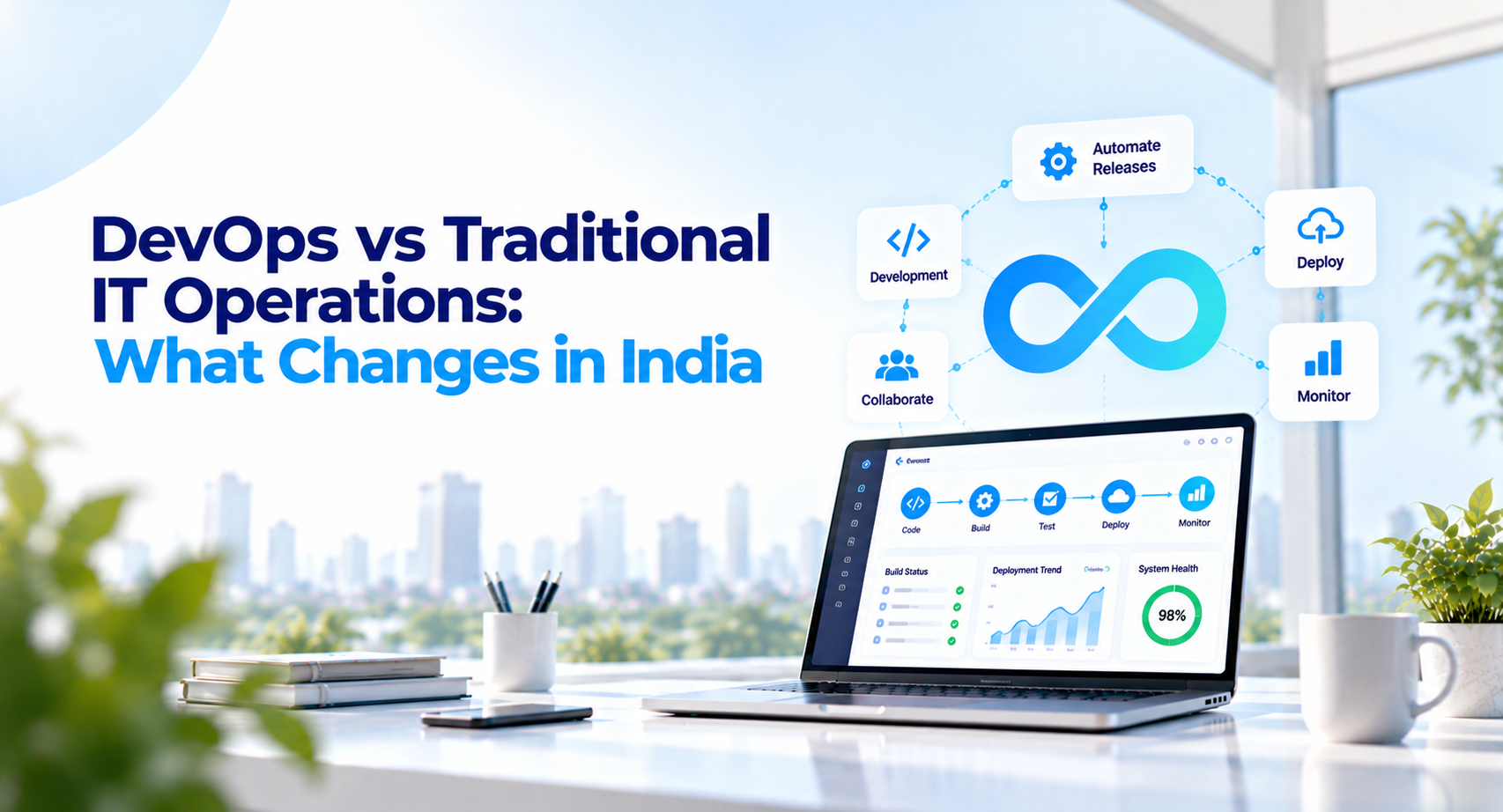
As per our view, in traditional IT operations, the software updates are usually large and happen less frequently. The teams can handle approvals themselves and can set up servers by hand. With DevOps, teams usually release smaller updates. They automate tasks such as building and testing software, and set up the infrastructure in a repeatable way with the help of code.
Monitoring and security also change. Traditional teams wait for alerts before solving the problems. But in DevOps, throughout the entire release process, the software is monitored on a regular basis, and this includes security checks also.
The main difference is ownership. Instead of just passing the software from team to team, all the teams work together and share responsibility for the software for the entire process, from development to release. But the tools alone are not enough to solve every problem; teams can be worried about the changing role of automation, and developers may not want to handle production issues outside working hours. Businesses that are using older systems and cloud systems should make changes gradually. In our view, DevOps vs. traditional IT Operations is about people and teamwork, as it is about technology.
What to Ask Before Moving from Traditional IT Operations to DevOps
Before switching, ask this question; these questions; they will help you in planning the change and understand your team's needs.
- Which tasks should we automate first?
- How will we manage approvals and keep records of changes?
- Which tools will you use, and will our team be able to manage them later?
- How will security checks be included in the release process?
- How will we measure progress and results?
How We Approach DevOps vs Traditional IT Operations
Our DevOps services include six areas, that is: cloud infrastructure management with infrastructure as code, CI/CD pipelines, configuration management with Ansible, Puppet, and Chef, containers and orchestration with Docker and Kubernetes, monitoring and performance, and DevSecOps.
We have offices in Noida, India, and Houston, USA.
If your team is comparing DevOps vs. traditional IT Operations and wants to understand which will fit your business, we’d be happy to connect. See more on our Services page.
Frequently asked questions
Q. What is the difference between DevOps and traditional IT operations?+
A. Traditional IT operations often separate development and operations responsibilities. DevOps encourages collaboration, shared ownership, automation and continuous feedback across software delivery and operation.
Q. Is DevOps better than traditional IT operations?+
A. Neither model is automatically better for every organisation. DevOps can benefit teams seeking more repeatable releases and closer collaboration, but adoption requires suitable processes, skills, security controls and organisational support.
Q. What is CI/CD in DevOps?+
A. Continuous integration (CI) helps teams integrate and test code changes regularly. Continuous delivery or deployment (CD) automates stages of preparing and releasing software, depending on the team's chosen workflow.
Q. How can a company move from traditional IT operations to DevOps?+
A. Start with a specific delivery or operational bottleneck, map the existing workflow, select a suitable process to automate, establish baseline metrics and introduce changes incrementally with team involvement.
Q. What should businesses look for in a DevOps service provider in India?+
A. Assess experience with CI/CD, infrastructure as code, configuration management, containers, monitoring, security practices, documentation and knowledge transfer to your internal team.
Modernise Your IT Operations with DevOps
Explore how EICE Technology can help your team implement CI/CD pipelines, infrastructure as code, configuration management, monitoring and DevSecOps practices suited to your environment.