Model-Agnostic Enterprise AI India: Swappable AI Providers
Relying on a single AI model provider can create challenges around pricing, availability and technical flexibility. Discover how model-agnostic enterprise AI helps businesses build portable prompts, flexible RAG architectures and tested alternatives while maintaining control over enterprise knowledge and data access.
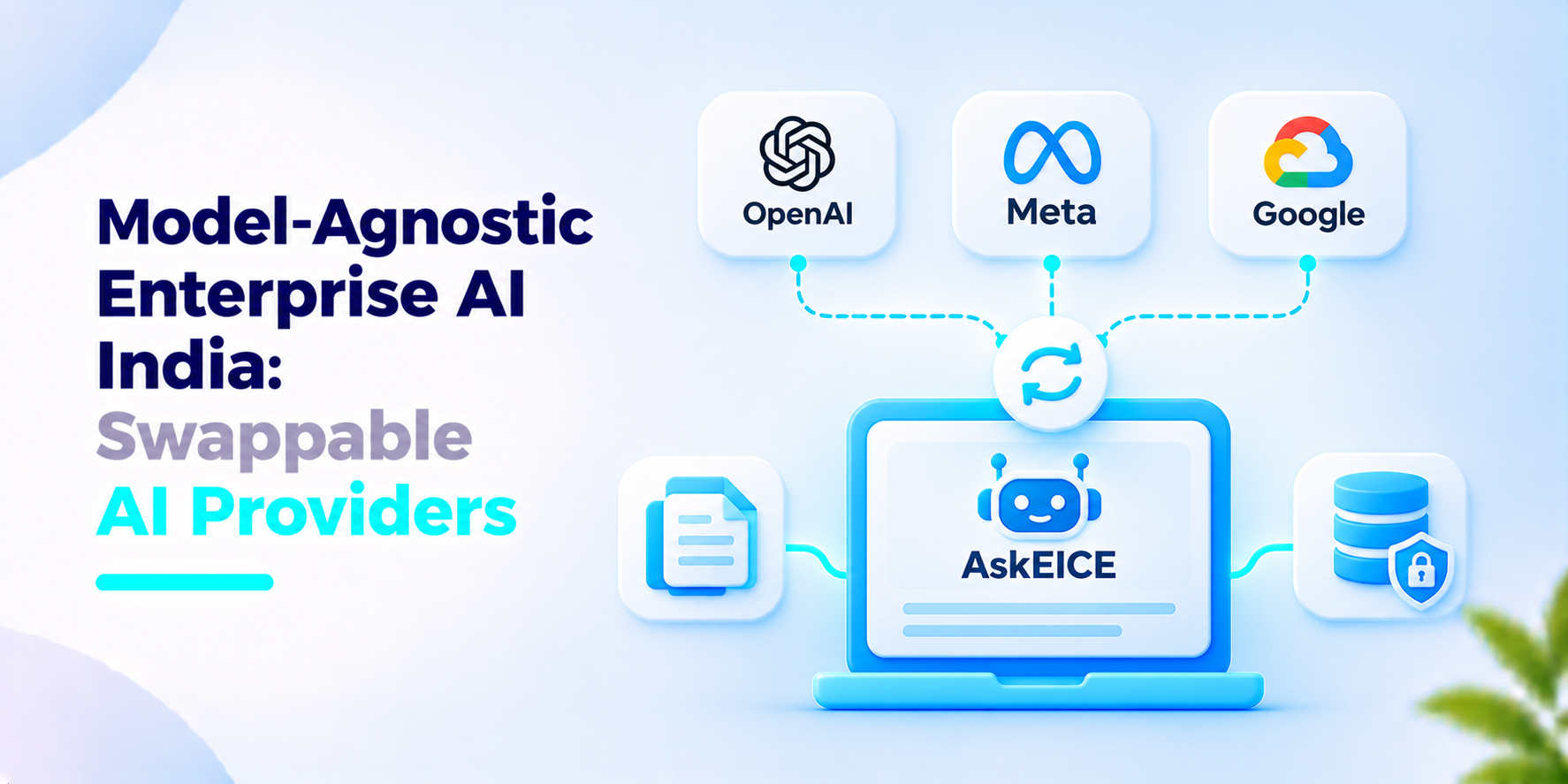
Many teams will select a specific model provider. They might then discover issues with pricing, conditions or access. By designing a model-agnostic enterprise AI solution, you can ensure you can easily change providers. This post will explain more.
What the India data says
According to Analytics India Magazine, in an article written by Ajay Rag dated 9th July 2026, there is caution among Indian enterprises using a limited number of foreign model providers. They highlight that providers are shifting away from seat based pricing models to consumption based pricing. It also includes a quote from Srinivas Padmanabhuni (formerly from Infosys Labs): “There is no standardisation of APIs across the industry so we recommend building modular API driven solutions that can support multiple providers. This will be a multi-API world.” They also include the quote from Nilesh Bhojani (Seclore): “Training for a specific model won’t translate.”
Note: This is trade press with no stats from surveys. Opinions are from named people and expert opinions. This is a caution about lock-in and not evidence that many companies have changed providers.
Model-agnostic enterprise AI: our view
Lock-in rarely comes from the model itself, but from the components built around it.
Prompting. Prompts will often behave differently when using a different model. Store your prompting in a file you own and add comments to show what they are for.
Indexing. If your documents are indexed in a way that can only be read by one vendor, you are locked in. LLM agnostic RAG will store your document index separately from the model providing the answer.
Testing. Have a set of static questions with accepted answers. When changing providers, run these to compare. Without this, you won’t be able to truly use swappable AI providers.
Pricing/Access. What happens if your provider increases their price or access is limited? Having an additional accepted model (even if rarely used) means this isn’t an issue, it is just a configuration change.
What to ask before you commit to model-agnostic enterprise AI
- Can we change the model?
- Where are our prompts stored? Who owns them?
- Is our document index readable outside of the vendors tools?
- Do we have a set of tests?
- What model would we switch to? Have we tested it?
- What data are we sending out of our network when we use a provider?
How We Approach Model-Agnostic Enterprise AI
Our AI Knowledge Agent AskEICE converts enterprise documents into a queryable solution. It is model agnostic and is fully on-premises. Answers will provide source information with links to the exact document and page. Access is role based in multi-organisation environments. We start with your documents and questions being asked and agree which model is best for each requirement.
If your team is considering model-agnostic enterprise AI, we’d love to chat.
Frequently asked questions
What is model-agnostic enterprise AI?+
Model-agnostic enterprise AI is an architecture designed to work with different AI models or providers without making the entire application dependent on one model.
Why should enterprises avoid AI vendor lock-in?+
Dependence on one provider can create risks around pricing, availability, API changes, product conditions and technical limitations. A flexible architecture gives organisations more options when their requirements change.
Can enterprises switch AI models without rebuilding their RAG system?+
Sometimes. Changing the generation model may not require rebuilding the document index. However, changing the embedding model may require re-embedding documents and queries because vector representations can differ.
Does model-agnostic AI mean all models produce the same answers?+
No. Models differ in reasoning, output quality, context handling, tool usage and response formats. Each replacement model should be tested before production use.
How can enterprises test an alternative AI model?+
Use a representative evaluation dataset containing real business questions, expected facts, source documents and scoring criteria. Compare accuracy, citation quality, latency, cost and security behaviour.
Build Enterprise AI Without Depending on One Model Provider
Make your enterprise knowledge easier to access with AskEICE. Explore a flexible AI knowledge solution designed around your documents, security requirements and business needs.