Healthcare Data Storage in India: Own Your Patient Records
Patient records can be scattered across hospital systems, shared drives and individual devices. Learn how healthcare providers in India can improve data ownership through better storage visibility, role-based access, encryption, audit trails and retention policies.
 By Ankit Rawat·Published: November 11, 2026 at 12:11 AM IST
Patient files pile up in places: a lab system, a shared drive, a doctor's laptop, a WhatsApp group. When someone asks where a record lives and who can open it, nobody is sure. Healthcare Data Storage in India teams must answer that question first before choosing any tool.
What the India rules say
The Ayushman Bharat Digital Mission published a Draft Health Data Management Policy in April 2022 (version 02). The policy is marked as a draft. It says that electronic medical records are stored at the health facility where they are created and that no personal data is stored outside the boundaries of India. The policy asks data fiduciaries to have a documented information security programme, encryption and de identification methods and independent audits once a year.
Three cautions. First the policy is still a draft. It is not known whether a later version has replaced it. Second the policy applies to participants in the national digital health ecosystem, which is voluntary so it may not bind your hospital. Third the policy is a guideline for that ecosystem, not a legal guide that Healthcare Data Storage in India providers must follow. Ask counsel to find out what applies to you.
Owning your records: our view
This section is our view. Ownership here means knowing at any moment, where each record's who can open it and what happened to it.
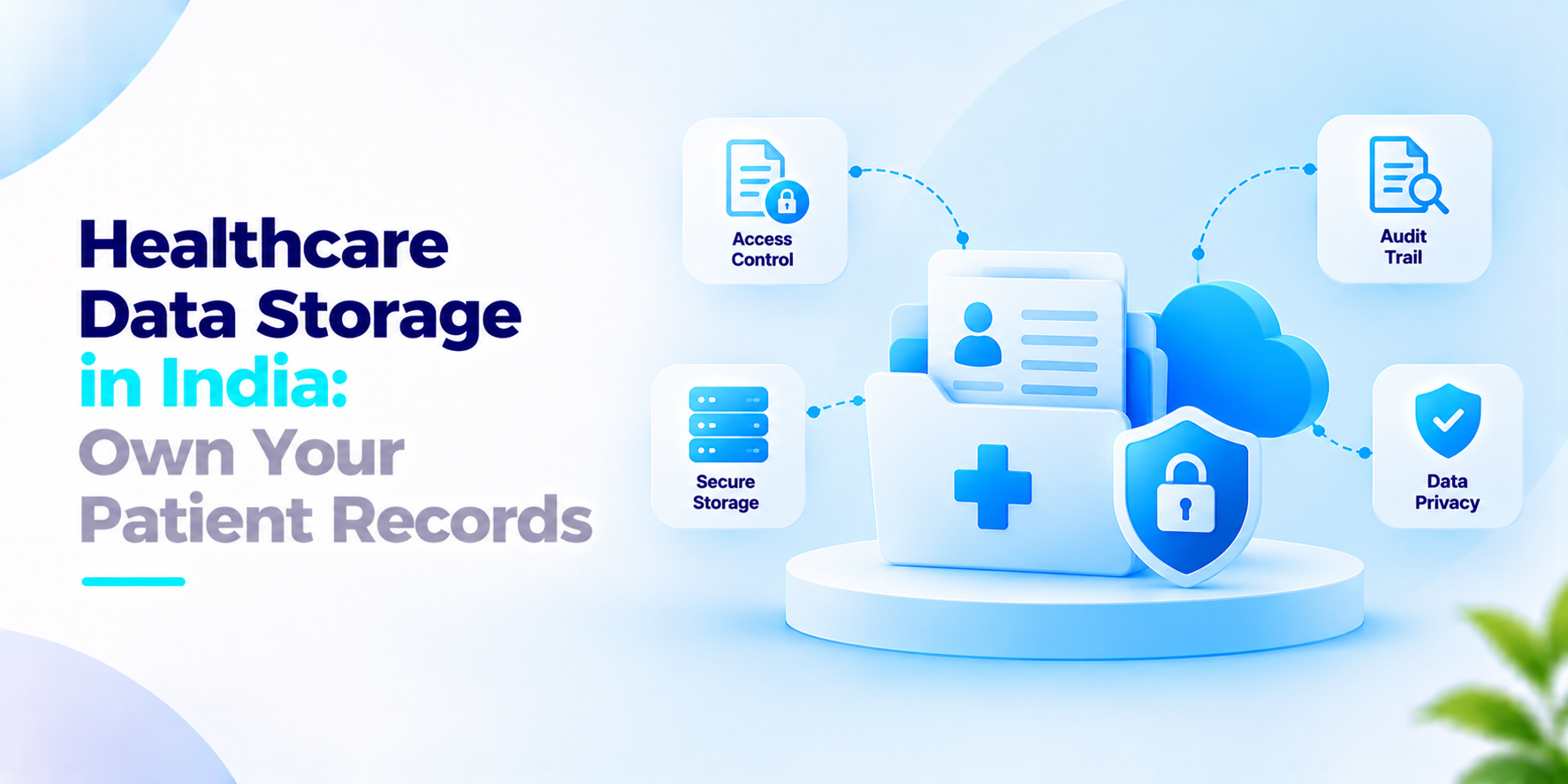
Know where records sit. List every place where patient files are kept including devices and shared folders. What you cannot list, you cannot protect.
Control who sees what. Staff need access. A receptionist does not need notes and a billing clerk does not need scans. Role-based access, reviewed regularly is the answer.
Keep a trail. A log of who opened it. Sharing a file helps with audits and with the day a patient asks questions.
Encrypt files at rest and in transit. Hold the keys under your control.
Decide on retention and deletion. Records kept forever are a risk and records deleted early create another risk. Write both rules down.
Place data deliberately. Some teams hold it on their servers, some in a cloud region in India, and some in a mix. The draft policy's wording on location is a reason to ask early.
What to ask before you choose healthcare data storage in India
• Where is each type of file stored today?
• Does the storage sit inside India. Can we show it?
• Who can open, change or share a file and is it logged?
• How are files. Who holds the keys?
• How long do we keep each record. Who deletes it?
• Can we leave the platform. Take our data with us?
How We Approach Healthcare Data Storage in India
iSyncDrive is our hybrid cloud storage and file sync platform, built for organisations such as healthcare providers that want ownership and control over file systems. It uses AES-256 encryption, role-based access with User, Admin and Super Admin roles, an admin dashboard and integration with S3, Blob and Ceph storage.
If your team is reviewing Healthcare Data Storage in India, we would welcome the conversation.
Frequently asked questions
What is healthcare data storage?+
Healthcare data storage is the process of storing and managing digital healthcare information, such as patient records, reports, scans and other medical files, so authorised people can access them when needed.
Why is secure patient data storage important?+
Secure storage helps healthcare providers protect sensitive patient information, control access, maintain records of file activity and manage retention and deletion.
What is hybrid cloud storage in healthcare?+
Hybrid cloud storage combines on-premises infrastructure with cloud storage. It can give healthcare organisations flexibility over where files are stored and how storage resources are managed.
What is role-based access control in healthcare?+
Role-based access control assigns permissions according to a person's job responsibilities. For example, a receptionist may need appointment information but not access to detailed clinical notes.
Should healthcare data be stored in India?+
The answer depends on the applicable laws, rules, contracts and the organisation's participation in relevant digital health ecosystems. The ABDM Health Data Management Policy includes India-specific storage provisions, but its scope and current status must be checked before applying them to a particular provider.
Take Control of Your Healthcare Data Storage
files across your storage environment with a hybrid cloud storage platform designed for visibility, access control and secure file management.
Related in Healthcare Technology
IoT in Healthcare in India: Where Connected Devices Are Used
Connected devices are helping hospitals explore new ways to monitor patients, track medical equipment and manage critical storage conditions. Learn where IoT in healthcare in India can fit, what hospitals should consider before deployment and how to measure a pilot before scaling it.