IoT in Healthcare in India: Where Connected Devices Are Used
Connected devices are helping hospitals explore new ways to monitor patients, track medical equipment and manage critical storage conditions. Learn where IoT in healthcare in India can fit, what hospitals should consider before deployment and how to measure a pilot before scaling it.
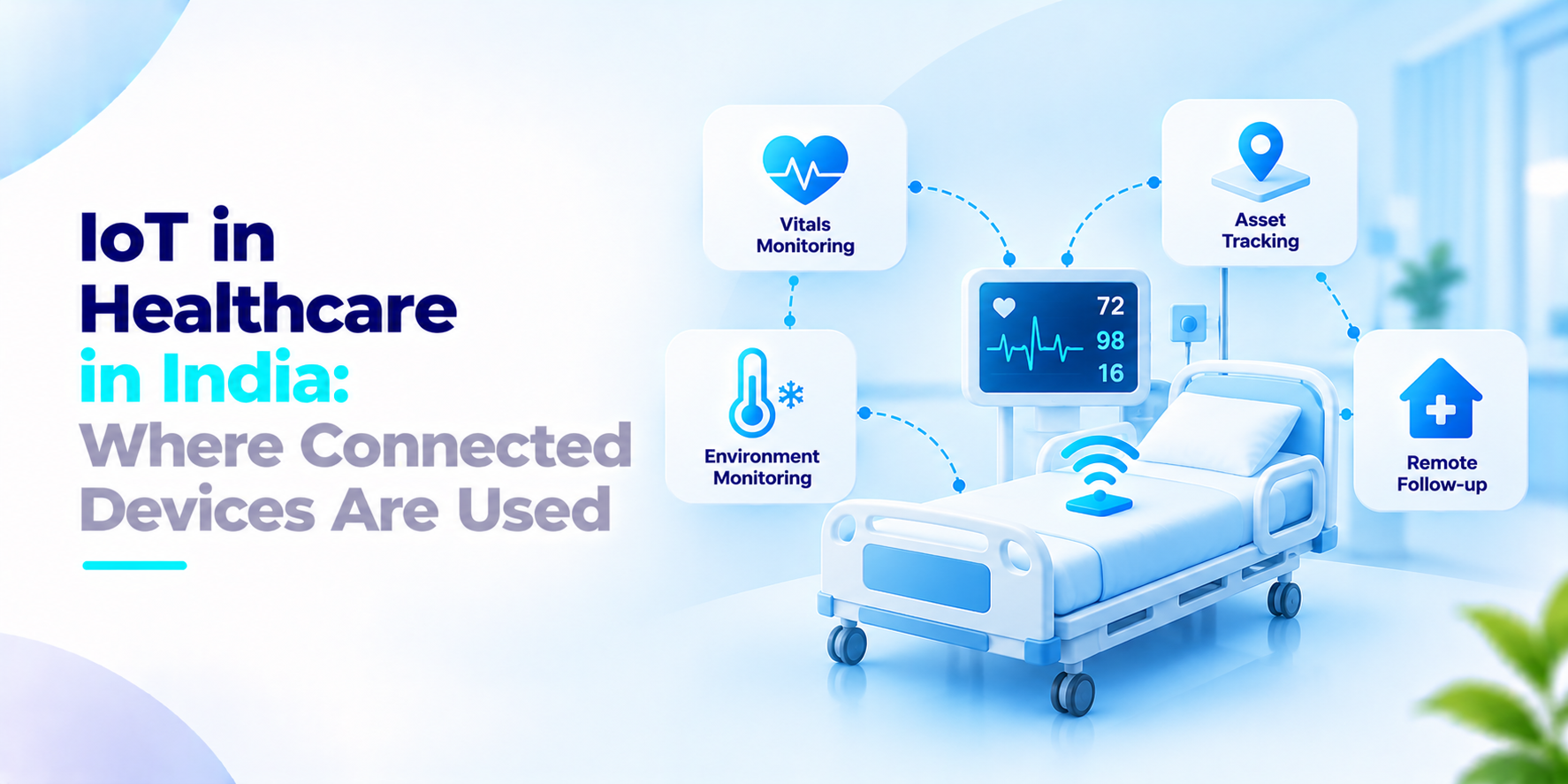
A hospital ward has patients and few nurses. Sensors that report vitals without a person walking to each bed are one answer. IoT in healthcare in India is largely about this: devices that collect readings and send them where staff can act. This post looks at one India study and at what to settle before a pilot.
What the Indian data says
A Healthcare IT News Asia article describes an impact assessment by Sattva Consulting of Dozee, a sensor sheet placed under a mattress that tracks vital signs. Sattva gathered views from 79 professionals in six public hospitals. The article reports up to 80% nursing time saved on manual vitals checks in -ICU wards and says about 95% of beds are poorly monitored by manual checks.
Three cautions. The article shows no date. It does not say who commissioned the assessment and the device is the company's product, so treat the savings as vendor-linked. The sample is 79 people in six hospitals. The figures are stated as potential not measured, across India. It covers one device type, not IoT in healthcare India as a whole.
Where connected devices fit in a hospital
This section is our view. Connected devices tend to help where a reading is taken often by hand and the delay matters.
- Vitals monitoring: Sensors on the bed or the patient send heart rate, breathing or temperature to a screen.
- Asset tracking: Tags show where wheelchairs, pumps and monitors are so staff stop searching.
- Environment monitoring: Temperature sensors in medicine and vaccine stores raise an alert when a fridge drifts out of range.
- Remote follow-up: A patient at home shares readings with a clinic, which suits conditions.
Connected devices also bring duties. Patient readings are data so decide who can see them, where they are stored and how long they are kept. Devices need power, network coverage and a plan for when they fail. A sensor that goes silent must raise an alert; staff may read the absence of alarms as good news.
Start with one ward and one question, such as "can we catch deterioration " and measure it against the current manual routine.
What to ask before you plan IoT in healthcare India
- Which task are we trying to remove and how often is it done today?
- Which readings do clinicians take? How will they be checked against the device?
- Where is the data stored and who may see it?
- What happens when a device or the network fails?
- How will alerts reach the person and who owns the response?
- How will the pilot be. What would make us stop?
How We Approach IoT in Healthcare India
We work in six steps: discovery and requirements, design and architecture, prototyping and validation, development and integration, deployment and maintenance and support. For a hospital, we would begin in discovery, with the ward, the task and the people involved and prove the idea in a prototype before any wider rollout.
If your team is exploring IoT in healthcare in India we'd welcome the conversation.
Frequently asked questions
What is IoT in healthcare?+
IoT in healthcare refers to connected devices and sensors that collect and transmit health or operational data. Hospitals can use these technologies for patient monitoring, equipment tracking, environmental monitoring and remote follow-up.
How is IoT used in hospitals?+
Hospitals can use connected devices to monitor patient vital signs, locate medical equipment, track storage conditions and support remote monitoring. The usefulness depends on the clinical or operational need and how the device data is integrated into staff workflows.
What is remote patient monitoring?+
Remote patient monitoring uses connected devices to collect patient health readings outside or within a hospital setting and transmit them to authorised healthcare professionals. The readings can help clinicians monitor trends and decide when further assessment is needed.
How can connected devices reduce manual patient monitoring work?+
Certain connected monitoring systems can automatically collect selected readings and make them available on a central dashboard. This may reduce some repetitive manual measurement and recording tasks, but clinical staff still need to validate readings, assess patients and respond to alerts.
How is IoT used for medical equipment tracking?+
Hospitals can attach identification or location tags to equipment such as wheelchairs, infusion pumps and patient monitors. Depending on the technology and infrastructure, staff can use tracking systems to locate equipment and understand its availability.
Turn Your Healthcare IoT Idea Into a Working Pilot
Identify the right hospital use case, define device and data requirements, and validate the solution through a focused prototype before planning a wider deployment.
Related in Healthcare Technology
Healthcare Data Storage in India: Own Your Patient Records
Patient records can be scattered across hospital systems, shared drives and individual devices. Learn how healthcare providers in India can improve data ownership through better storage visibility, role-based access, encryption, audit trails and retention policies.