IoT Proof of Concept in India: Why a Small Pilot Comes First
An IoT proof of concept helps businesses test sensors, connectivity, data quality, and installation requirements on a small scale before committing to a wider rollout. Learn how to define success criteria and decide whether your pilot is ready for production.
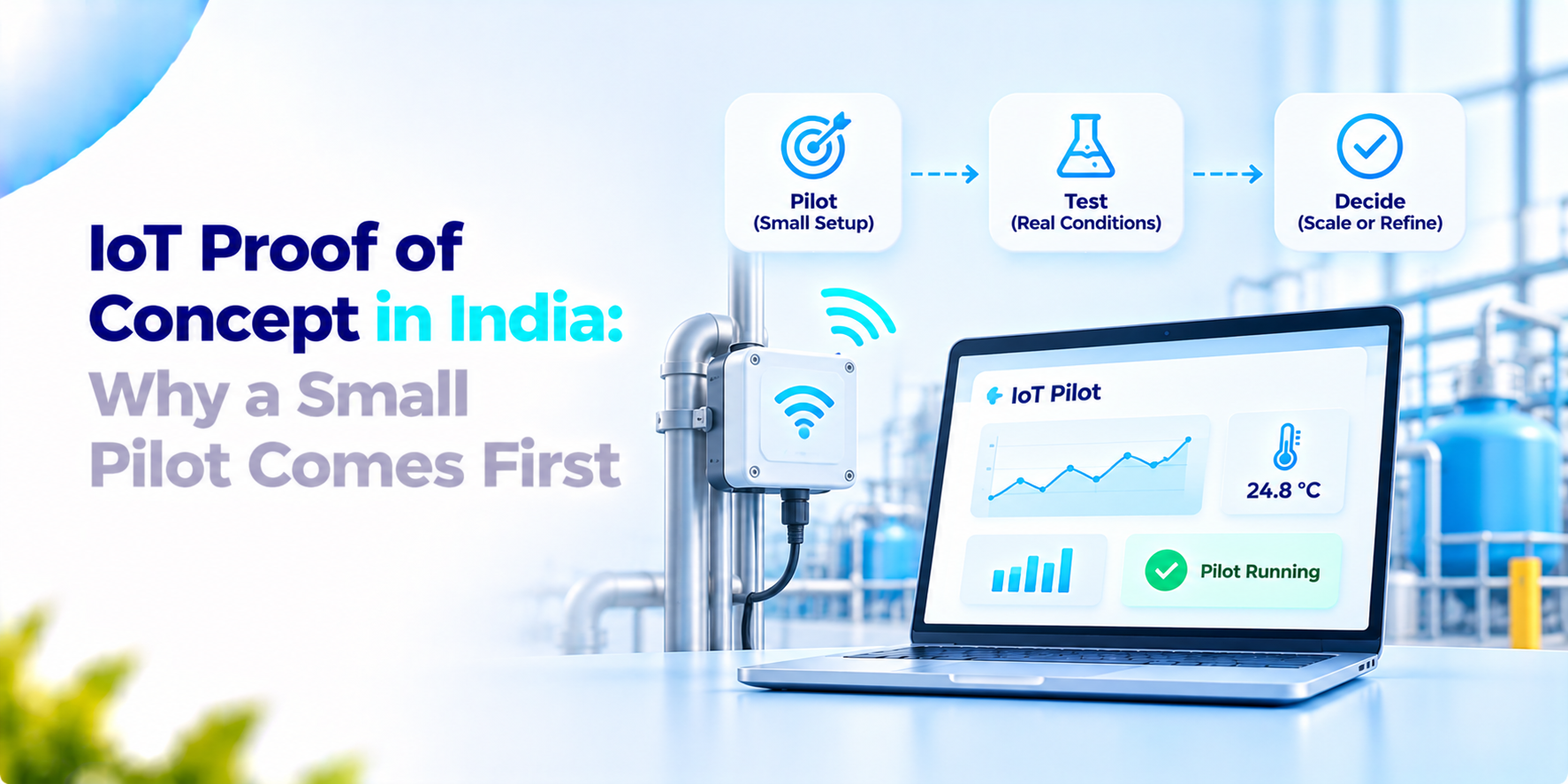
IoT projects usually look very simple: sensors collect data, that data is shown on the dashboard and the business expects to save money. But the actual real projects can have many problems related to power, network coverage, installation and data quality. So, an IoT proof of concept in India can help your business test the idea on a small scale instead of investing in a big project.
What the India data says
Voice&Data, a trade publication, reported on 24 May 2017 about a Cisco survey of 1,845 IT and business decision‑makers in the US, the UK and India. All of them worked at organisations that were running or had finished initiatives. The article says that 60 percent of IoT initiatives stall at the proof of concept stage. 26 Percent of companies called an initiative a complete success and about a third of completed projects were not seen as successful.
Three cautions.
Cisco sells networking and IoT products so it has an interest in the topic. The article gives no figures and it does not say how the sample was chosen. It is from 2017, so today's numbers may differ. Read it as a warning that pilots often fail to become products, not as an Indian rate.
Why an IoT proof of concept comes first
This section is our view. An IoT proof of concept answers one question: does this idea work in our conditions? Keep it small enough to finish in weeks and clear enough to judge.
Pick one problem. For example, track temperature in one room or machine run time on one line.
Use sites. A lab test hides problems such as signal, dust, heat and power cuts.
Set the pass mark in advance. Write down what the data must show, for how long and how accurately.
Record what the pilot cost, what broke and what you changed. Those notes shape the budget for the stage.
An IoT proof of concept is also a time to test the boring parts. Who installs the devices? Who replaces one? Where does the data go? A pilot that skips these questions can look good. Still fail at scale.
A pilot differs from production. Production needs monitoring, updates, security and support. Treat the move from one to the other as a decision, not an automatic next step.
What to ask before you start a proof of concept
1. What single question must the IoT proof of concept answer?
2. What result counts as a pass and who decides for the proof of concept?
3. Which site, devices and network will we use for the proof of concept?
4. What will it cost to repeat this at ten times the size of the proof of concept?
5. Who owns the data and the devices after the proof of concept?
6. What do we do if the IoT proof of concept fails?
How We Approach a Proof of Concept
Our IoT service runs in six phases: discovery and requirements, design and architecture, prototyping and validation, development and integration, deployment and maintenance and support. We treat prototyping and validation as a phase so the IoT proof of concept is checked against the requirements we agreed in the start. We serve teams in cities including Delhi, Mumbai, Bengaluru, Hyderabad, Chennai, Pune, Kolkata and Ahmedabad.
If your team is planning a proof of concept, we would welcome the conversation.
Frequently asked questions
What is an IoT proof of concept?+
An IoT proof of concept is a small, focused test designed to determine whether an IoT idea can work under defined conditions. It can help validate sensor accuracy, connectivity, data collection, installation requirements, and the usefulness of the resulting data before a larger investment.
Why should businesses start with an IoT pilot project?+
A pilot lets a business identify technical and operational problems on a limited scale. It can reveal issues with network coverage, power, device installation, data quality, and maintenance before those problems become more expensive across a larger deployment.
How long does an IoT proof of concept take?+
The duration depends on the use case, hardware availability, site access, integration requirements, and how much data is needed to evaluate success. A focused pilot may take weeks, but the schedule should be based on the agreed test criteria rather than an arbitrary deadline.
What should an IoT proof of concept test?+
A pilot should test the assumptions that matter most to the business. These may include sensor accuracy, network reliability, data completeness, power requirements, installation effort, device replacement, and the usefulness of the data for the intended decision.
How is an IoT proof of concept different from a production deployment?+
A proof of concept validates whether an idea works under defined conditions. Production deployment requires a broader operating model, including monitoring, security, device and software updates, maintenance, support, and plans for scaling. Passing a pilot does not automatically mean the solution is ready for production.
Validate Your IoT Idea Before You Scale
Test sensors, connectivity, data quality, and installation requirements through a focused IoT proof of concept. Explore EICE IoT services to define success criteria and plan your next steps with greater confidence.
Related in Internet of Things (IoT)
IoT Support Services in India: Maintenance After Deployment
Deploying IoT devices is only the beginning. Learn how ongoing support, firmware updates, device monitoring, gateway maintenance, and security help keep IoT systems running after deployment.